
Executive summaryThe best AI receptionist for dealerships answers every inbound call, works out what the caller wants, books or routes it, and logs the result. Service callers reach a person only 59% of the time at the average dealership, and 66% of those who don’t connect never call back (Car Wars, 2026). Of the six tools compared here, Spyne AI Receptionist covers 24/7 answering, booking, department routing and Spanish. Pick the one that books into your scheduler and hands off cleanly, not the one with the best demo voice. |
Your best advisor is under a car. Your second line has rung four times in a minute, and the caller just hung up to dial the next dealer on the list. Dealers missed more than 3.4 million service calls in the first half of 2026 (Car Wars, 2026). The best AI receptionist for dealerships fixes that exact moment. Below are six tools scored on coverage, booking, routing, integrations, languages and proof, plus the missed-call math for your store.
What is the best AI receptionist for dealerships?
The best AI receptionist is the one that books into your scheduler and hands off to a person cleanly: Spyne AI Receptionist for 24/7 booking with routing, Numa for DMS-connected service booking, Toma for one agent across departments. Here is the short list.
- Spyne AI Receptionist: 24/7 call answering with booking, routing by department and Spanish support
- Numa: service departments that want DMS-connected booking with text and call handling
- Toma: one voice agent across service, sales test drives and parts questions
- 11Sight (Service and Front-Desk Agents): a documented handoff model and a 14-day trial
- Impel Voice AI: stores already running the Impel platform
- Kenect AI receptionist: stores already using Kenect for texting
Of the six, one names a trial length and none publishes a price.
What is an AI receptionist for a car dealership?
An AI receptionist for a car dealership is software that answers inbound calls in a conversational voice, works out why the caller is phoning, and then books, routes or answers. It replaces the keypad menu with natural speech. Good ones book into your scheduler, hand off to a person with context and log the call.
You’ll also see it searched as an “AI virtual receptionist” or “virtual receptionist for car dealerships”. The difference from a live answering service is who answers: software, any hour, no hold queue. The difference from an IVR or auto attendant is that the caller talks normally instead of pressing 3 for service. For a person-versus-software cost comparison, see AI receptionist vs human receptionist for dealerships.
How should you score AI receptionist software for a dealership?
Score AI receptionist software on what happens after the phone is answered. Answering is the easy part. Booking into your scheduler and handing off cleanly decide whether a call becomes an RO. We used the seven criteria below.
| Criterion | Weight | What to ask the vendor |
| Call coverage | 20% | Does it answer 24/7, overflow only, or both? |
| Booking | 20% | Does it book, reschedule and cancel in my scheduler, and confirm by text? |
| Routing and handoff | 15% | Does it route to sales, service or parts and pass context to a person? |
| Published integrations | 15% | Which DMS, CRM and phone systems does it name? |
| Languages | 10% | Which languages does it support, by name? |
| Proof | 10% | Is there a named dealer result, or only vendor-wide averages? |
| Pricing transparency | 10% | Is there a price, a trial or a published guarantee? |
We credited only what each vendor’s own site documents.

Which AI receptionist for car dealerships has the best reviews?
No independent review-site ranking of these six tools was verified for this guide, so any claim that one has “the best reviews” is unproven, including ours. What we can compare is what each vendor publishes. Check G2, Capterra and Google reviews yourself, and ask each vendor for two dealer references in your OEM.
How do the six AI receptionists compare, one by one?
Each tool below gets the same four lines: what it does, who it fits, what it publishes, and what to watch for.
1. Spyne AI Receptionist
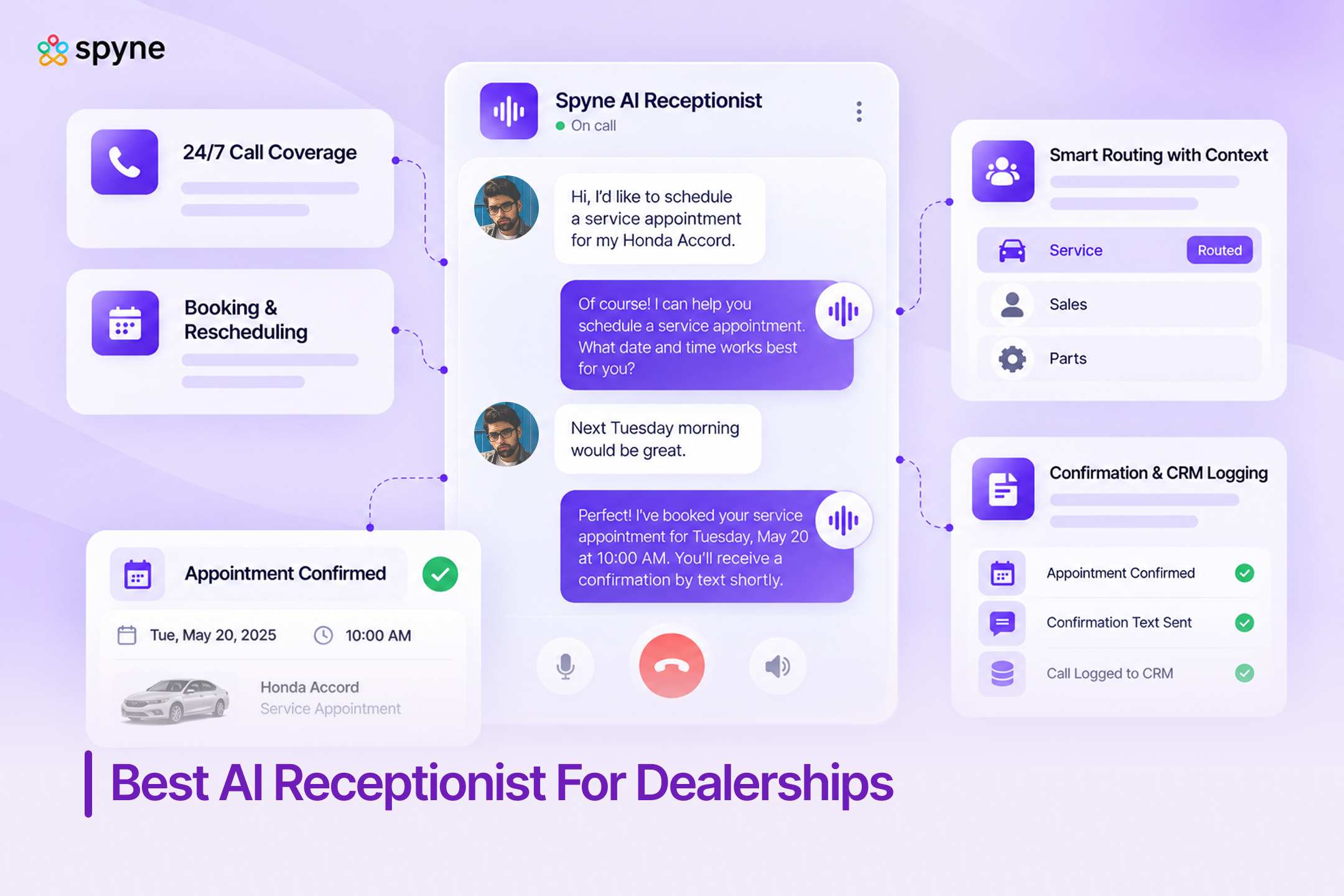
AI Receptionist answers inbound calls around the clock, recognizes caller intent instead of a keypad menu, books or reschedules service, and routes to sales, service or parts with context. Spanish is supported. It texts a confirmation after each booking and logs lead details and a call summary to your CRM. Apex Auto Group, a Spyne customer, booked 184 after-hours appointments in month one. The full feature list is in the Spyne section below.
2. Numa
Numa handles calls and texts and says it books customers into an open service bay without double-booking. It reports an 80%+ appointment booking rate, 90% DMS coverage across the industry and 1,400+ dealerships (vendor claims, 2026). It also runs sales and service agents. Its page says it connects to DMS, scheduling and CRM systems, so ask which ones, by name, for your store. Languages, 24/7 coverage and pricing aren’t stated, so ask about all three in the demo.
3. Toma
Toma’s voice agents answer calls at any hour, schedule and confirm service, book test drives, handle parts inquiries and escalate critical issues to staff. Toma claims stores can add 100+ appointments and $30,000 in monthly revenue (vendor claims, 2026). It can also run recall appointment outreach by checking your DMS for customers with open recalls. The dealership page names no DMS platforms, languages or pricing, so ask for all three in the demo.
4. 11Sight
11Sight sells a Service Agent for first-line, overflow or after-hours calls, and a Front-Desk Agent that greets callers and forwards them. It says its agents handle 76% of calls and transfer the other 24% with context, and it offers a 14-day trial (vendor claims, 2026). Calls can go to a person, a department or another AI agent, so the handoff path is documented. The integration is described as to a call center platform rather than a named DMS, and languages aren’t stated.
5. Impel Voice AI
Impel lists Voice AI inside a broad retail platform: “Turning every call into a tracked opportunity.” Its site shows 14 integration logos, says Impel is SOC 2 Type II compliant, and says it operates in 51 countries. The logos include CDK, Cox, DealerSocket, Xtime, Tekion and VinSolutions, but the page doesn’t tie them to the voice product. The stats shown are company-wide, so ask for a voice demo and voice-specific results.
6. Kenect AI receptionist
Kenect lists an AI receptionist alongside AI scheduling and recall campaigns, and says calls are answered 24/7/365 (vendor claim, 2026). Its site shows DMS logos including DX1, CDK, DS and Motility. The page doesn’t describe what the receptionist books or how it routes calls, so ask for both in the demo.
What does a good call connection rate look like?
A good connection rate is the one top dealerships already hit: 78% of service callers reaching a person, against 59% at the average store (Car Wars, 2026). That is a 19-point gap. Only 46% of missed calls got a follow-up (Car Wars, 2026).
So the target isn’t 100%. It is closing the gap to the top group and following up on the calls you still miss. Before you buy, pull three numbers from your own phone system or call-tracking tool: calls answered, calls abandoned, and missed calls that got a callback within an hour. Then ask each vendor how it reports those same three figures after launch, so you can compare before and after on your own data.
How much service revenue do missed calls cost a dealership?
A missed service call is usually a lost repair order, and you can estimate it. In the first half of 2026, 59% of service callers connected, 41% didn’t, and 66% of those who couldn’t reach anyone never called back (Car Wars, 2026). Service calls were 36% of inbound volume.
The math to run: monthly inbound calls x 36% service share x 41% not connected x 66% never call back x booking rate x average RO.
Worked example (assumptions, not benchmarks): 30% of those lost callers would have booked, and the average customer-pay RO is $400. Replace both with your own numbers.
| Store size | Monthly inbound calls (assumed) | Service callers who never call back | Lost bookings at 30% | Revenue at stake at $400 RO |
| Small rooftop | 600 | about 58 | about 18 | about $7,000 a month |
| Mid-size store | 1,500 | about 146 | about 44 | about $17,500 a month |
| Large store or group rooftop | 4,000 | about 390 | about 117 | about $46,800 a month |
The chain is answered call, then booked appointment, then repair order. An AI receptionist only recovers the part of that chain it completes, and your advisors still have to work the booked ROs. For more on overflow and nights, see dealership after-hours answering service and dealership service department phone answering.
What does an AI receptionist cost for a dealership?
No vendor in this comparison publishes a price. Spyne says pricing varies by call volume, workflows, integrations and support level, and 11Sight says to contact them. Only 11Sight names a trial length. There is insufficient public data for dollar tiers, so get quotes for your call volume and compare them against the monthly figure above. Ask every vendor for quotes in the same format: price at your monthly call volume, what counts as a billable call, setup fees and trial terms. Without that, the quotes can’t be compared.
What should you ask before you sign with any AI receptionist?
Ask six questions, and get each answer in writing:
- Where does a booked appointment land, and in which scheduler?
- Which languages are supported, by name?
- What happens when a call needs a person, and how fast is the handoff?
- Which phone system do you work with, and do I keep my number?
- How is the AI disclosed to callers in my state?
- What is the price at my call volume, and what does the trial cover?
Common mistake: judging by the demo voice. A clean handoff to an advisor, with context, matters more than whether the voice sounds human. A second one is signing without a test booking. Ask for a live test appointment in your own scheduler during the demo, and watch where it appears.
Spyne AI Receptionist: AI Receptionist Software for Car Dealerships
Most dealerships don’t have a phone-answering problem. They have a connection problem, where the call rings while every advisor is busy and the caller moves on. Spyne AI Receptionist picks up each call, works out what the caller needs, and finishes the job or hands it to the right person. It sits on your phones and your scheduler, so the booked appointment appears where your advisors already work.
1. 24/7 Answering
Picks up every inbound call, including after hours and weekends. Calls that used to roll to voicemail at 6:05 PM get an answer. Apex Auto Group, a Spyne customer, booked 184 after-hours appointments automatically in month one. Your team doesn’t need a night shift to cover the phones.
2. Conversational Intent Recognition
Callers speak normally instead of pressing keys. Nobody has to find “press 2 for service.” It works out whether the caller wants service, sales or parts from what they say, then acts on it. That removes the menu step where callers tend to give up and dial the next dealer.
3. Booking
Books, reschedules or cancels against your scheduling system and sends a text confirmation. Your advisors open the day’s schedule and the brake job is already on it. It checks open slots before offering a time, so the caller gets a real appointment instead of a promise of a callback. The page doesn’t name a specific scheduler, so confirm in the demo which one it writes to.
4. Department Routing
Routes to sales, service or parts with the conversation context, so the caller doesn’t repeat the story. A caller asking about a part goes to parts, and one who wants a salesperson goes to sales, each with the request already captured. Your team picks up knowing why the customer called.
5. CRM Logging
Captures lead details and a call summary in your CRM. Your BDC sees who called and why. A call that came in at 7 PM becomes a record the BDC can follow up on the next morning instead of a missed opportunity nobody knew about. The page doesn’t name a specific CRM, so ask which ones it connects to.
6. Trained On Your Store
Answers common questions from your inventory and processes, and can work with your existing phone number depending on setup. That covers routine questions such as what’s in stock or how your service process works, so advisors aren’t pulled off a vehicle for a quick answer. Whether you keep your number depends on your phone setup, so ask before launch.
7. Spanish Supportv
Answers Spanish-speaking callers when no bilingual advisor is free. It helps a store in a multilingual market answer callers at 7 PM, after the bilingual advisor has gone home. The page names Spanish only, so ask for the full language list and a live test call if you serve other languages.

Conclusion
Forty-one percent of service callers didn’t reach anyone in early 2026, and most of those never called back. The best AI receptionist for dealerships is the one that books into your scheduler and hands off cleanly, so run the missed-call math with your own call volume first. Then see how Spyne AI Receptionist answers the calls your team can’t.