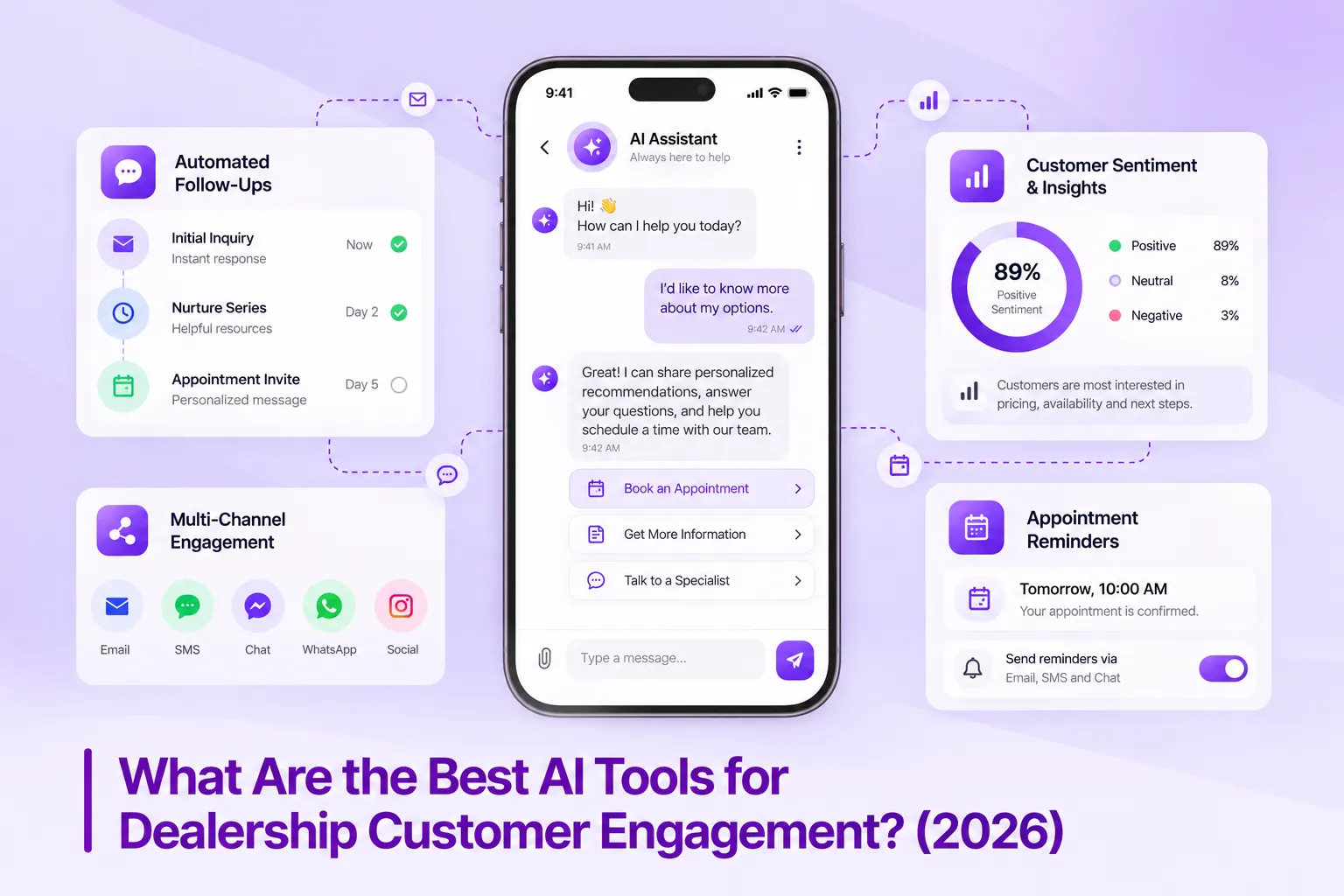

| Executive Summary: The best AI tools for dealership customer engagement in 2026 connect conversations, dealership data, appointment workflows, and follow-up instead of operating as isolated chatbots. Vini AI, Drive Centric, Podium, Numa, Fullpath, automotiveMastermind, Matador AI, STELLA Automotive AI, and Conversica address different parts of that engagement stack. The need is measurable: Foureyes found 42.7% of qualified dealership leads were mishandled in 2025, while 15.2% never reached the CRM. Dealers should evaluate platforms on response speed, channel coverage, personalization, CRM/DMS integration, appointment completion, follow-up consistency, and multi-rooftop controls rather than simply comparing chatbot features. |
Customer engagement breaks when a buyer calls after hours, texts after browsing a VDP, returns three days later, and the dealership treats each interaction like a new lead. That fragmentation matters because Foureyes’ 2026 benchmark found 62.8% of returning sales leads still received no salesperson follow-up within 24 hours. Meanwhile, Cox Automotive found 63% of buyers prefer an omnichannel purchase experience combining digital and dealership interactions.
This guide compares the leading AI tools for dealership customer engagement, where each fits, how dealer groups should evaluate them, and which repetitive sales and service conversations are practical to automate.
Why Are Dealerships Investing in AI Customer Engagement in 2026?
AI customer engagement has moved from experimental chatbot use toward operational dealership workflows. CDK Global reported in January 2026 that nearly 40% of dealers were already using AI, 77% of those users had integrated AI into existing systems, and another 22% were planning investment.
Customer behavior explains the urgency. Cox Automotive’s 2026 Car Buyer Journey Study surveyed 2,300 recent buyers and found:
- 19% of all vehicle buyers used AI websites or AI-generated search overviews during the purchase process.
- Usage reached 25% among new-vehicle buyers.
- 84% of mostly digital buyers who used AI assistants reported high satisfaction with their purchase experience.
- 63% of buyers said their ideal process combines online and dealership activities.
The engagement problem inside the store is less about adding another communication channel and more about maintaining continuity across them. A shopper may move between phone, SMS, chat, email, the VDP, and the showroom before buying.
That is why current dealership AI increasingly combines conversational AI, AI lead response, CRM automation, scheduling, customer data, and human handoff.
What Are the Best AI Tools for Dealership Customer Engagement in 2026?
The strongest dealership customer engagement platforms solve different operational problems. Some concentrate on real-time conversations, others on fixed ops calls, customer-data activation, predictive outreach, or enterprise-wide customer lifecycle management.
| AI platform | Best fit | Engagement focus | Primary channels |
| Vini AI by Spyne | Connected sales, service and BDC engagement | Lead response, qualification, appointments, re-engagement, context retention | Voice, SMS, chat, email |
| DriveCentric | Enterprise dealership lifecycle engagement | CRM, AI follow-up, customer lifecycle, service-to-sales | Messaging, video, CRM engagement |
| Podium / Jerry | Unified dealership communications | Lead response, voice, messaging, scheduling, repeat engagement | Phone, text, web chat, email, social |
| Numa | Fixed ops and service engagement | Calls, scheduling, service communication, follow-up | Voice, SMS |
| Fullpath | Customer-data-driven personalization | CDP, lifecycle marketing, audience activation | Email, SMS, paid media |
| automotiveMastermind | Predictive retention and conquest | Propensity scoring, personalized outreach, loyalty | Email, direct marketing, sales workflows |
| Matador AI | Sales and service lead nurturing | Qualification, response, follow-up, appointments | Voice, text, chat, email, video |
| STELLA Automotive AI | Service phone automation | Service inquiries and appointment booking | Voice |
| Conversica | Automated lifecycle conversations | Lead re-engagement, service, F&I and follow-up | Email, SMS and digital conversations |
The right shortlist depends on where customer engagement currently breaks. A dealer losing inbound service calls needs a different product evaluation than a 20-rooftop group trying to unify customer identity and outreach.
1. Vini AI by Spyne: Best for Connected Sales, Service and BDC Engagement
Vini AI is a conversational AI platform designed for dealerships that want customer conversations to continue across channels without losing the customer, vehicle, or appointment context. It supports inbound and outbound engagement around sales, service, BDC, parts, and finance workflows.
Dealers can use Vini AI conversational agents to:
- Capture customer inquiries 24/7.
- Qualify buyer intent and vehicle preferences.
- Answer supported inventory and vehicle questions.
- Book test drives and service appointments.
- Run reminders and follow-up.
- Re-engage missed or cold opportunities.
- Route customers to employees with conversation context.
- Sync interaction details and action items into connected dealership systems.
The distinction matters when a customer moves between channels. Vini can retain supported context during the workflow, reducing the need to restart the conversation after a handoff.
Dealers evaluating the broader role of channels can also review Spyne’s guide to omnichannel CRM for dealerships.
Best fit: Franchise dealerships and groups that want conversational engagement covering sales and service instead of deploying separate phone, chat, and follow-up products.
2. DriveCentric: Best for Unified Sales and Service Customer Engagement
DriveCentric is a strong option for dealerships that want customer engagement, CRM workflows, and AI connected across sales and service. Rather than treating each department as a separate communication system, DriveCentric focuses on maintaining customer context throughout the dealership relationship.
In 2026, DriveCentric expanded this approach with its Service Engagement Hub, a fixed-ops CRM and engagement environment designed for service advisors and service BDC teams. The company positions its broader offering as one engagement platform connecting Sales, Service, and F&I around a shared customer record.
Relevant capabilities include:
- AI-assisted customer communication and follow-up
- Sales and service CRM workflows
- Lead ownership and activity tracking
- Customer communication history
- Service-to-sales opportunity identification
- Video and messaging engagement
- AI-supported inventory responses
- Cross-department customer context
This makes DriveCentric particularly relevant for dealerships where customer information and follow-up become fragmented after the initial sale. A customer moving from sales into service can remain part of a connected record rather than becoming an unrelated fixed-ops contact.
DriveCentric has also expanded its AI capabilities throughout 2026, including inventory-aware responses and tools designed around automotive customer engagement and BDC workflows.
Best fit: Franchise dealerships and dealer groups that want sales and service teams working from a more connected customer engagement and CRM environment.
3. Podium Jerry: Best for Combining AI Conversations With a Unified Inbox
Podium is well suited to dealerships that want AI engagement and employee communication managed within the same customer messaging environment. Jerry, Podium’s automotive AI employee, works sales and service opportunities across phone, text, chat, email, and other supported sources.
Podium says Jerry can qualify leads, reference inventory, schedule appointments and test drives, perform proactive follow-up, and use conversation history to personalize responses. The company also offers a unified inbox for dealership employees and AI activity.
Podium reports more than 6,000 dealerships using its automotive offering. One published dealer case study reported 50% higher engagement after deploying its AI, although dealership-specific case studies should be treated as individual outcomes rather than universal benchmarks.
Best fit: Dealers wanting customer messaging, AI BDC functions, phone engagement, and team visibility in one environment.
4. Numa: Best for Fixed Ops Customer Engagement
Numa is strongest when the engagement problem sits inside the service department. Its AI operating system connects dealership calls, texts, appointment scheduling, DMS context, customer follow-up, and service communication.
For example, Numa’s scheduling workflow can identify a customer, interpret the requested service, check live availability, book the appointment, update the DMS, and send confirmation during the same interaction. Its published materials state coverage across major systems including CDK, Reynolds & Reynolds, Tekion, Dealertrack, and Xtime.
That makes Numa particularly relevant for stores where advisors spend too much time answering routine calls, handling appointment changes, sending updates, or recovering missed service opportunities.
For a broader comparison of service-specific products, see Spyne’s guide to the best AI for dealership service departments.
Best fit: Fixed Ops Directors prioritizing service calls, scheduling, CSI workflows, and customer retention.
5. Fullpath: Best for Data-Driven Personalized Engagement
Fullpath approaches customer engagement through customer data rather than primarily through an AI receptionist. Its Customer Data Platform consolidates fragmented dealership data, resolves customer identities, and then activates that information across marketing workflows.
Fullpath reports more than 200 integration opportunities, roughly 9,200 merged shopper profiles on average, and automated engagement through email, SMS, social, search, display, and programmatic channels.
For dealer groups, identity resolution can be particularly important. A buyer may purchase from one rooftop, service at another, and later shop inventory at a third location. Engagement improves when those activities contribute to one usable customer profile rather than three unrelated records.
Best fit: Marketing teams and dealer groups prioritizing customer-data unification, personalization, lifecycle campaigns, and group-level activation.
6. automotiveMastermind: Best for Predictive Customer Engagement
automotiveMastermind is built around deciding which customers should receive outreach before the team starts the conversation. Its Behavior Prediction Score ranks prospects using purchase propensity, while predictive marketing applies customer and market data to personalized campaigns.
The company says more than 54,000 sales professionals use automotiveMastermind and that it works with 700+ dealer groups in the United States. Its dealer-group offering focuses on cleaning and activating cross-rooftop customer data, standardizing communication, loyalty, service-to-sales activity, and personalized marketing.
This is a different engagement layer than an AI receptionist. Mastermind helps answer who should be contacted, why, and with what message, while conversational platforms execute more of the live interaction.
Best fit: Dealer groups focused on equity mining, customer loyalty, service-to-sales opportunities, conquest, and predictive outreach.
7. Matador AI: Best for Multi-Channel Lead Nurturing
Matador AI focuses on working dealership leads continuously across multiple communication channels. Its sales products cover incoming lead response, follow-up, appointment setting, and ongoing customer conversations across text, voice, and chat.
Matador’s current platform describes automotive AI agents that answer, follow up, and book appointments, with broader capabilities spanning sales and service. In August 2026, the company announced Stellantis program eligibility for selected lead-nurturing solutions across voice, text, chat, email, and video.
That channel breadth makes Matador worth evaluating when the BDC’s primary problem is inconsistent follow-up rather than inbound call coverage alone.
Best fit: High-volume sales organizations that need persistent lead nurturing and appointment workflows across several channels.
8. STELLA Automotive AI: Best for Service Voice Automation
STELLA is a specialized option for dealerships whose customer-engagement problem starts with the telephone. STELLA Service answers inbound service calls, handles common questions, and books appointments into supported dealership scheduling systems.
The company says its service AI can answer calls 24/7 and complete appointment booking in under two minutes, while reducing the need for service employees to manage routine scheduling interactions manually.
A specialized voice product may be preferable when the dealership already has satisfactory CRM, marketing, and messaging systems and does not want to replace them.
Best fit: Service departments primarily trying to reduce holds, unanswered calls, and manual appointment scheduling.
9. Conversica: Best for Automated Lifecycle Follow-Up
Conversica is designed for dealerships that need persistent AI-driven conversations after the initial lead arrives. Its automotive AI agents support sales opportunities, cold-lead re-engagement, test-drive scheduling, service-lane utilization, and F&I-related customer engagement.
Conversica’s automotive offering emphasizes personalized conversations rather than generic batch messaging. In July 2026, the company also introduced Ignite, an automotive revenue activation engine designed to connect customer, vehicle, sales, service, and conversation data already stored across dealership systems.
Best fit: Dealerships looking for ongoing lifecycle outreach across sales, service, and existing CRM data.
Which AI Platform Works Best for Dealer Groups?
Dealer groups should select an AI platform based on the layer they need to standardize across rooftops. A group struggling with inconsistent conversations needs a different architecture than one struggling with fragmented customer identities or predictive marketing.
| Dealer-group requirement | Platforms worth evaluating | Why |
| Sales + service conversations across rooftops | Vini AI, Podium, DriveCentric | Broad conversational and lifecycle coverage |
| Unified customer data | Fullpath | CDP and identity resolution |
| Predictive loyalty and conquest | automotiveMastermind | Cross-rooftop customer intelligence |
| Service communication at scale | Numa | Fixed ops voice, scheduling and follow-up |
| Persistent sales lead nurturing | Matador, Conversica | Multi-touch follow-up and re-engagement |
| Broad enterprise lifecycle layer | DriveCentric, Vini AI | Sales, service, marketing and additional modules |
Multi-rooftop buyers should ask one question early: Can the system recognize one customer across stores without creating conflicting outreach?
A customer who purchases at Store A, services at Store B, and submits another lead to Store C should not receive three disconnected campaigns. Customer identity, suppression rules, ownership, routing, brand standards, and reporting become more important as rooftop count increases.
Spyne’s franchise dealership AI solution is built around this group-level requirement, including engagement, CRM/DMS connectivity, and cross-rooftop workflows.
How Do Dealerships Automate Repetitive Customer Conversations?
Dealerships should automate high-volume interactions where the next action follows clear dealership rules and reliable system data. The objective is to remove repetitive communication from employee queues while keeping negotiations, exceptions, complaints, and judgment-heavy conversations with people.
Good automation candidates include:
- New-lead response: Immediately acknowledge and qualify incoming website, phone, or CRM opportunities.
- After-hours inquiries: Answer inventory, dealership, appointment, and supported service questions when the BDC is closed.
- Appointment scheduling: Offer supported sales or service availability, confirm the slot, and update the connected system.
- Appointment reminders: Send confirmations, reminders, rescheduling options, and no-show recovery messages.
- Lead follow-up: Continue contact when a buyer stops replying after the first conversation.
- Aged-lead re-engagement: Revisit lost, no-contact, or previously interested leads using current context.
- Routine service communication: Handle scheduling questions, reminders, recall outreach, and supported status requests.
- Customer routing: Transfer the conversation to the right employee while retaining context.
Spyne’s guide to connected dealership conversations goes deeper into how CRM data, AI responses, scheduling, and human handoff fit into the same workflow.
The case for automation is supported by current sales-process data. Foureyes analyzed 22,900+ automotive dealership websites and found 42.7% of qualified leads were mishandled in 2025, while 15.2% never reached the CRM.
What Should Dealerships Look for in an AI Customer Engagement Platform?
Dealerships should evaluate the quality of completed customer workflows, not the number of AI features in a sales deck. A strong engagement system should know enough dealership context to answer accurately, take the next permitted action, document the interaction, and bring in a person when needed.
1. Automotive-specific data grounding
The AI should reference live or current dealership data where required, including inventory, customer records, operating hours, appointments, and supported service information.
CDK’s 2026 research found 63% of dealers want AI supported by comprehensive automotive industry data, while 47% specifically want predictive models trained by automotive experts.
2. Cross-channel context
Phone, SMS, chat, and email should not create four independent customer histories. If the shopper switches channels, the next interaction should use relevant prior context where the workflow supports it.
Dealers comparing texting specifically can also review the best automotive text messaging platforms.
3. CRM and DMS read-write capability
Ask vendors to demonstrate the actual integration. Have them create an appointment, update a lead, write a note, retrieve relevant context, and show what happens when the integration fails.
A logo on an integrations page does not tell you which actions are supported.
4. Real appointment completion
The engagement platform should do more than tell the customer someone will call back. For supported workflows, it should complete the intended action inside the dealer’s process.
5. Human handoff with context
Customers should not need to repeat their vehicle, concern, budget, or appointment request after the AI escalates the interaction.
6. Multi-rooftop governance
Groups need store-specific business rules, brand voice, routing, reporting, customer ownership, suppression logic, and permission controls.
7. Measurement tied to dealership outcomes
Track:
- Contact rate
- Response time
- Qualified lead rate
- Appointment set rate
- Appointment show rate
- Service bookings
- Lead-to-sale rate
- Re-engagement rate
- Human escalation rate
- Resolution rate
- CRM logging rate
Message volume is an activity metric. Completed customer actions tell a dealership whether engagement actually improved.
How Does Better Customer Engagement Affect Service Retention?
Service retention improves when the dealership communicates clearly, conveniently, and consistently before, during, and after the RO. AI can support that process through scheduling, status communication, reminders, and follow-up, but customer experience still depends on how the dealership executes the work.
J.D. Power’s 2026 U.S. Customer Service Index found that when overall service satisfaction reached 950 or higher, 86% of mass-market customers and 88% of premium customers said they definitely would return for paid service. The study also identified keeping customers informed about service status as an important satisfaction driver.
That makes customer communication an operating issue for Fixed Ops, not simply a marketing function.

Conclusion
The dealership AI market in 2026 is separating into clear engagement layers. Voice specialists solve unanswered calls. Conversational AI handles qualification, appointments, and follow-up. CDPs organize customer identity and personalization. Predictive systems decide who deserves outreach next. Dealer groups increasingly need several of those capabilities coordinated instead of another disconnected chatbot.
The best evaluation therefore starts with the customer journey your store currently fails to complete. Measure missed contacts, handoffs, follow-up, booked appointments, shows, and CRM accuracy before comparing vendors. Then require each provider to demonstrate those workflows against your existing stack.
Book a demo with Spyne to see how Vini AI can connect dealership conversations across sales, service, voice, messaging, follow-up, and appointment workflows.