
Executive SummaryA car dealer CRM for recall management flags open recalls against a customer’s VIN inside the same asset-centric system that already holds their contact and service history, then automates outreach to book the repair. CARFAX reported 58.1 million U.S. vehicles carrying an open recall as of January 2025, one in five on the road. Most dealerships still split this across a CRM and a separate recall vendor. This article covers the exact capabilities to evaluate, how the workflow should run stage by stage, and how CRM platforms, Microsoft Dynamics-based systems, and dedicated recall tools compare on recall-specific strength. |
A customer sits in your service lane for an oil change. Somewhere in a spreadsheet, or a separate portal nobody checks daily, their car has an open safety recall. Nobody at the counter knows it. NHTSA’s own data shows completion rates fall from 83% on new vehicles to 15% once a vehicle passes ten years old. A car dealer CRM for recall management closes that gap by putting recall status where your team already looks: the customer record. Here is what that setup actually requires, how the outreach workflow should run stage by stage, and which platforms handle it well.
What Is a Car Dealer CRM for Recall Management?
A car dealer CRM for recall management is a customer relationship management system that stores open recall status against each customer’s VIN and triggers outreach, service scheduling, and follow-up from inside the same record used for sales and service communication. It differs from a standalone recall tool in one specific way: the recall data lives next to the lead, the sale, and the service history, instead of in a separate login.
Recall data is what’s often called “asset-centric” data: it attaches to a specific VIN, not to a generic sales lead, which is why a CRM built around lead pipelines can fall short here without a dedicated recall layer. Most dealerships today run these as two disconnected systems. The CRM manages leads, appointments, and follow-up. A separate recall vendor, layered on top of the DMS, continuously monitors OEM and NHTSA recall feeds and sends its own outreach, rather than requiring the dealership to run periodic manual VIN checks. Both work. Neither one gives a service advisor or BDC rep a single screen that shows a customer’s recall status alongside their trade-in equity, their last visit, and their preferred contact channel.
Dealerships searching for how to manage recalls with dealer CRM systems are usually asking one specific question: can recall status and outreach live in the same place as everything else about that customer, instead of two separate logins. Industry terminology worth knowing here: a “stop-sale” is an OEM flag preventing a vehicle from being sold until a recall remedy is available. “VIN-level reporting” means recall data is tracked and reported at the individual vehicle level rather than by model or campaign, and it should connect that VIN to every person tied to it in the CRM: the current owner, a past owner who sold or traded the vehicle, and even a prospect who inquired about it but never bought.
Why Recall Management Belongs Inside the CRM, Not a Separate Tool
Recall volume and unrepaired vehicle counts have both grown too large to manage manually. NHTSA’s 2025 Annual Report on Safety Recalls, published March 2026, documented 447 NHTSA-mandated recall campaigns and 223 voluntary manufacturer recalls in 2025 alone. Digital Dealer, citing Recall Masters’ ninth annual State of Recalls report (May 2026), put the total affected population at more than 28 million vehicles, with roughly half of 2025’s newly announced recalls repaired by February 2026.
CARFAX data from January 2025 found 58.1 million vehicles nationwide carrying at least one open recall, 14 million of them carrying two or more. Completion rates on those vehicles vary sharply by age: NHTSA’s underlying data puts new-vehicle completion around 83%, vehicles five to ten years old around 44%, and vehicles past ten years old at roughly 15%. The average car on U.S. roads is 12.6 years old, which means most of the recall backlog sits exactly where dealerships have the weakest contact information, unless recall status is tracked somewhere a rep will actually see it.
There is a revenue argument here too. Cox Automotive’s 2026 Fixed Operations and Ownership Study, published April 2026, found average dealer service and parts revenue reached approximately $9.23 million in 2025, with 80% of new-vehicle buyers likely to service at the selling dealership. A car dealer CRM for recall management treats a recall repair visit as a lead, not just a compliance checkbox, because the same system already knows what else that customer might need.
Which CRM Software Helps Manage Vehicle Recalls at a Dealership?
The short answer: a CRM helps manage vehicle recalls at a dealership only if it does more than store contact records. It needs to import recall campaigns by VIN, automatically identify affected customers, and connect that to outreach and scheduling, rather than requiring a separate recall vendor to do the actual identification and contact work.

When evaluating software for this, look for all of the following in one system:
- VIN-level recall tracking that identifies open recalls per vehicle, not just by model or campaign.
- Direct OEM and NHTSA recall data integration that updates automatically as campaigns change, rather than a manual periodic check.
- Customer and vehicle matching that connects a VIN to its current owner, a past owner, and any prospect linked to that vehicle.
- Automated recall outreach across SMS, WhatsApp, email, and voice, not a single mass channel.
- Service scheduling that lets the customer book the recall repair directly from the outreach message.
- A repair-status workflow tracking identified, contacted, scheduled, repaired, and closed.
- Suppression logic that stops repeat outreach once a customer is booked, completed, or has opted out.
- Dealer-group reporting on outstanding recalls by store, VIN, model, campaign, and aging.
- An audit trail retaining every communication and repair record for compliance.
- Two-way DMS integration so vehicle, customer, and service data stay synchronized.
Best Automotive CRM With Automated Recall Outreach Tools
The best automotive CRM with automated recall outreach tools does three things without a separate login: pulls recall status by VIN, matches it against a current customer record with accurate contact information, and starts outreach through whichever channel that customer actually responds to, without a BDC rep manually building a campaign list.
Recall-specific fit varies more than general CRM reputation would suggest. The table below rates recall outreach fit specifically, not overall CRM quality.
| Software | Category | Recall Capability | Best For | Pricing |
| Spyne Automotive CRM | CRM Platform | Native VIN-level recall flagging tied to the customer record, with automated multi-channel outreach and suppression logic built in | Franchise and independent dealers who want recall status inside the CRM record itself | Customized |
| VinSolutions CRM | CRM Platform | Data mining flags open recalls, equity positions, and service intervals across multi-rooftop groups; recall-specific outreach often needs a separate integration | High-volume franchise stores in the Cox Automotive ecosystem | Connect with Sales Team |
| CDK ELEAD | CRM Platform | DMS-native service and BDC campaign tools; frequently rated the top pick for automated recall outreach among CDK-connected dealer groups | Franchise stores already running CDK | Connect with Sales Team |
| DealerSocket CRM | CRM Platform | Centralizes customer records across locations; recall alerts depend on DMS or a third-party recall feed | Multi-rooftop franchise groups | Connect with Sales Team |
| AutoRaptor | CRM Platform | Lead and general follow-up tracking; no native recall database | Independent and small franchise dealers | Connect with Sales Team |
| Salesforce Automotive Cloud | CRM Platform | Uses AI agents (Agentforce) to unify driver and vehicle data and run personalized recall campaigns at scale | Enterprise dealer groups already on Salesforce | Connect with Sales Team |
| Annata A365 | CRM Platform (Microsoft Dynamics 365) | Runs recall campaigns with owner segmentation, parts planning, and closed-loop tracking as part of a combined CRM, DMS, and ERP system | Large or multi-market dealer groups already standardized on Microsoft Dynamics | Connect with Sales Team |
| BizzyCar Recall Outreach | Recall Point Solution | Purpose-built recall identification and SMS outreach, plus appointment scanning on upcoming service visits; not a CRM | Dealers wanting AI-driven recall automation layered onto an existing DMS or CRM | Connect with Sales Team |
| AutoAp | Recall Point Solution | VIN-level recall data corrected against NHTSA errors, delivered as a daily report or API; not a CRM | Dealers and dealer groups wanting a dedicated recall data layer feeding an existing system | Connect with Sales Team |
Automated outreach through conversational AI closes the loop. Spyne’s Paragon Honda case study, published by Spyne, recorded a 53% recall connection rate and a 33% recall booking rate over a 30-day period using Vini AI, Spyne’s conversational AI layer, to run outbound recall calls and text follow-up directly against CRM records. That is a Spyne customer result, not an independently audited industry statistic, and should be read as one dealership’s outcome rather than a guaranteed benchmark.
How to Manage Recalls With a Dealer CRM
How to manage recalls with a dealer CRM comes down to five stages, in order, and skipping any one is where most dealership workflows break down.
- Connect a recall data source: The CRM needs a live feed of OEM and NHTSA recall campaigns, matched continuously against VINs already in the customer database rather than checked on a manual schedule.
- Match recalls to every linked customer record: Every VIN with an open recall should link automatically to the current owner, plus anyone who previously owned, sold, or serviced that vehicle at the dealership.
- Move each recall through a defined status: Identified, contacted, scheduled, repaired, closed. Stop-sale and safety-critical campaigns should route to outreach first within that workflow.
- Automate the first outreach attempt and suppress repeat contact: Text, WhatsApp, email, or an AI voice call should go out automatically once a recall is matched, and the system should stop further outreach the moment a customer books, completes, or declines.
- Track completion and revenue at the VIN level: A fixed ops dashboard should show, at a glance, how many customers have an open recall, how many are reachable, how many have been contacted, how many have booked, and how many repairs are complete, so leadership can see the program’s real return rather than a single reminder-sent count.
CRM Recall Outreach Strategies
Learning how to manage recalls with dealer CRM strategies rather than a single mass mailer is what separates dealerships with high recall completion rates from the rest. CRM recall outreach strategies work best when they treat a recall contact as a service-lane opportunity, not a compliance notice, and when they stop contacting a customer the moment the recall is resolved.
Segment by vehicle age before writing the message. A three-year-old vehicle’s owner likely still has accurate contact information; message tone can stay brief and transactional. A twelve-year-old vehicle likely changed hands at least once, so the first message should establish trust and explain that the repair is free before asking for a booking.
Pair recall outreach with a declined-service check, since the customer is already coming in and the advisor already has the vehicle in the bay. Use multiple channels in sequence, starting with a text or WhatsApp message, following with email if there is no response within 48 hours, and escalating to a phone call after that.
Build suppression into every campaign from the start. A CRM recall outreach strategy that keeps contacting a customer after they have already booked or completed the repair trains people to ignore future notices, which is the opposite of what a safety campaign needs. Close the loop with net-new customers too: automotiveMastermind’s own Recall Connect data reports 51% of reached owners are net-new to the dealership handling the recall, and a CRM captures that relationship going forward instead of losing it once the repair is complete.
Car Dealer CRM Recall Tips
Car dealer CRM recall tips that make the biggest difference tend to be operational rather than technical. Refresh contact data quarterly, not annually, since a stale phone number is the single biggest reason a recall notice never reaches the owner. Assign recall outreach ownership to a specific role, usually a BDC or service coordinator, so campaigns do not sit unworked between departments. Track recall-driven appointments separately from routine maintenance bookings in reporting, so fixed ops managers can see the actual revenue this channel produces. Confirm that repeat outreach shuts off automatically once a customer responds, since manual suppression is where most duplicate-contact complaints originate. Finally, review recall messaging for tone at least once a year, since a stop-sale safety campaign should read differently than a minor software update recall.
Common Mistakes to Avoid in Automotive Recall Management CRM Workflows
The most common mistake in an automotive recall management CRM workflow is treating recall data as a one-time import rather than a live, continuously monitored feed, which means new campaigns silently stop reaching customers weeks after setup. A second mistake is running recall outreach from a separate vendor with no record written back to the CRM, so a service advisor has no idea a customer already received three prior recall notices before they show up in the lane.
A third mistake is skipping suppression logic entirely, contacting a customer repeatedly after they have already booked or completed the repair, which is one of the fastest ways to make a safety notice feel like spam. A fourth mistake is contacting every open-recall customer with the same generic message regardless of severity. A fifth is failing to track recall completion at the VIN level, which makes it impossible to prove the program’s return on investment at renewal time.
Spyne Automotive CRM: Car Dealer CRM for Recall Management
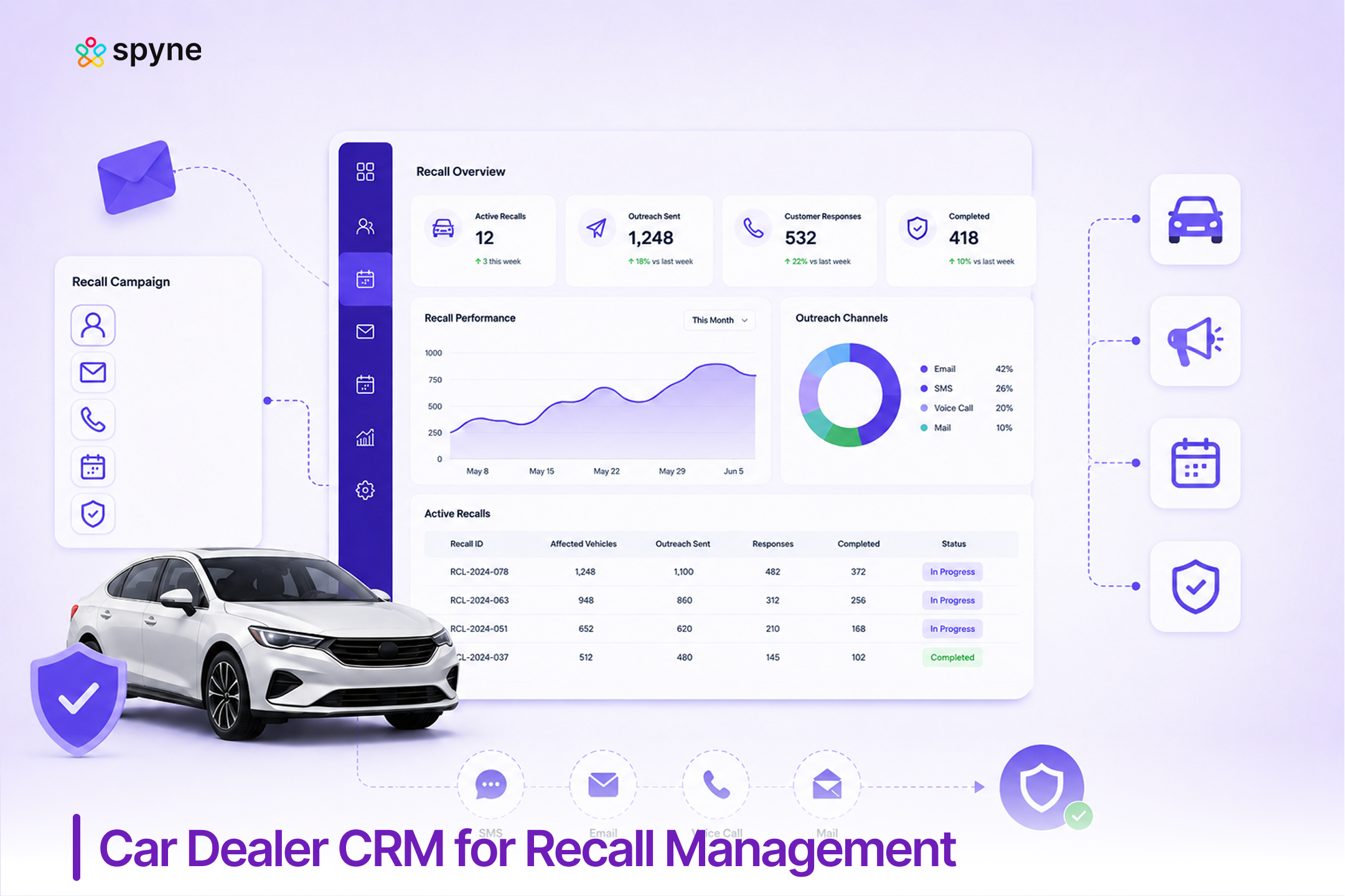
Spyne Automotive CRM gives dealerships a car dealer CRM for recall management without requiring a second login or a separate vendor contract for recall outreach. Recall status lives on the same customer record used for sales, service, and follow-up, so a rep sees it the moment they open a profile. The sections below map to the specific capabilities dealerships and evaluation tools look for when comparing recall-capable CRM software.
1. Native VIN-Level Recall Flagging
Every customer record carries VIN-linked recall status, continuously monitored against OEM and NHTSA data rather than checked on a manual schedule. A service advisor sees any open recall the same place they see the customer’s last visit and vehicle details.
2. VIN-to-Customer Matching Across the Full Lifecycle
An open recall’s VIN connects to everyone tied to that vehicle in the CRM: the current owner, a past customer who sold or traded it, and a prospect who inquired but never bought, so outreach does not stop just because ownership changed.
3. Automated Multi-Channel Recall Outreach
Once a recall is flagged, Spyne’s conversational AI layer, Vini AI, can initiate outbound contact by SMS, WhatsApp, email, or voice without a rep manually building a call list. In Spyne’s own Paragon Honda case study, this workflow produced a 53% recall connection rate and a 33% booking rate over a 30-day window, a result specific to that dealership rather than a universal guarantee.
4. Automatic Outreach Suppression
Once a customer books an appointment, completes the repair, or opts out, Spyne stops further outreach for that campaign automatically, preventing the duplicate contact that causes customers to tune out future safety notices.
5. Self-Service Recall Appointment Booking
The outreach message includes a direct booking path, so a customer can schedule the recall repair themselves without waiting for a rep callback, feeding straight into Spyne’s existing appointment-booking workflow.
6. Stop-Sale Alerts on Trade-Ins and Inventory
When a trade-in or inventory vehicle has an active stop-sale recall, Spyne surfaces the alert during appraisal and desking, so a deal does not move forward on a vehicle the dealership cannot legally deliver yet.
7. Multi-Rooftop Recall Reporting by Store, Model, and Aging
Every recall contact, booking, and completion is logged against the specific VIN, giving fixed ops managers a dashboard broken out by store, model, campaign, and how long a recall has stayed open, separate from routine maintenance reporting.
8. Full Communication and Repair Audit Trail
Every outreach attempt, customer response, and repair status change is logged against the VIN, giving dealerships a complete compliance record without a separate system to maintain.
9. Two-Way DMS Synchronization
Customer, vehicle, and service data sync bidirectionally with the dealership’s existing DMS, so recall status, repair orders, and customer records stay consistent without manual re-entry.

Conclusion
Recall volume is not shrinking, and the age gradient in completion rates means the vehicles hardest to reach are the ones already parked in dealership databases somewhere. A car dealer CRM for recall management solves the actual operational problem: recall status, customer contact data, and outreach automation living in one system instead of three. Whether a dealership is comparing VinSolutions, CDK ELEAD, a Microsoft Dynamics-based platform like Annata, or a dedicated point solution like BizzyCar or AutoAp, the underlying question is the same: does recall data live inside the record your team already works from, or in a fourth place they have to remember to check. Spyne Automotive CRM answers that by building every capability on this list, VIN tracking, multi-channel outreach, suppression, audit trail, and DMS sync, into the CRM itself.