
| Executive Summary: Dealerships prevent duplicate AI follow-up by connecting customer conversations across phone, SMS, email, CRM workflows, and lead sources into one coordinated communication process. Duplicate outreach usually occurs when separate systems trigger messages without visibility into previous customer activity. Cox Automotive research shows that automotive buyers interact across multiple digital channels before purchasing, making consistent communication increasingly difficult for disconnected systems. A unified follow-up workflow uses customer identity matching, conversation history, ownership rules, and CRM synchronization to ensure every interaction moves the buyer forward instead of restarting the same conversation. |
Dealerships are adding more communication channels than ever before. A single shopper can now interact through a website form, marketplace inquiry, chatbot, phone call, SMS conversation, and email campaign before speaking with a salesperson.
The challenge is that every new channel creates another opportunity for disconnected follow-up.
A customer who already answered vehicle questions through text may still receive a generic email. A salesperson may call a lead that an AI assistant already qualified. A BDC representative may restart a conversation because CRM notes were not updated.
According to Cox Automotive, today’s vehicle buyers complete much of their research online before visiting a dealership, creating more digital touchpoints that dealerships need to manage consistently.
This blog explains why duplicate AI follow-up happens, how dealerships can prevent fragmented customer communication, and how connected conversational AI helps sales teams maintain context across every interaction.
Why Do Dealerships Send Duplicate Follow-Up Messages?
Dealerships send duplicate follow-up messages because their communication systems often operate independently instead of sharing customer activity, conversation history, and ownership information.
Duplicate outreach usually happens when multiple tools manage different parts of the same customer journey:
- CRM automated emails and task workflows
- AI chat assistants handling website conversations
- AI voice agents managing inbound and outbound calls
- Marketplace lead notifications from third-party sources
- BDC processes for lead engagement
- Salesperson follow-up activities
Each system may be performing its intended function, but the customer experience breaks down when these systems cannot recognize previous interactions.
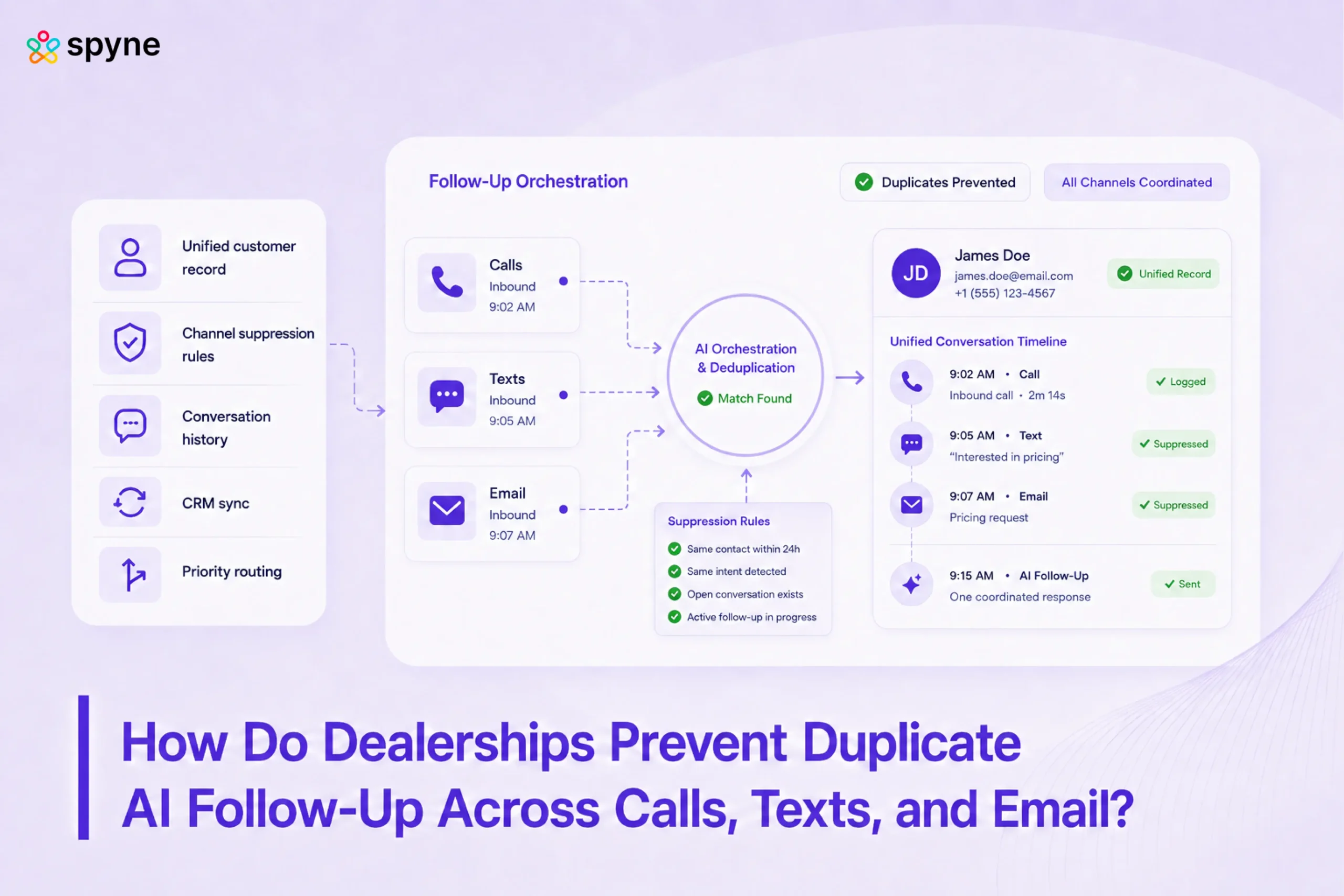
For example, a shopper submits a vehicle inquiry through a third-party marketplace, which enters the dealership CRM and triggers an automated response sequence. At the same time, an AI assistant may initiate an SMS conversation while a salesperson receives a task notification to make a manual follow-up call. Although each action is intended to improve response speed, the lack of shared conversation history can make the dealership appear disorganized because the customer receives multiple disconnected touchpoints instead of one continuous buying experience.
The solution is not reducing follow-up activity. Dealerships need connected systems that understand previous customer interactions before initiating the next communication.
How Do Dealerships Coordinate AI Follow-Up Across Calls, Texts, and Email?
Dealerships coordinate AI follow-up by creating a shared customer communication record where every interaction is visible before another message, email, or call is initiated.
A connected follow-up process should capture:
- Customer identity
- Lead source
- Previous conversations
- Contact attempts
- Vehicle interest
- Buying timeline
- Appointment status
- Assigned salesperson
- Next recommended action
This allows dealerships to move from activity-based follow-up to context-based engagement.
For example, if a customer has already discussed trade-in details or financing questions through SMS, the next interaction should continue that conversation instead of restarting the qualification process.
Why Multiple Systems Create Follow-Up Conflicts
Most dealership technology stacks were built around specific functions rather than one connected customer journey.
A dealership’s technology stack typically consists of multiple systems designed to manage different stages of customer engagement. The CRM stores lead information, tracks customer activity, and manages sales workflows, while marketing platforms automate campaigns and nurture sequences. Phone systems handle inbound and outbound conversations, chatbot solutions manage website interactions, and sales teams continue relationship-driven follow-up with active buyers.
The challenge emerges when these systems operate independently without a shared customer record, creating gaps in visibility and increasing the likelihood of repetitive or conflicting outreach.
This becomes more complex for dealer groups operating multiple rooftops, where the same customer may interact with different locations, departments, or sales teams.
A connected AI workflow helps dealerships understand whether a customer is:
- A new lead entering the sales process
- An active conversation already in progress
- An existing appointment requiring confirmation
- A previous customer returning for another purchase
- A service customer exploring additional opportunities
Without this identification layer, automation can create duplicate engagement instead of improving the customer experience.
How Can Dealerships Prevent Multiple Salespeople From Contacting the Same Lead?
Dealerships prevent multiple salesperson outreach by creating clear ownership rules and ensuring every customer interaction updates the dealership record immediately.
A strong process includes:
- Assigning ownership when a lead enters the system.
- Recording every AI and human interaction.
- Preventing new outreach sequences when active conversations exist.
- Routing qualified opportunities to the correct salesperson.
- Maintaining conversation history during handoffs.
This is especially important when dealerships combine AI follow-up with BDC teams.
AI should handle repetitive communication tasks, while sales teams should receive customers who are ready for deeper conversations.
The objective is not replacing human follow-up. It is preventing multiple employees from working the same opportunity while other leads receive no attention.
How Does CRM Automation Differ From AI Follow-Up?
CRM automation manages scheduled activities, while AI follow-up manages live customer conversations and responses.
Traditional CRM automation typically handles:
- Reminder emails
- Task creation
- Lead status updates
- Follow-up schedules
Conversational AI adds another layer by:
- Responding immediately
- Understanding customer questions
- Maintaining conversation history
- Adjusting responses based on buyer intent
- Escalating when human involvement is needed
For dealerships, the difference is important because buyers do not follow a fixed communication timeline. A shopper may ask about availability at 10 PM, request pricing at midnight, or respond to an old message weeks later. AI follow-up helps dealerships respond based on customer behavior rather than only scheduled tasks.
How Does Conversation Intelligence Prevent Repetitive Customer Interactions?
Conversation intelligence prevents repetitive customer interactions by giving dealership teams visibility into what a shopper has already discussed, what information has been collected, and what action should happen next. This allows AI systems and sales teams to continue conversations naturally instead of restarting the buying process with every new touchpoint.
A connected conversation history helps dealerships understand:
- Which vehicle the customer is interested in
- Whether pricing or availability questions were already answered
- If the customer has shared trade-in details
- Whether financing concerns were discussed
- Whether an appointment was offered or scheduled
- Which communication channel the customer prefers
Without this context, even well-intentioned follow-up can create friction. A shopper who already provided vehicle preferences through chat should not need to repeat those details during a phone call.
This becomes increasingly important as dealerships adopt more communication channels. According to Cox Automotive, consumers continue to complete more of their vehicle research digitally before visiting a dealership, increasing the number of interactions dealerships must manage across websites, marketplaces, and direct communication channels.
The goal of conversation intelligence is not simply storing transcripts. It is helping every employee and AI system understand the customer’s current position in the buying journey.
How Should Dealerships Build an AI Follow-Up Process That Avoids Duplicate Outreach?
Dealerships should build AI follow-up processes around three core principles: customer identity, communication ownership, and workflow coordination. Without these foundations, adding more automation can increase activity while making the customer experience less consistent.
A strong dealership AI follow-up process should include:
1. Establish clear conversation ownership
Every customer interaction should have a defined owner based on the stage of the buying journey. For example:
- AI handles immediate responses, basic questions, and qualification.
- BDC teams manage engaged prospects who require additional nurturing.
- Sales consultants take over high-intent buyers.
- Managers handle escalations and stalled opportunities.
Ownership rules prevent multiple employees or systems from competing for the same customer.
2. Connect every communication channel
Phone calls, SMS conversations, emails, website chats, and marketplace interactions should contribute to one customer record. A disconnected approach creates situations where:
- The CRM schedules follow-up without knowing a customer already responded.
- A salesperson calls after an AI conversation has already started.
- Marketing campaigns continue after a buyer has moved further into the sales process.
A connected workflow ensures each interaction builds on the previous one.
3. Use customer intent to determine the next action
Not every customer requires the same follow-up sequence. A shopper asking about vehicle availability has different needs from someone comparing financing options or requesting a trade evaluation.
AI follow-up should recognize signals such as:
- Vehicle-specific questions
- Purchase timeline
- Budget discussions
- Appointment requests
- Trade-in interest
- Objection patterns
This allows dealerships to prioritize meaningful conversations instead of simply increasing the number of touches.
How Does Vini AI Help Dealerships Avoid Duplicate Follow-Up?
Vini AI helps dealerships prevent duplicate follow-up by maintaining customer conversation context across voice, SMS, and digital interactions while connecting those conversations with dealership workflows.
Unlike isolated automation systems that trigger separate actions, Vini AI is designed to help dealerships manage conversations as one continuous customer journey.
Spyne’s conversational AI platform, Vini, supports dealerships by:
- Responding to inbound customer inquiries quickly
- Maintaining context from previous interactions
- Qualifying shoppers before human handoff
- Routing conversations to the appropriate team member
- Supporting CRM-connected workflows
- Reducing repetitive customer conversations
For dealerships, the operational challenge is not simply knowing whether outreach happened. The bigger challenge is knowing what information the customer has already provided, who owns the next action, and whether the next interaction moves the buyer closer to an appointment.
A connected conversational AI workflow helps sales teams spend less time rebuilding context and more time progressing qualified opportunities.
What Role Does CRM Integration Play in Preventing Duplicate AI Follow-Up?
CRM integration prevents duplicate AI follow-up by ensuring customer activity, conversation history, and next steps are visible to both automated systems and dealership employees.
A dealership CRM should act as the central record for:
- Lead source information
- Customer preferences
- Communication history
- Appointment details
- Sales ownership
- Follow-up status
However, many CRM workflows rely heavily on scheduled tasks and manual updates. When customer conversations happen outside the CRM, important context can be missed.
For example, a customer may answer an SMS from an AI assistant, but if that conversation is not reflected in the CRM workflow, a salesperson may continue with outdated information.
This is why dealerships increasingly evaluate conversational AI platforms based on integration capabilities rather than standalone messaging features. A connected AI system should work alongside existing dealership technology instead of creating another isolated communication channel.
How Can Dealer Groups Prevent Duplicate Follow-Up Across Multiple Rooftops?
Dealer groups prevent duplicate follow-up across rooftops by establishing centralized communication rules while maintaining location-specific ownership. Without shared visibility, the same customer may interact with multiple stores within the same group and receive inconsistent outreach.
Multi-rooftop dealerships should define:
- Customer ownership rules
- Lead assignment logic
- Cross-store visibility permissions
- Shared communication history
- Escalation workflows
This becomes especially important when customers shop multiple brands or submit inquiries through different dealership websites.
A connected AI workflow helps dealer groups understand whether a customer represents a new opportunity or an existing conversation already being handled elsewhere. The objective is not limiting dealership engagement. It is ensuring every interaction feels intentional and coordinated.
How Should Dealerships Measure Whether AI Follow-Up Is Working?
Dealerships should measure AI follow-up performance by tracking customer engagement quality, response consistency, and appointment outcomes rather than only counting the number of messages sent. A higher volume of outreach does not always indicate a better process if customers receive repetitive communication or sales teams lack visibility into conversations.
Key metrics dealerships should monitor include:
| Metric | Why It Matters |
| Duplicate outreach rate | Identifies how often multiple systems or employees contact the same customer unnecessarily |
| Average response time | Measures how quickly shoppers receive engagement after submitting an inquiry |
| Lead contact rate | Shows whether dealership processes successfully connect with buyers |
| Appointment set rate | Measures whether conversations create meaningful next steps |
| Appointment show rate | Evaluates whether follow-up creates committed customer visits |
| CRM activity accuracy | Determines whether customer records reflect actual conversations |
| Customer opt-out rate | Shows whether communication frequency or relevance needs improvement |
For example, a dealership may have strong lead response numbers but still lose opportunities if customers receive inconsistent answers across channels. Measuring communication quality helps managers identify whether automation is improving the buying experience or simply creating more activity.
How Can AI Call Bots Help Dealerships Manage Phone Follow-Up?
AI call bots help dealerships manage phone follow-up by handling inbound conversations, capturing customer intent, and ensuring opportunities are not lost when sales teams are unavailable. Phone remains one of the highest-intent dealership communication channels, but missed calls and inconsistent availability can create gaps in the buying journey.
A dealership-focused AI call bot can support:
- After-hours customer conversations
- Overflow call handling during peak periods
- Basic vehicle availability questions
- Appointment scheduling
- Lead qualification
- Call routing to the right department
According to Car Wars industry benchmarks, dealerships can miss a significant percentage of inbound calls during busy periods, creating opportunities for competitors to engage customers first.
The goal of AI phone automation is not replacing sales conversations. It is ensuring customers receive an immediate response while dealership teams focus on opportunities that require human expertise.
Spyne’s AI call bot for car dealerships helps dealerships handle customer conversations, schedule appointments, and reduce missed opportunities from unanswered calls.
What Should Dealerships Look for in an AI Follow-Up System?
Dealerships should evaluate AI follow-up systems based on their ability to maintain customer context, integrate with existing technology, and support dealership-specific workflows. A system that only sends automated messages may increase outreach volume without improving customer engagement. Important evaluation criteria include:
CRM and DMS connectivity
The AI system should connect with dealership systems so customer interactions, appointments, and lead details remain visible to employees.
Multi-channel communication support
Modern shoppers move between channels. A customer may begin through chat, continue through SMS, and complete the conversation by phone. AI follow-up should maintain continuity across these interactions.
Human handoff capability
AI should recognize when a customer needs a salesperson, manager, or service advisor and transfer the conversation with relevant context.
Dealership-specific understanding
Automotive conversations require knowledge of inventory, vehicle details, appointments, financing questions, and dealership processes.
Generic AI systems may answer questions, but dealership AI needs to understand the workflows behind each conversation.
How Many Follow-Up Attempts Should Dealerships Make Before Moving a Lead Into Nurture?
Dealerships typically use multiple follow-up attempts across phone, SMS, and email before moving a lead into a longer-term nurture process. The right number depends on lead source, buying intent, and customer engagement signals rather than a fixed number of attempts.
A common dealership follow-up approach includes:
- Immediate response after lead submission
- Multiple contact attempts during the first week
- Continued personalized outreach over the following weeks
- Long-term nurture for customers who are interested but not ready
The important factor is consistency across channels.
A dealership should not send ten disconnected messages from different systems. Instead, every interaction should build on previous conversations and provide a relevant reason for the customer to respond.
AI follow-up helps dealerships maintain this consistency by handling repetitive communication while allowing sales teams to step in when purchase intent increases.
How Does AI Improve Dealership Follow-Up Without Replacing Sales Teams?
AI improves dealership follow-up by handling repetitive communication tasks while allowing sales teams to focus on higher-value customer conversations. The strongest dealership AI workflows are designed around collaboration between automation and employees rather than replacing human involvement.
AI can support teams by:
- Responding immediately when leads arrive
- Answering common questions
- Collecting customer preferences
- Scheduling appointments
- Following up with unresponsive shoppers
- Preparing conversation summaries for sales teams
Salespeople remain responsible for relationship building, negotiation, product demonstrations, and closing conversations.
The operational advantage comes from reducing missed opportunities and improving consistency across every customer interaction.
Dealerships already invest heavily in advertising, inventory acquisition, and sales staffing. Connected AI follow-up helps ensure those investments are supported by a communication process that responds consistently when customers are ready to engage.

Closing Thoughts
Duplicate follow-up is not a communication problem; it is a coordination problem. As dealerships add more channels, including marketplace leads, SMS, email, chat, and voice, the ability to maintain customer context becomes critical. The dealerships that perform best will not be the ones sending the most messages, but the ones creating consistent conversations across every touchpoint. A connected AI follow-up process helps teams respond quickly, understand customer intent, and avoid frustrating buyers with repetitive outreach. By combining automation with human ownership, dealerships can protect lead investments while creating a smoother path from first interaction to appointment.
Book a demo with Spyne to see how Vini AI helps dealerships coordinate customer conversations across every channel.