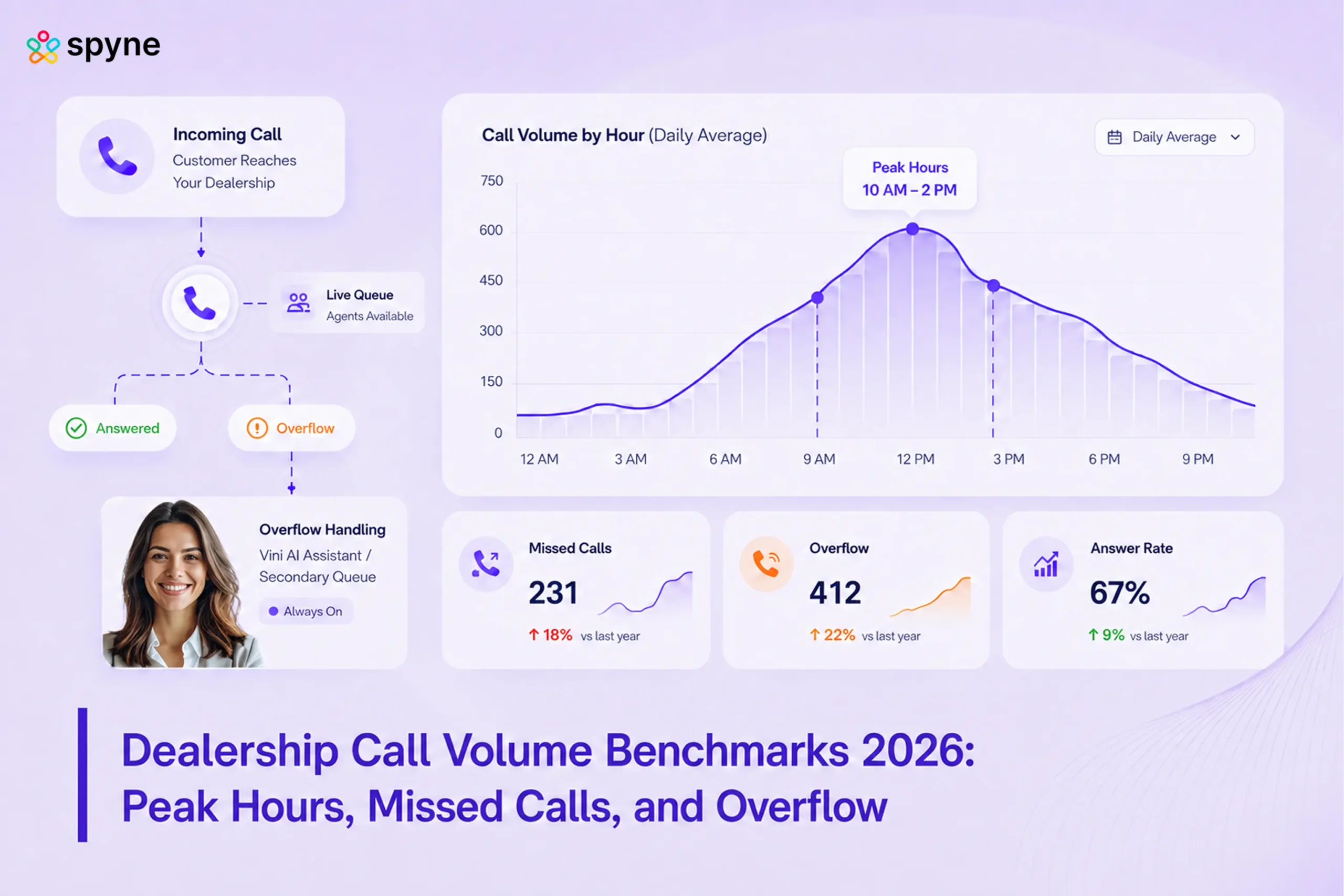

| Executive Summary: Dealership call volume is concentrated around specific operational windows rather than evenly distributed throughout the day. Sales calls typically peak during late morning hours, while service departments experience their highest pressure during early morning vehicle drop-off periods. In 2026, phone remains a critical dealership channel, with CDK reporting that 61% of service appointments are still booked by phone. Missed calls, long holds, and overflow create lost appointment opportunities. Vini AI helps dealerships manage inbound sales and service conversations by handling routine requests, scheduling appointments, routing customers, and providing additional coverage during peak demand periods. |
Dealership phones become a bottleneck when customer demand arrives faster than employees can respond. A service advisor checking in vehicles, a salesperson working a showroom customer, or a BDC representative handling multiple leads cannot always answer every incoming call immediately. The result is missed opportunities at the exact moments when customer intent is highest.
CDK’s 2026 dealership research found that 61% of service appointments are still booked through phone conversations, while average service hold time reached 9.3 minutes. This shows that digital scheduling has grown, but phone interactions remain central to dealership operations.
This guide breaks down dealership call volume benchmarks for 2026, including peak calling hours, missed-call rates, service department overflow, and how dealerships can create additional phone capacity without adding unnecessary headcount.
When Is the Peak Call Hour at a Car Dealership?
The broad dealership call peak usually occurs between 10 AM and 12 PM, especially on Mondays, while service departments often experience their busiest period earlier in the morning.
Dealership calls do not arrive evenly throughout the day. Customer behavior creates predictable spikes based on work schedules, weekend shopping activity, service appointments, and vehicle ownership needs.
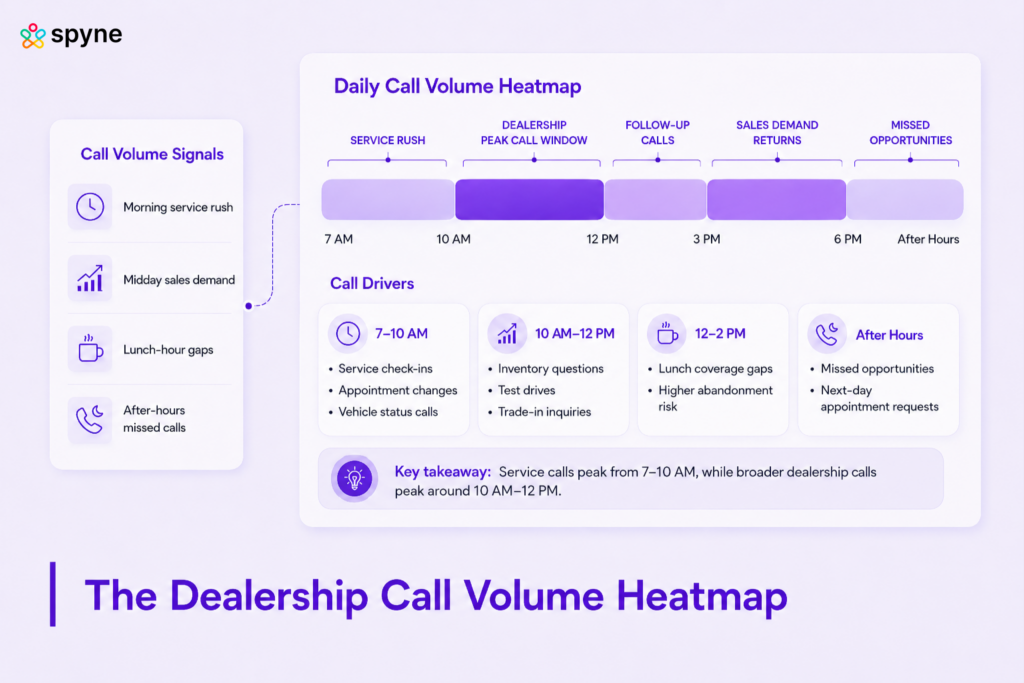
An analysis of nearly 3,000 dealerships found Monday generated the highest inbound call volume, with late morning being the busiest period.
The reason is simple: customers often research vehicles, compare options, or notice service needs over the weekend. They then contact dealerships once the workweek begins.
The typical call pattern looks like this:
| Time | Primary Call Drivers |
| 7 AM–10 AM | Service appointments, vehicle drop-offs, repair questions |
| 10 AM–12 PM | Inventory questions, sales inquiries, test drives, service scheduling |
| 12 PM–2 PM | Increased abandonment risk due to lunch coverage gaps |
| 3 PM–6 PM | Vehicle updates, appointment confirmations, after-work inquiries |
| After hours | Inventory questions, appointment requests, missed opportunities |
For dealerships evaluating phone performance, the important question is not only “How many calls do we receive?”
It is:“When do our highest-intent customers call, and do we have enough capacity to answer?”
Why Do Dealership Calls Spike on Monday?
Monday call volume increases because dealerships receive accumulated weekend demand while teams return to normal operations.
Weekend shoppers often spend Saturday and Sunday researching inventory, comparing vehicles, or discussing purchases with family members. Many wait until Monday to contact the dealership.
The same pattern appears in service.
Customers who notice vehicle problems over the weekend often call Monday morning to schedule maintenance or repairs.
Monday pressure is amplified because several workflows compete:
- Sales teams respond to weekend internet leads
- Service advisors manage Monday morning appointments
- BDC teams handle new inquiries and follow-ups
- Managers review weekend opportunities
- Customers request updates from previous conversations
This creates a capacity mismatch.
A dealership may have enough employees for the average day but still struggle when demand concentrates into a two-hour window.
When Do Dealership Service Departments Receive the Most Calls?
Service departments usually experience their highest phone pressure between 7 AM and 10 AM because calls overlap with customer check-ins, repair orders, and lane activity.
A 2026 automotive report found that nearly 30% of daily service calls arrive during this three-hour morning window.
This creates a unique fixed-ops challenge.
Service advisors are not simply answering phones. They are also:
- Writing repair orders
- Explaining recommendations
- Checking customers in
- Coordinating technicians
- Managing vehicle pickup timelines
- Handling warranty questions
The phone competes directly with customers already standing in the dealership.
This is why service departments often experience more call friction than sales departments.
A missed sales call may lose a vehicle inquiry.
A missed service call may lose:
- A repair order
- Future maintenance visits
- Customer retention
- Recall opportunities
- Long-term service revenue
Dealerships looking to improve fixed ops efficiency should also evaluate how AI improves dealership service operations alongside call handling performance.
How Many Calls Does the Average Dealership Miss Per Month?
There is no single missed-call benchmark that applies to every dealership, but service-specific research shows missed appointment opportunities can reach hundreds per month at higher-volume stores.
A Numa dataset covering nearly 600 dealerships found service departments missed:
- 158 appointment-related calls per month on average
- 216 missed calls at the 75th percentile
These numbers represent service appointment opportunities, not every dealership phone call.
The difference matters.
A missed call can include:
- A customer trying to schedule maintenance
- A customer checking repair status
- A vehicle availability inquiry
- A finance question
- A parts request
The commercial impact depends on the intent behind the call.
A dealership receiving 1,500 monthly calls could experience significant leakage if even a small percentage of high-intent callers fail to connect.
Example scenario:
| Monthly Calls | 20% Missed | 30% Missed | 40% Missed |
| 500 | 100 | 150 | 200 |
| 1,000 | 200 | 300 | 400 |
| 1,500 | 300 | 450 | 600 |
| 2,500 | 500 | 750 | 1,000 |
These figures are scenarios, not universal dealership averages. The best benchmark comes from your own call-tracking data.
What Actually Counts as a Missed Dealership Call?
A missed dealership call is not limited to unanswered calls. It includes any inbound conversation where the customer fails to complete the intended action, such as booking an appointment, getting vehicle information, or reaching the right department.
Many dealerships measure only whether a call was answered. That creates an incomplete picture because a connected call can still become a lost opportunity.
A dealership call can fail at several points:
| Call Outcome | What Happens | Business Impact |
| Unanswered call | No employee picks up | Immediate lost opportunity |
| Abandoned call | Customer hangs up while waiting | Customer may contact another dealership |
| Voicemail | Customer leaves a message instead of completing the task | Slower response and lower urgency |
| Failed transfer | Customer reaches the wrong department or gets disconnected | Frustrating experience |
| Callback required | Customer waits for another interaction | Higher chance of losing intent |
| Unresolved conversation | Customer connects but does not receive an answer | Opportunity remains incomplete |
Car Wars research across dealership call data has shown that unconnected calls often result from abandonment, voicemail, or incomplete handoffs rather than only phones going unanswered.
This distinction matters because dealerships can appear healthy based on answer rate while still losing high-intent conversations.
A dealership that answers 90% of calls may still struggle if:
- Inventory questions are transferred incorrectly
- Service appointments require callbacks
- After-hours inquiries are not captured
- Customers wait too long for assistance
- Lead information is not logged into the CRM
The goal should not only be answering more calls.
The goal should be completing more customer actions.
Why Do Dealership Customers Abandon Calls?
Customers abandon dealership calls when waiting times exceed their willingness to stay, especially when they need immediate answers about service appointments, vehicle availability, or pricing.
The problem is amplified because dealership callers usually have a specific intent.
A service customer may be calling because:
- Their vehicle needs immediate attention
- They need transportation arrangements
- They want to confirm appointment availability
A sales customer may be calling because:
- They found a specific vehicle online
- They want to confirm availability
- They are comparing multiple dealerships
The longer the customer waits, the easier it becomes to contact another store. This is particularly important for internet-generated opportunities.
A customer who clicks a vehicle listing and calls the dealership is already further down the buying journey than someone casually browsing.
For sales teams, improving this handoff between marketing spend and customer response is where AI lead response for dealerships becomes valuable.
Why Are Service Departments More Vulnerable to Call Overflow?
Service departments experience more phone pressure because advisors are responsible for both physical customer interactions and inbound communication at the same time.
Unlike many sales conversations, service calls often happen during operationally critical moments.
A service advisor may be:
- Checking in a customer
- Reviewing technician recommendations
- Explaining repair estimates
- Updating customers about vehicle status
- Coordinating loaner vehicles
At the same time, another customer may be calling to schedule an appointment.
This creates a conflict between two valuable activities:
Serving the customer already in the lane
and
Helping the customer trying to enter the lane
Neither should be ignored. A strong service operation needs a way to maintain phone availability without forcing advisors to choose between current customers and incoming opportunities.
This is why many dealerships are evaluating AI service solutions for dealerships as additional capacity rather than replacing service teams.
Do Online Service Schedulers Reduce Dealership Phone Volume?
Online scheduling reduces some dealership phone demand, but phone calls remain one of the most important service channels in 2026.
CDK reported that 61% of customers still schedule service appointments by phone, showing that many customers continue to prefer human conversations when booking maintenance or repairs.
Digital scheduling has improved accessibility, but it does not eliminate complex conversations.
Customers still call when they need:
- Appointment recommendations
- Repair explanations
- Warranty clarification
- Vehicle status updates
- Recall information
- Transportation questions
Pied Piper’s 2026 Service Scheduling Effectiveness Study evaluated more than 4,000 service requests and found website scheduling performed better than phone scheduling in its evaluation. The takeaway is not that dealerships should eliminate phone support.
The takeaway is that dealerships need both:
- Strong digital scheduling experiences
- Reliable phone availability
Customers should be able to choose the channel that fits their situation.
What Happens When 10 Customers Call a Dealership at the Same Time?
When multiple customers call simultaneously, dealerships need additional conversation capacity rather than staffing only for average demand.
A dealership cannot realistically hire enough employees to cover every possible peak moment. The better approach is creating a layered response system.
Example:
First layer: Immediate response
Handle:
- Store hours
- Directions
- Basic FAQs
- Appointment requests
- Vehicle availability questions
Second layer: Qualification and routing
Capture:
- Customer name
- Vehicle interest
- Service need
- Appointment preference
- Urgency
Then route the conversation appropriately.
Third layer: Human involvement
Employees handle:
- Negotiations
- Complex service issues
- Customer complaints
- Escalations
- Deal-specific conversations
This model allows employees to spend more time on conversations requiring judgment while ensuring routine requests do not disappear into voicemail.
For dealerships evaluating this approach, automotive conversational AI provides the infrastructure to manage more conversations without increasing phone staffing proportionally.
How Can Dealerships Handle Call Overflow Without Adding Staff?
Dealerships can handle call overflow without adding staff by combining better scheduling, call routing, automation, and performance measurement.
The goal is not to automate every customer interaction. The goal is to prevent valuable conversations from being lost during predictable pressure periods.
1. Identify your dealership’s call peaks
Start by analyzing:
- Calls by hour
- Calls by department
- Abandoned calls
- Hold duration
- Transfers
- Appointment outcomes
- After-hours inquiries
A dealership should build its own call heatmap instead of relying only on industry averages.
2. Protect high-volume periods
Avoid scheduling internal meetings, training sessions, or non-critical activities during peak call windows. For many stores, this means protecting:
- Monday late morning sales traffic
- Morning service rush
- Lunch coverage periods
- End-of-day customer activity
3. Separate routine and complex conversations
Not every caller needs the same level of human involvement. Faster workflows for routine requests like:
- Appointment scheduling
- Hours
- Directions
- Basic inventory questions
- Status updates
Complex requests should reach experienced employees like:
- Negotiations
- Escalations
- Complaints
- Technical questions
4. Connect conversations to dealership systems
A missed call is more damaging when customer context disappears. Connecting calls with CRM and dealership workflows helps teams understand:
- Who called
- What vehicle they asked about
- Previous conversations
- Appointment history
- Next follow-up action
This is where AI CRM automation for dealerships can help reduce disconnected customer experiences.
How Much Revenue Can Missed Dealership Calls Put at Risk?
The revenue impact of missed calls depends on customer intent, appointment conversion rates, and average dealership transaction value. Dealers should calculate opportunity loss using their own performance data.
A simple missed-call calculation:
Missed calls × appointment intent × booking rate × show rate × average revenue per appointment
Example:
A dealership identifies:
- 150 missed service calls
- 40% were appointment-related
- 75% booking opportunity
- $500 average repair order value
Potential exposure:
150 × 40% × 75% × $500
= $22,500 in monthly service opportunity
This does not mean every missed call equals lost revenue.
Some calls may involve:
- General questions
- Existing appointment updates
- Directions
- Non-revenue conversations
The purpose of the calculation is identifying whether phone leakage deserves attention. For dealer groups, this becomes even more important because a small missed-call percentage multiplied across multiple rooftops can represent significant lost customer demand.
Which Dealership Call Metrics Should Managers Track Weekly?
Dealerships should track customer outcomes, not only call volume. The most useful metrics connect phone activity to appointments, sales opportunities, and service revenue.
A weekly dealership call scorecard should include:
| Metric | Why It Matters |
| Total inbound calls | Measures demand |
| Answer rate | Shows coverage |
| Abandonment rate | Shows customer frustration |
| Average hold time | Measures phone friction |
| Voicemail rate | Identifies missed opportunities |
| Transfer success | Measures routing quality |
| Appointment set rate | Connects calls to revenue |
| After-hours calls | Shows coverage gaps |
| Call-to-appointment conversion | Measures effectiveness |
| Repeat callers | Identifies unresolved issues |
For BDC managers, these metrics should connect with broader AI BDC metrics dealerships should measure, including response speed, appointment conversion, and lead engagement.
How Vini AI Fits Into Dealership Peak-Hour and Overflow Coverage
Vini AI is best positioned as additional call capacity for repeatable dealership workflows, while employees retain conversations that require judgment, negotiation, diagnosis, or sensitive customer handling.
Spyne’s conversational AI platform,Vini AI, gives dealerships 24/7 coverage for inbound sales and service calls, handling lead qualification, appointment scheduling, customer routing, warm transfers, and CRM logging while allowing teams to focus on higher-value conversations.
During peak periods, dealerships can use Vini AI to support:
- Inbound service scheduling and rescheduling
- Common service and dealership questions
- Sales lead capture and qualification
- Inventory-aware buyer conversations
- Test-drive and showroom bookings
- After-hours inquiries
- Department routing
- Callback scheduling
- CRM logging and conversation context
- Warm transfers when human involvement is required
Vini AI should complement the BDC and service team rather than make every customer conversation an automation task.
What does this look like under real dealership call volume?
McGrath Acura of Westmont handles more than 3,000 monthly inbound sales and service calls. After deploying Spyne’s conversational AI for inbound workflows, Spyne reports 25% higher demand capture, 15% of bookings occurring after hours, a 40% qualified-to-booking rate, and more than 50 additional appointments per month.
That is a more useful model for overflow than “replace the receptionist.” The operating objective is to increase usable capacity precisely when demand exceeds available people.

Conclusion
Dealership call volume benchmarks reveal a simple operational reality: customer demand arrives in spikes, while dealership staffing usually follows averages. Monday sales traffic, morning service rushes, lunch coverage gaps, and after-hours inquiries create moments where even well-run stores can lose opportunities. With phone still responsible for a significant share of service bookings, dealerships cannot treat unanswered calls as minor friction. The strongest operators measure their call patterns, identify capacity gaps, and create additional coverage where demand is highest. Book a demo with Spyne to see how Vini AI can help your dealership capture more sales and service conversations during peak demand.