
Executive SummaryCar dealership lead conversion software is the CRM and AI sales-engagement technology that turns inbound leads into scheduled appointments and sold vehicles, through faster response, lead scoring, and automated follow-up. Platforms US dealerships most often shortlist for this in 2026 include Spyne Automotive CRM, VinSolutions, DriveCentric, DealerSocket, and AutoRaptor, each suited to a different dealership size and BDC structure. Cox Automotive’s 2025 Car Buyer Journey Study found only 19% of shoppers who want to finalize price online can actually do it, a friction point that stalls conversion. |
A hot lead goes cold in the time it takes a salesperson to finish a walk-around. Every dealership has watched a promising internet lead disappear because nobody called back fast enough, or because a follow-up got buried in someone’s inbox. Cox Automotive’s 2025 AI Readiness in Auto Retail Study found 81% of dealers now believe AI-driven tools are here to stay, yet most still convert leads the same way they did a decade ago. This guide breaks down what car dealership lead conversion software actually does, which platforms lead the category in 2026, and the tips, strategies, and tools that raise your close rate starting this month.
What Is Car Dealership Lead Conversion Software?
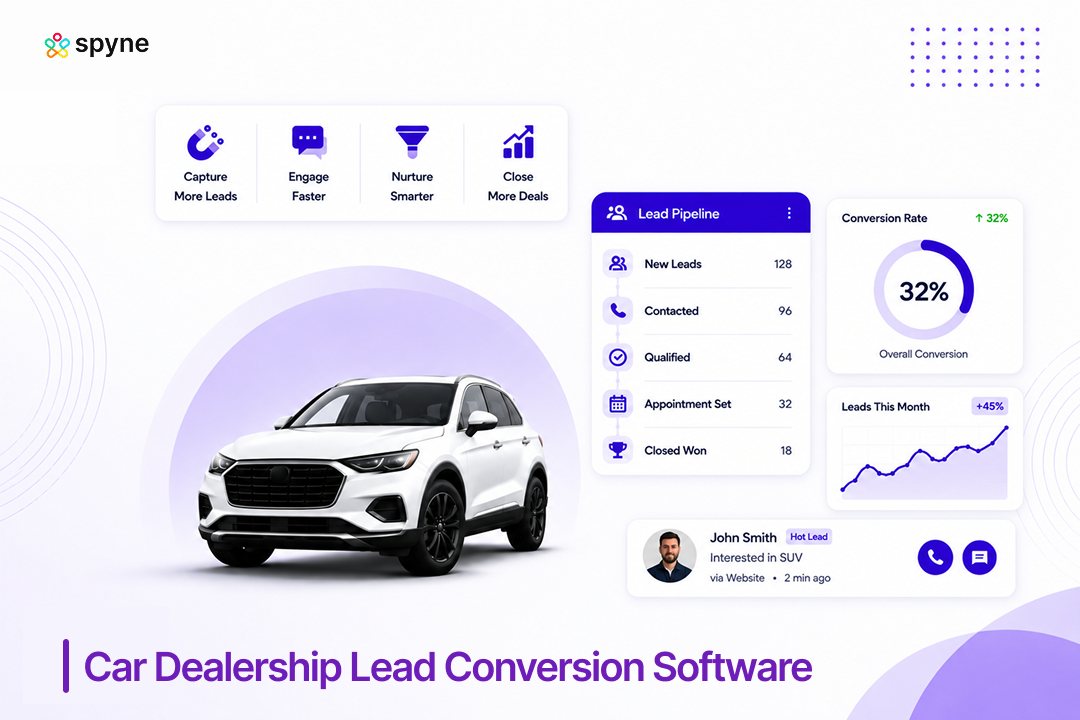
Car dealership lead conversion software is a CRM-based platform, often bundled inside a broader Automotive CRM or Internet Lead Management (ILM) system, built to move existing leads through the sales funnel faster using automated response, lead scoring, and follow-up sequencing instead of manual phone trees and spreadsheets. It is not lead generation software, which focuses on acquiring new leads from ads or listing sites. Conversion tools pick up where generation leaves off: the lead already exists in the CRM, and the software’s job is to engage it, qualify it, and push it toward an appointment before a competitor does.
Most car dealership lead conversion software shares a common core: a unified inbox for email, text, and chat leads, automated assignment so nothing sits unworked, scoring that flags who is ready to buy now, and reporting that shows where leads stall in the pipeline. Some platforms add AI chat or voice assistants that work leads around the clock, which matters given how much shopping now happens outside business hours.
Why Lead Conversion Is Where Dealership Revenue Quietly Leaks Out
Lead conversion is where most of a dealership’s marketing spend either pays off or evaporates, because a lead already in the CRM is far cheaper to close than a new one is to acquire. Cox Automotive’s 2025 Car Buyer Journey Study, its 16th annual edition, surveyed 2,300 vehicle buyers and found 63% of dealers call AI investment critical for long-term success, while only 25% of new-vehicle buyers had actually used an AI tool while shopping. That gap between belief and execution is where conversion opportunity sits unclaimed.
The same study found buyers want more of the transaction handled digitally than dealerships currently deliver. 37% of shoppers want to finalize price online, but only 19% are able to. 48% want to submit a credit application online, yet only 33% can. Every one of those unmet expectations is a moment where an engaged lead can stall, get distracted, or start shopping a competitor instead. A car dealership lead conversion software platform exists specifically to close that gap, keeping the lead engaged with fast, relevant responses until it either books an appointment or disqualifies itself. Dealers asking how to improve dealer lead conversion rates should start by measuring exactly where in this digital gap their own leads are stalling before choosing a fix.
Best Software To Improve Lead Conversion At A Car Dealership
The best software to improve lead conversion at a car dealership combines four things in one workflow: instant automated first response, lead scoring that separates hot leads from browsers, task-based follow-up that survives staff turnover, and reporting that shows exactly where leads are getting stuck. Software that does only one of these, for example, a texting tool with no scoring, leaves the rest of the funnel to manual effort and memory.
Quick answer
Ranked by what each does best, the platforms most frequently shortlisted for this in 2026 are:
- Spyne Automotive CRM: best for dealerships that want lead scoring and follow-up tied directly to live inventory and pricing, so no message ever references a vehicle that already sold.
- VinSolutions: best for franchise dealer groups already running on the Cox Automotive stack (Autotrader, vAuto, Dealer.com).
- DriveCentric: best when the real problem is salesperson adoption rather than lead volume, thanks to a simpler workflow reps actually use.
- DealerSocket: best for multi-rooftop groups needing standardized, high-volume BDC workflows.
- AutoRaptor: best for independent and used-car dealers wanting round-robin lead assignment without enterprise complexity.
When evaluating any of these, look for five criteria: response speed (acknowledging a new lead within minutes across email, text, and chat), lead scoring and prioritization (ranking by buying intent instead of oldest-first), automated persistent follow-up (a structured cadence across channels, not one reminder that expires), CRM and DMS integration (lead status and sales data staying connected end to end), and manager-level visibility (a dashboard showing response times and conversion by source). Platforms scoring well across all five, not just one, move a dealership’s actual close rate.

Which Car Dealership Lead Conversion Software Fits Your Dealership
- Franchise dealership already on Cox Automotive. VinSolutions for ecosystem depth, or Spyne Automotive CRM if inventory-connected scoring matters more.
- Salespeople don’t follow up consistently. DriveCentric or Spyne Automotive CRM, both built around simple task queues instead of dense menus.
- Running a CDK DMS. Elead CRM, for native DMS integration and BDC phone workflows.
- Independent or used-car dealership. AutoRaptor for a lighter setup, or Spyne Automotive CRM when scoring accuracy still matters.
- Lead and inventory data live in separate systems. Spyne Automotive CRM is built to keep scoring and follow-up tied to real-time inventory instead of a static feed.
- The main problem is slow response, not features. Pair your CRM with a platform that includes a built-in AI response layer, covered next.
Best Car Dealership Lead Conversion Platforms in 2026
The best car dealership lead conversion platforms in 2026 fall into two categories that increasingly work together instead of competing: automotive CRMs that own the lead record end to end, and AI conversion layers that sit on top of a CRM to handle instant engagement and persistent follow-up. Dealerships getting the strongest results tend to pair one of each rather than expecting a single tool to cover both roles.
Automotive CRM Platforms for Lead Conversion
Below is a neutral comparison of Spyne Automotive CRM against the other established CRM platforms US dealerships most often shortlist for this category.
| Platform | Best For | Key Lead-Conversion Feature | Pricing |
| Spyne Automotive CRM | Dealerships wanting unified lead-to-sale tracking with inventory and merchandising data connected | Automated lead scoring and follow-up sequencing tied directly to real-time inventory and pricing data | Customized |
| VinSolutions CRM | Franchise dealer groups already on a Cox Automotive DMS stack | Automated Intelligence and Virtual Assistant for lead scoring and follow-up | Connect with Sales Team |
| DriveCentric | Dealers whose main gap is salesperson adoption and speed-to-lead | AI-assisted lead response with a simplified, mobile-first workflow | Connect with Sales Team |
| DealerSocket CRM | Multi-rooftop groups needing standardized BDC workflows | Automated marketing and task-based lead workflows | Connect with Sales Team |
| Elead CRM | Dealers wanting deep call-tracking and BDC phone workflows, especially on CDK | Call tracking with automated lead alerts and routing | Connect with Sales Team |
| AutoRaptor | Independent and used-car dealers wanting a simpler setup | Round-robin lead assignment with 80-plus lead source integrations | Connect with Sales Team |
No single CRM wins on every criterion, so request a live demo focused on your own lead sources rather than relying on feature lists alone. G2 and Capterra reviewers flag the same trade-off: deeper automation means a longer setup curve, while simpler tools adopt faster but score leads less precisely.
AI Conversion Layers That Pair With a CRM
A newer category of tools sits on top of a dealership’s existing CRM to handle instant engagement, AI-driven follow-up, and appointment setting, rather than acting as the system of record. Impel and Conversica are the names most often cited here, built around automated conversations and BDC follow-up rather than full CRM functionality; treat their vendor-reported pilot results as directional, not guaranteed. Spyne Automotive CRM builds this same instant-response and follow-up layer natively into the CRM, so a dealership gets both roles from one system instead of two.
Website-focused tools like Gubagoo and Podium solve a narrower problem: converting anonymous site visitors into identified leads via chat and text before they reach the CRM, worth pairing with a CRM rather than replacing one. Digital retailing platforms like Roadster and CarNow, and conversational AI agents like Swirl and Drivee AI, handle the online-to-store handoff specifically.
Other names surface in specific situations: LeadSquared and Fullpath for very high lead volumes, Salesforce Automotive Cloud and Microsoft Dynamics 365 for groups already standardized on those ecosystems, and Zoho CRM or Freshsales for a lighter independent-dealer setup. Regional platforms like AUTOSherpa and Groweon target markets outside the US and are not typically shortlisted here.
Lead Conversion Strategies for Car Dealers by Funnel Stage
Lead conversion strategies for car dealers work best when matched to the specific stage where a lead is stalling, rather than applied as one blanket process for every lead in the pipeline. For dealers specifically asking how to improve dealer lead conversion rates without buying new software first, the five strategies below are the highest-value starting point.
1. Cut first-response time to minutes, not hours
The single highest-impact strategy is shrinking first-response time. A lead that submits a form at 9 p.m. and gets a reply the next morning has often already engaged a competitor. An automated text or chat acknowledgment, followed by a call the moment the store opens, keeps the lead warm instead of cold.
2. Score leads instead of working them in order received
Not every lead deserves equal urgency. A shopper asking for a specific VIN’s out-the-door price is further along than someone who filled out a generic “get a quote” form. Scoring by intent signals and vehicle specificity lets BDC reps spend limited time on the leads most likely to convert this week.
3. Build a follow-up cadence that outlasts one missed call
Most lost leads are not lost because a rep botched the first call. They are lost because the second, third, and fourth follow-ups never happened. A defined cadence across call, text, and email over 10 to 14 days converts leads a single-touch process would have written off.
4. Align the BDC and the sales floor on handoff
A lead scheduled by the BDC but handed to an unprepared salesperson often walks. Sharing lead history and prior notes at handoff turns a cold introduction into a warm continuation of a conversation that already started.
5. Personalize outreach with real inventory and pricing data
Generic “thanks for your interest” messages convert worse than outreach referencing the specific vehicle or price range a lead asked about. Pulling live inventory data into follow-up messages makes every touch feel relevant instead of templated.
Car Dealership Lead Conversion Tips for Every BDC and Sales Team
These car dealership lead conversion tips apply regardless of which software a dealership runs, and cost nothing beyond a process change.
- Answer the phone like it is your only lead: Reps juggling several leads tend to rush qualification calls, which lowers appointment-set rates even when response time is fast.
- Text before you call on internet leads: Many shoppers screen unknown numbers but read a text immediately, often getting a faster reply than a cold call would.
- Confirm every appointment twice: A confirmed appointment that no-shows wastes a slot; a same-day text reminder cuts no-shows without extra staff time.
- Log every disposition, even “not interested.”: Skipped dispositions quietly corrupt the scoring and reporting built on top of that data.
- Revisit “dead” leads every 30 to 60 days: A lead that did not buy in March may be back in the market by June; a simple reactivation touch regularly resurfaces real opportunities.
Car Dealership Lead Conversion Tools: Must-Have Features to Look For
The right car dealership lead conversion tools share a specific set of features that directly support moving a lead from inquiry to sale, rather than generic CRM functionality borrowed from other industries.
- Unified lead inbox: Every email, text, WhatsApp, chat, and phone lead should land in one place instead of being scattered across tools reps check individually.
- Automated first-response messaging: The tool should send an immediate acknowledgment the moment a lead comes in, well inside the five-minute window tied to higher appointment-set rates.
- Behavioral and intent-based lead scoring: Scoring should weigh real buying signals, like a VIN-specific inquiry or a returning visitor viewing a vehicle page, above a generic form submission.
- Task-based follow-up automation: Reps should get a structured task queue telling them exactly who to contact and when, instead of relying on memory.
- DMS and inventory integration: Tools work best referencing live vehicle and pricing data, so follow-up messages stay accurate as inventory changes.
- Compliance-safe messaging: Automated texting and calling should log timestamped consent and follow TCPA rules, so faster follow-up never becomes a liability.
- Source-level conversion reporting: Managers need visibility into which lead sources are actually converting, not just generating volume.
- Mobile access for on-the-lot use: Sales staff need to log notes and see scoring from a phone, not just a desktop at their station.
- Lifecycle and aftersales triggers: The strongest tools extend past the first sale into service reminders and lease-end alerts, since many future conversions come from existing customers.
Common Mistakes That Kill Dealership Lead Conversion Rates
Understanding how to improve dealer lead conversion rates starts with knowing what breaks them. The most common mistake is treating every lead the same way regardless of source or intent, wasting fast follow-up on low-intent leads while high-intent leads wait in a queue. A close second is letting leads sit unassigned overnight and on weekends, the exact windows when Cox Automotive’s 2025 research shows shoppers increasingly browse on their own schedule.
Other frequent mistakes: measuring lead volume instead of lead-to-sale conversion by source, which hides poorly converting sources; skipping CRM data hygiene, which quietly breaks scoring over time; and rolling out new software without retraining the BDC team, leaving it underused within months.
Spyne Automotive CRM: Car Dealership Lead Conversion Software Built for Dealers
Spyne Automotive CRM is car dealership lead conversion software that closes the conversion gap by connecting lead scoring and follow-up automation to the same real-time inventory and pricing data dealerships already manage in Spyne’s ecosystem. It keeps every follow-up message, reminder, and manager report tied to what is actually on the lot right now, so leads convert on accurate information instead of stale details.
1. Automated Lead Scoring by Buying Intent
Spyne Automotive CRM scores incoming leads based on the specificity of their inquiry, weighting VIN-level searches, financing requests, and trade-in submissions above generic contact-form fills. A BDC manager can see at a glance which leads from this morning need a call in the next ten minutes versus which can wait for the standard cadence.
2. Instant Multi-Channel First Response
New leads trigger an automated acknowledgment across email, text, WhatsApp, or chat within minutes of submission, well inside the five-minute window tied to higher appointment-set rates, so a shopper hears back before they move on to the next dealership’s site. This closes the exact response-time gap that Cox Automotive’s research repeatedly identifies as a major source of lost conversion.
3. One Platform Instead of a CRM Plus a Separate AI Layer
Many dealerships now pair their CRM with a separate AI conversion tool just to get instant response and persistent follow-up, adding a second contract, login, and integration to maintain. Spyne Automotive CRM builds that same instant-response and follow-up automation directly into the CRM, so BDC teams work from one system instead of two. Lead history, scoring, and inventory data never have to sync between separate platforms, which is exactly where data usually goes stale or gets dropped.
4. Task-Based Follow-Up Sequencing
Instead of relying on a rep to remember a callback, Spyne Automotive CRM assigns structured follow-up tasks across call, text, and email over a defined window. If a lead goes unworked past its scheduled task, it escalates to a manager instead of quietly falling through.
5. Live Inventory-Connected Messaging
Follow-up messages and appointment confirmations pull directly from current inventory and pricing data, so a lead never receives a message referencing a vehicle that already sold. This keeps every touchpoint accurate without extra manual checking.
6. BDC-to-Sales Handoff with Full Lead History
When a BDC-scheduled lead becomes a store visit, the assigned salesperson sees the full conversation history and prior notes before the customer walks in, turning a cold handoff into a warm, informed conversation.
7. Source-Level Conversion Reporting
Managers get a dashboard showing conversion rate by lead source, campaign, and rep, not just raw lead counts, making it possible to shift ad spend toward the sources that actually produce sold units.
8. Automated Reactivation of Cold Leads
Leads that went quiet 30, 60, or 90 days ago are automatically resurfaced for a reactivation touch instead of sitting dormant in the CRM. Many dealerships recover real, closable opportunities from leads they had otherwise written off.
9. Mobile Access for On-the-Lot Teams
Sales staff can view lead scores, log notes, and update statuses from a phone while walking the lot with a customer, keeping CRM data current without pulling anyone back to a desk.

Conclusion
Choosing car dealership lead conversion software is less about the longest feature list and more about closing the specific gaps in your own funnel: slow response, unscored leads, inconsistent follow-up, and disconnected data. That is the real answer to how to improve dealer lead conversion rates over the long run: not a single tool, but a process a platform makes consistent. A purpose-built platform like Spyne Automotive CRM, which combines the CRM and the AI conversion layer in one system, makes that consistency dependent on the platform rather than on any one rep remembering to do the right thing. Whatever car dealership lead conversion software a dealership picks, the goal stays the same: convert more of the leads already sitting in the pipeline before a competitor does.