
A lead marked cold in a dealership CRM is not always out of market. Some shoppers stop responding, miss an appointment, return to the website unnoticed, or get closed-lost before their buying timeline matures. Foureyes found that 40% of dealership leads that eventually purchased closed more than three days after the initial inquiry. Its 2026 benchmark report also found that 62.8% of qualified returning leads received no salesperson follow-up within 24 hours.
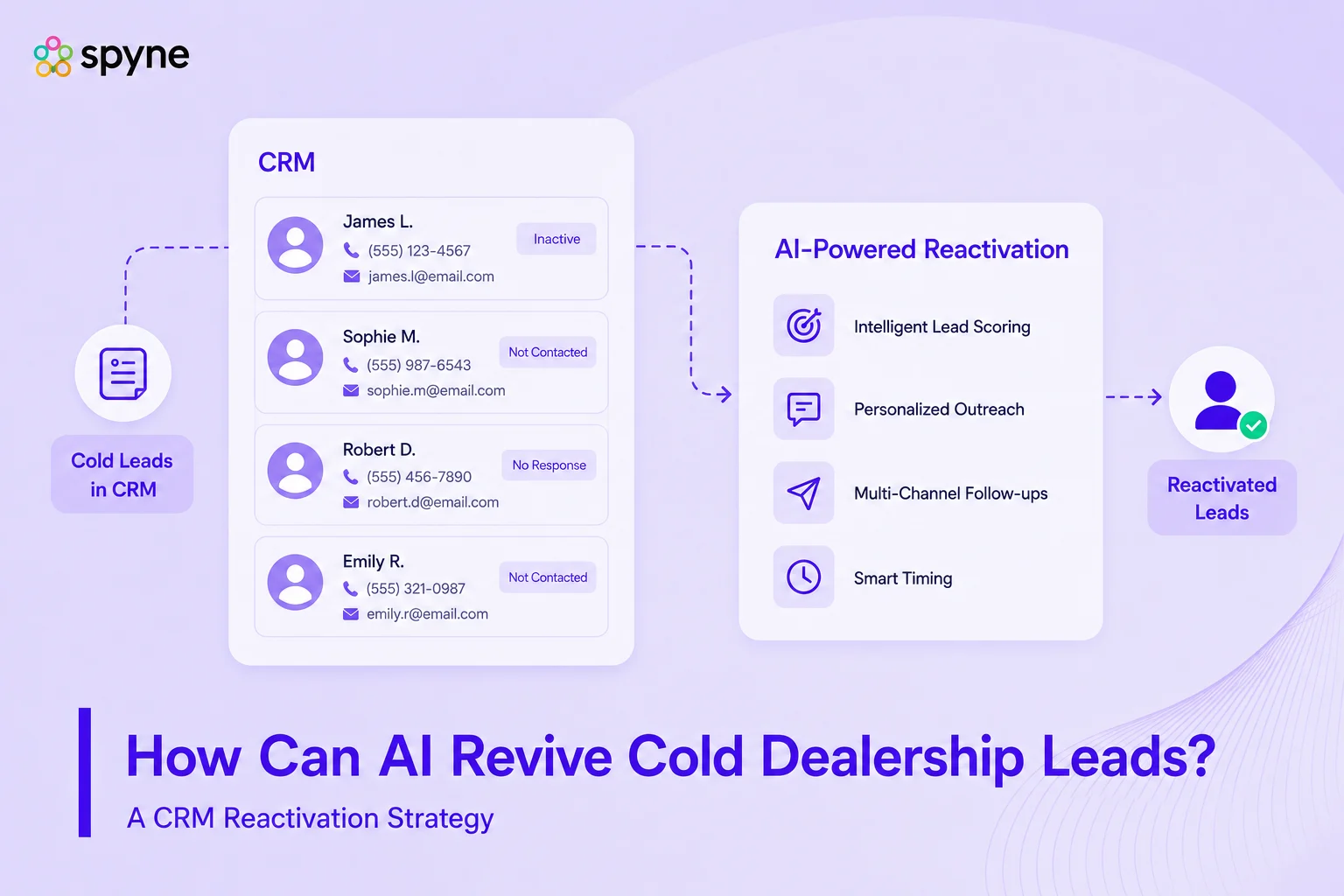
AI can help dealerships identify eligible records, restart relevant conversations, qualify current intent, and route appointment-ready shoppers to staff. This article explains which cold leads to prioritize, how AI reactivation works, what compliance controls matter, which metrics to track, and how Vini AI supports the process.
Can AI Revive Cold Dealership Leads?
AI can revive some cold dealership leads when the CRM contains accurate history, valid contact permissions, and enough context to restart a relevant conversation. An AI agent can contact eligible shoppers, determine whether they remain in market, answer supported questions, schedule appointments, and update the CRM. It cannot make every dormant lead responsive. Dealerships should exclude people who opted out, purchased elsewhere, have unresolved complaints, or require immediate human assistance.
What Does Dealership Research Reveal About Cold Leads?
Research does not support treating every old record as a viable opportunity. It does show that dealerships can lose sales when follow-up stops too early, CRM dispositions do not reflect current shopper activity, or returning prospects remain unnoticed.
-
Sales activity continues after the first few days
Foureyes analyzed dealership sales-process data and reported that 60% of eventual buyers closed within three days, while 40% closed later. The practical implication is not that every lead deserves indefinite outreach. It is that a short follow-up window can misclassify shoppers whose purchase timing extends beyond the dealership’s initial cadence.
-
Some closed-lost leads continue shopping
Foureyes defines “hidden” dealership opportunities as leads marked closed-lost in the CRM that continue engaging with the dealership’s digital properties. This exposes a CRM problem rather than a messaging problem. A static disposition can become inaccurate when the customer returns to inventory pages, revisits a vehicle, or resumes research.
-
Returning leads still experience follow-up gaps
The 2026 Foureyes Automotive Dealer Benchmarks Report reviewed dealership sales-process data and found that 62.8% of qualified sales leads did not receive salesperson follow-up within 24 hours of returning to a dealer website. Reactivation therefore should include fresh behavioral signals, not only a lead’s original creation date.
-
Automation improves coverage but can create handoff failures
Pied Piper’s 2026 Internet Lead Effectiveness study measured responses across 3,290 dealership websites. The industry average rose to 71 out of 100 as AI and automation expanded. However, the study also found that when automated responses required human intervention, customer questions were twice as likely to go unanswered.
That finding is central to reactivation strategy. AI can restart the conversation, but a weak handoff can waste the recovered opportunity.
What Is a Cold Lead in a Dealership CRM?
A cold dealership lead is a sales opportunity with no recent meaningful engagement. However, a seven-day no-show and a three-year-old duplicate record require different treatment.
Common CRM categories include:
- No-contact lead: The dealership never established a two-way conversation.
- Unresponsive lead: The shopper engaged initially but stopped replying.
- Appointment no-show: The shopper booked a visit but did not arrive.
- Closed-lost lead: Staff marked the opportunity lost without recording a sale.
- Unsold showroom lead: The shopper visited but left without purchasing.
- Dormant opportunity: No meaningful activity occurred during the dealership’s defined period.
Lead age alone should not determine eligibility. Status, consent, history, purchase records, and recent activity matter more.
Which Cold Leads Should Dealerships Reactivate?
Not every dormant CRM record deserves another follow-up attempt. Dealerships should prioritize leads with verified contact permissions, usable CRM history, a clear reason for re-engagement, and evidence that the customer may still be in market.
| CRM segment | Reactivation potential | What to verify first |
| No-contact internet leads | High when recent | Consent, lead source, and vehicle interest |
| Engaged but unresponsive leads | High | Last conversation and unresolved question |
| Appointment no-shows | High | Original appointment and current need |
| Unsold showroom visitors | Conditional | Visit notes and reason for leaving |
| Closed-lost leads | Conditional | Loss reason and subsequent activity |
| Duplicate or incomplete records | Low | Identity and contact accuracy |
| Customers who opted out | Exclude | Suppression status |
| Active complaints | Human review | Complaint ownership and resolution |
| Customers who already purchased | Exclude or move to retention | Purchase status |
Do not place the entire CRM into one campaign. A clean segment produces better conversations and clearer reporting.
The most defensible priority order is usually:
- Recent no-shows and engaged leads with an unresolved next step
- Closed-lost leads showing fresh website or inventory activity
- No-contact leads with valid permissions and accurate vehicle context
- Older records with a clear ownership, lease, trade, or service trigger
- Broad aged databases only after suppression and data-quality checks
This order favors evidence of present intent over record age. It also reduces the risk of treating an outdated database as a current demand pool.
How Does AI Reactivate Leads From a Dealership CRM?
A typical AI reactivation workflow follows these steps. It should combine CRM status with recent behavioral evidence whenever the dealership has approved access to that data. A closed-lost status alone should not override a new website return, fresh inventory engagement, or an unresolved customer question.
- Pull records that match approved campaign criteria.
- Remove suppressed, duplicated, active, and ineligible contacts.
- Read verified fields such as vehicle interest, source, status, and interaction history.
- Select an approved voice, SMS, or email workflow.
- Restart the conversation using relevant CRM context.
- Determine whether the customer remains in market.
- Collect updated preferences or answer supported questions.
- Book an appointment, schedule a callback, or transfer the conversation.
- Write the outcome, transcript, disposition, and next action into the CRM.
- Report results by segment, source, lead age, and campaign.
The AI should personalize only from approved data. When information is missing, it should ask rather than invent availability, pricing, incentives, or customer details.
This process depends on clean CRM data and clear workflow ownership. Dealerships building that foundation can review Spyne’s guide to AI CRM for car dealerships and the broader dealership AI buyer’s guide before selecting a reactivation workflow.
How to Build an AI Lead-Reactivation Strategy
AI lead reactivation works best when it follows a defined dealership process rather than a generic outreach sequence. The strategy should connect clean CRM segmentation, relevant messaging, qualification rules, stopping conditions, and immediate staff ownership.
Step 1: Audit the CRM Before Contacting Anyone
Poor CRM data creates irrelevant outreach and compliance risk. Review the proposed audience for:
- Duplicate customer records
- Missing or invalid contact details
- Incorrect lead statuses
- Recent vehicle purchases
- Opportunities active in another workflow
- Opt-outs and internal do-not-call records
- Unresolved complaints
- Leads assigned to former employees
- Vehicles that are no longer available
- Notes containing sensitive or contradictory information
Every selected record should have a documented reason for inclusion.
Step 2: Build Focused Reactivation Segments
Segment leads according to why they went cold. Useful fields include:
- Reason for inactivity
- Time since last meaningful contact
- Lead source
- Vehicle previously considered
- New or used vehicle interest
- Appointment history
- Last recorded objection
- Preferred communication channel
- Consent and suppression status
A no-show needs a rescheduling message, while a shopper whose vehicle sold may need alternatives. Dealerships can use the qualification framework in Spyne’s guide to AI lead qualification for dealerships to define which responses indicate genuine buying intent.
Step 3: Give Each Segment a Relevant Reason to Respond
Each message should provide a relevant reason to respond:
- Confirming whether the shopper remains in market
- Helping locate a similar available vehicle
- Rescheduling a missed appointment
- Continuing an incomplete financing conversation
- Reconnecting the customer with a named salesperson
- Updating preferences because the original vehicle is unavailable
Never manufacture urgency or mention unverified prices, inventory, or incentives.
Step 4: Configure Channels, Timing, and Stopping Rules
Cadence should reflect consent, lead age, prior engagement, channel, and dealership policy.
Define stopping rules before launch. Outreach should stop or move to human review when:
- The customer opts out
- The customer says they purchased elsewhere
- The contact information is incorrect
- The customer requests a specific staff member
- A complaint or sensitive issue appears
- The lead becomes active in another campaign
- The approved sequence ends without engagement
Step 5: Launch a Controlled Test
Start with one clean segment and a limited batch. Review transcripts, verify CRM writeback, and compare qualified conversations, appointments, shows, sales, and opt-outs with a historical baseline.
Step 6: Route Engaged Leads Immediately
Define ownership for:
- New appointment notifications
- Pricing questions
- Trade-in discussions
- Financing questions
- Vehicle substitutions
- Complaints
- Callback requests
Set response expectations because a recovered lead can quickly become cold again. For broader rollout planning, use Spyne’s AI implementation roadmap for dealerships to define ownership, escalation, integration, and review processes.
What Should AI Say to a Cold Dealership Lead?
A good opening identifies the dealership, uses verified context, asks one question, and provides an opt-out.
SMS example
Hi Chris, this is the virtual assistant for Lakeview Honda. You previously asked about a used Honda CR-V but did not schedule a visit. Are you still looking for a similar vehicle? Reply STOP to opt out.
Voice example
Hi Chris, I’m the virtual assistant calling for Lakeview Honda. You previously contacted us about a used Honda CR-V. I’m calling to see whether you are still shopping or whether your plans have changed.
Avoid context-free openings such as “Are you still interested?”
For channel-specific workflows, see Spyne’s guides to automated text messaging for car dealerships and AI outbound calling for dealerships. These pages should continue owning their broader channel topics, while this article remains focused on aged sales-lead recovery.
Example of an AI Lead-Reactivation Conversation
AI: Hi Chris, I’m the virtual assistant for Lakeview Honda. You previously asked about a used Honda CR-V but did not schedule a visit. Are you still looking for a similar vehicle?
Customer: Maybe. Is the blue one still available?
AI: The CR-V from your original inquiry has been sold. I can help check similar available options. Are you looking for another used CR-V, and has your budget changed?
Customer: Used is fine. I want to stay below $28,000.
AI: Understood. When are you hoping to purchase?
Customer: Within two weeks. I also have a Civic to trade.
AI: I can arrange a visit to review available CR-Vs. A team member should handle the trade-in discussion because the vehicle needs an appraisal. Would Saturday morning or afternoon work better?
Customer: Morning.
AI: I have requested a Saturday morning appointment and will send the details. A salesperson will follow up about your Civic.
The CRM receives the updated budget, preferences, timing, trade-in request, appointment, transcript, and owner. The AI does not promise a trade value or unverified vehicle match.
How Is AI Reactivation Different From CRM Automation?
| CRM automation | Conversational AI reactivation |
| Sends predefined messages | Holds a two-way conversation |
| Follows fixed workflow triggers | Adjusts to the customer’s response |
| Records opens, clicks, or replies | Identifies intent and next action |
| Requires staff to interpret many replies | Can qualify, route, or book within limits |
| Often ends after receiving a reply | Can continue using verified context |
AI does not replace the dealership CRM. The CRM remains the system of record, while the AI reads approved information and writes conversation outcomes back. Dealer groups comparing governance, integrations, and multi-rooftop controls can also review Spyne’s guide to the best AI platforms for dealership groups.
When Should AI Transfer a Reactivated Lead to Staff?
AI should transfer or escalate the conversation when the customer:
- Requests a salesperson
- Wants to negotiate price
- Asks for a final payment or out-the-door figure
- Requests a trade-in valuation
- Raises a complaint
- Mentions a complex financing situation
- Disputes previous dealership information
- Asks a question the AI cannot verify
- Demonstrates clear appointment or purchase intent
Each transfer should include updated needs, a summary, the transcript, and the required action.
Is AI Lead Reactivation TCPA Compliant?
AI lead reactivation can be compliant only when the dealership’s channel, technology, consent, purpose, timing, opt-out process, and recordkeeping follow applicable federal and state requirements. Compliance cannot be assumed because a customer previously submitted a lead.
The FCC has confirmed that AI-generated voices fall within the TCPA’s restrictions on artificial or prerecorded voice calls. The FTC’s Telemarketing Sales Rule limits calling times, restricts calls to consumers who asked not to be called, and imposes Do Not Call obligations. FCC rules also require callers to honor reasonable consent-revocation requests, subject to applicable requirements and effective dates.
Before launching, dealerships should establish counsel-reviewed controls covering:
- Consent source, language, scope, and seller
- National and internal Do Not Call suppression
- Channel-specific calling and texting permissions
- Permitted calling hours
- Immediate opt-out capture
- Consent revocation across connected workflows
- Campaign and consent record retention
- State-specific requirements
- Dealership and vendor responsibilities
- Commercial email requirements, including accurate sender information, non-deceptive subject lines, a valid postal address, and a functioning opt-out mechanism under CAN-SPAM.
Which Metrics Show Whether Reactivation Is Working?
A successful reactivation campaign should produce qualified opportunities, not merely more calls, texts, or replies. Dealerships should measure how many eligible records become active conversations, appointments, showroom visits, and completed sales.
| Metric | What it reveals |
| Eligible lead count | True campaignable CRM audience |
| Contact or delivery rate | Accuracy of contact data |
| Response rate | Initial campaign engagement |
| Re-engagement rate | Leads confirming renewed interest |
| Qualified-lead rate | Relevant sales opportunities recovered |
| Appointment-set rate | Qualified conversations producing bookings |
| Show rate | Reactivated appointments that visit |
| Sale rate | Reactivated leads that purchase |
| Opt-out rate | Potential targeting or messaging problems |
| Cost per recovered appointment | Campaign efficiency |
| CRM disposition coverage | Whether every outcome was recorded |
Report by segment, source, age, channel, and rooftop. Blended averages can hide weak targeting.
Dealerships should also separate conversation metrics from sales outcomes. A high response rate can still produce little value when most replies are opt-outs, wrong numbers, or customers who already purchased. The strongest operational metric is the proportion of eligible records that become qualified, owned opportunities with a recorded next action.
A campaign should be reviewed when:
- Contact rates are low, which may indicate stale CRM data
- Responses are high but qualification is low, which may indicate weak targeting
- Appointments are set but show rates remain poor
- Human callbacks are delayed after AI escalation
- Opt-outs cluster around one segment, channel, or message
- CRM dispositions remain incomplete after conversations
Why Do AI Reactivation Campaigns Fail?
Most reactivation campaigns fail because of weak CRM data, poor targeting, generic messages, or delayed salesperson follow-up. The technology may restart the conversation, but the dealership process determines whether that interest becomes a real opportunity.
Common failure points include:
- Poor CRM hygiene
- Missing consent verification
- Generic messaging
- Contacting customers who already purchased
- Referring to stale inventory
- Treating every dormant lead identically
- Excessive outreach
- Missing stopping rules
- Weak human handoffs
- Delayed salesperson response
- Measuring attempts instead of appointments and sales
- Allowing AI to answer unsupported pricing or finance questions
Most failures are operational. AI cannot compensate for inaccurate records or ignored handoffs. Dealerships still evaluating vendors should use Spyne’s comparison of AI tools for dealership lead follow-up rather than turning this article into a vendor-selection guide.
How Vini AI Supports Aged-Lead Reactivation
Vini AI can support aged-lead reactivation as a connected dealership workflow rather than a standalone outbound campaign. The objective is to identify eligible CRM records, re-establish a useful conversation, update current buying intent, and return the opportunity to the appropriate dealership employee.
-
CRM-based audience selection
Vini can work approved segments such as no-contact, no-show, and closed-lost leads. The dealership defines the audience rules, suppression logic, and campaign purpose before outreach begins. This prevents the system from treating every dormant record as equally valuable or equally contactable.
-
Contextual re-engagement
The agent can use verified CRM details, prior vehicle interest, recorded interaction history, and connected inventory context to explain why the dealership is reaching out. When the original vehicle is unavailable, Vini can collect updated preferences rather than continuing with stale information.
-
Two-way qualification
Vini can determine whether the customer remains in market and collect current requirements such as vehicle type, budget range, timing, appointment preference, and trade-in interest. This distinguishes a reactivated opportunity from a simple reply.
-
Appointment booking and callback coordination
When the shopper is ready to proceed, Vini can book an appointment or schedule a callback through the dealership’s connected workflow. The appointment should include the conversation context and assigned ownership, reducing the need for the shopper to repeat the entire discussion.
-
Human escalation with context
Negotiations, final payment questions, out-the-door pricing, trade-in valuations, financing exceptions, complaints, and disputed information should move to dealership staff. Vini can transfer the transcript, updated intent, and required next action so the handoff begins with context.
-
CRM writeback and campaign visibility
The workflow can update lead status, disposition, notes, appointment details, and conversation outcomes in the CRM. This matters because reactivation should improve the system of record, not create another disconnected communication log.
Vini does not make every dormant lead recoverable, and it does not replace CRM governance or salesperson accountability. Its value is strongest when the dealership already has clean campaign criteria, approved outreach rules, reliable integrations, and defined ownership after a lead re-engages.
How Should a Dealership Launch Its First Reactivation Campaign?
The safest approach is to begin with one clean, high-potential CRM segment instead of contacting the entire database. A controlled launch helps the dealership test messaging, handoffs, compliance rules, CRM writeback, and actual sales outcomes before expanding.
Use this launch checklist:
- Choose one recoverable CRM segment.
- Verify consent and suppression status.
- Remove duplicate, purchased, and active records.
- Define one clear campaign purpose.
- Approve messages, channels, and escalation rules.
- Assign staff ownership for recovered opportunities.
- Test CRM data access and writeback.
- Launch a controlled batch.
- Review transcripts, dispositions, and opt-outs.
- Compare appointments, shows, and sales with a baseline.

Conclusion
AI can revive selected cold dealership leads, but the opportunity is not the age of the database. It is the gap between what the CRM says and what the customer is doing now.
Current dealership research shows that meaningful sales activity continues after the first few days, returning shoppers often receive no timely follow-up, and automation can fail when human intervention is unclear. A successful reactivation strategy therefore combines eligible segmentation, recent intent signals, verified context, compliant outreach, and immediate ownership.
Dealerships should begin with one defensible segment, measure qualified recoveries rather than message volume, and expand only after CRM writeback and staff handoffs are reliable.
Book a demo with Spyne and see how Vini AI can help your dealership re-engage eligible CRM leads, qualify renewed interest, and route appointment-ready shoppers to your team.