
Running a dealership these days is more than just selling cars, from inventory and sales to financing, service, and customer follow-ups. Now, running these processes on disconnected systems creates delays, duplicate work, and missed opportunities. This is why top automotive leaders rely on DMS (Dealership Management Software).
Also, the automotive dealership management software market was worth around $5.9 billion in 2025 and is expected to grow at a 9.3% CAGR through 2035. Therefore, this shift from disconnected systems to a unified solution is necessary for auto dealers.
A unified DMS software helps dealerships manage inventory, streamline sales, track customer interactions, automate workflows, and gain real-time business insights. In this blog, we are discussing “what is DMS?”, “How does it work?”, and “how to find the best automotive dealership management software?”
What is Dealership Management Software?
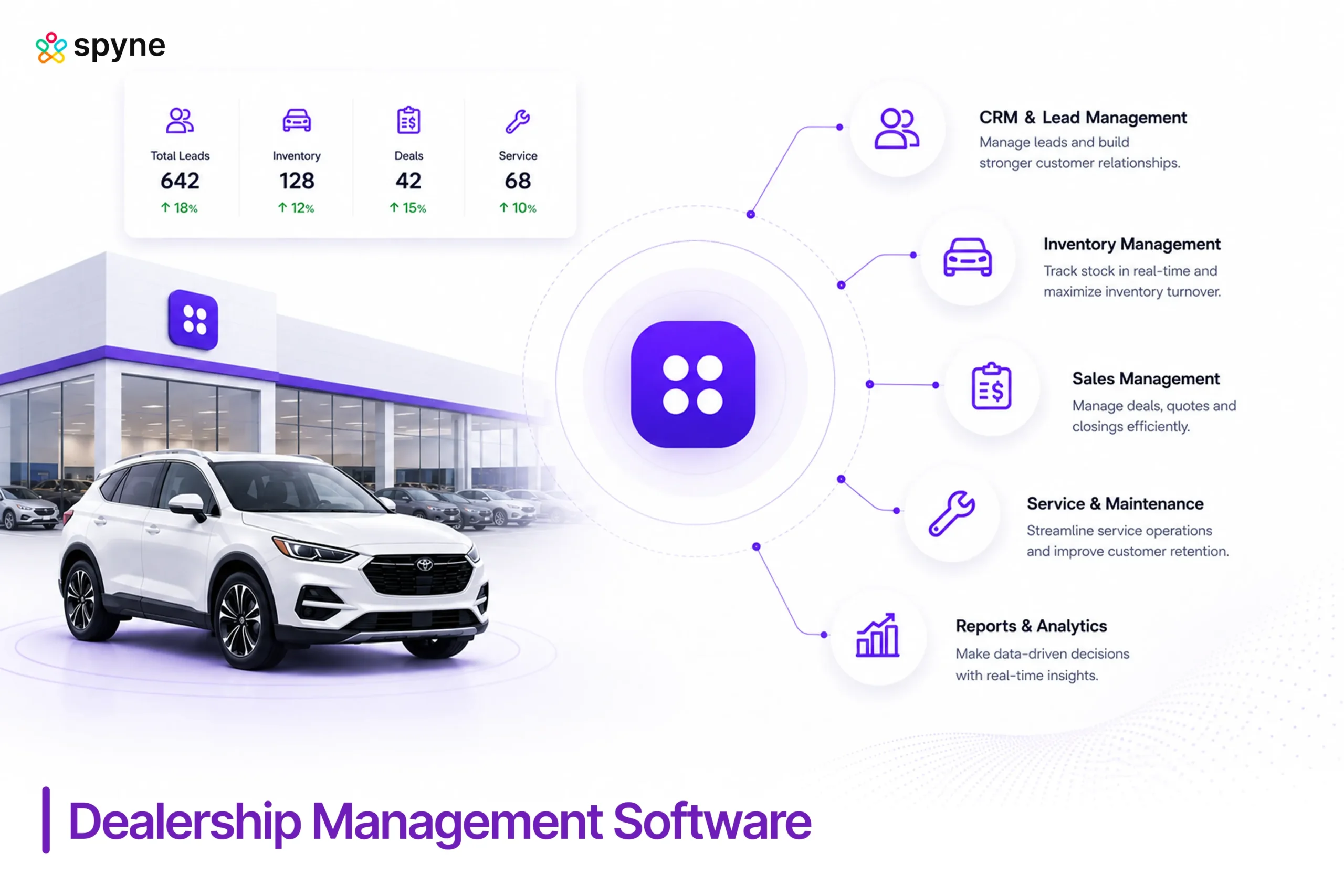
Dealership Management Software (DMS) is an all-in-one software platform that helps automotive dealerships manage their day-to-day operations. It acts as a unified platform that connects multiple departments, including sales, inventory management, customer relationship management (CRM), financing, service, parts, accounting, and reporting. DMS allows every department to access and share data in real-time.
Further, by centralizing these functions, a dealer management system eliminates manual processes, improves operational efficiency, reduces errors, and helps dealerships deliver a faster, more seamless customer experience.
Core Functionalities of Dealership Management Software
Modern dealership management software platforms go far beyond just storing customer and vehicle information. They act as the operational hub of a dealership, connecting every department through shared data and automated workflows. Here are the core functionalities you should expect from a robust dealer management system (DMS).
1. Sales and F&I (Desking)
The sales and finance module helps dealerships manage the entire vehicle sales process, from the first inquiry to final contract through AI agents. It allows you to create deal structures, calculate monthly payments, evaluate trade-ins, prepare financing options, and generate purchase agreements from a single interface. In fact, many DMS software platforms also integrate with lenders and automate compliance checks, reducing paperwork and speeding up deal closures.
2. Inventory Management System (IMS)
Inventory management enables dealerships to track every vehicle throughout its lifecycle. It monitors new and used inventory, VIN details, pricing, acquisition costs, reconditioning status, and stock availability in real-time. Advanced car dealership inventory management software like Spyne also syndicates vehicle listings to marketplaces, dealership websites, and social media while providing insights into inventory aging and pricing performance.
3. Service & Workshop Management
The service module streamlines after-sales operations by managing service appointments, repair orders, technician assignments, labor tracking, and parts usage. It also maintains complete vehicle service histories, helping advisors deliver better customer support while improving workshop efficiency and turnaround times.
4. Customer Relationship Management (CRM)
A built-in CRM helps dealerships capture leads, organize customer information, track every interaction, and automate follow-up via email, SMS, or phone. By centralizing customer data, auto dealership management software ensures no opportunity is missed and builds stronger, long-term customer relationships that drive repeat business.
5. Financial & Accounting Integration
Dealer management systems simplify dealership finances by automating invoicing, payment processing, tax calculations, payroll, and financial reporting. Many solutions also integrate with accounting platforms while eliminating duplicate data entry and ensuring accurate financial records across every department.
6. Reporting & Analytics
Real-time dashboards and customizable reports give dealership leaders complete visibility into business performance. Managers can monitor sales trends, inventory turnover, service revenue, profit margins, employee productivity, and customer metrics, allowing them to make faster, data-driven decisions that improve profitability.

Cloud-Based vs. On-Premise DMS
Dealerships often get confused when deciding which DMS solution to go with- cloud-based or on-premise. Both of these models manage sales, inventory, service, and accounting. However, they differ in cost, accessibility, maintenance, and IT requirements.
Cloud-Based Dealership Management Solution
A cloud-based DMS solution runs on the provider’s servers and offers remote access through web browsers. It operates on a monthly or annual subscription model.
Key benefits
- Lower upfront investment
- Access from any device or location
- Automatic software updates and security patches
- Built-in backups and disaster recovery
- Easy to scale across multiple rooftops
- Faster implementation
On-Premise Dealership Management Solution
On-premise DMS requires dealerships to purchase a license and host the system on local hardware. It requires dedicated in-house servers and internal IT management.
Key benefits
- Greater control over hardware and data
- Customizable infrastructure
- May suit dealerships with strict internal IT policies
- Can operate with limited internet dependency
| Features | Cloud-Based DMS | On-Premise DMS |
| Pricing | Lower upfront costs with a monthly or annual subscription (SaaS) model. | Higher initial investment for software licenses, servers, and infrastructure. |
| Access | Accessible from anywhere via a web browser on desktops, tablets, or mobile devices. | Primarily accessible through the dealership’s local network unless remote access is configured. |
| Updates | Automatic software updates, security patches, and new features managed by the vendor. | Manual updates handled by the dealership’s IT team. |
| Scalability | Easily scales as your dealership adds users, locations, or new features. | Scaling often requires additional hardware, licenses, and IT resources. |
| Data Control | Data is securely hosted by the provider with enterprise-grade security and compliance measures. | Complete control over data storage and infrastructure, managed internally. |
| Backup & Recovery | Automatic backups and built-in disaster recovery provided by the vendor. | Backups and disaster recovery must be managed by the dealership’s IT team. |
| Maintainance | Server maintenance, monitoring, and system performance are handled by the software provider. | Ongoing server maintenance, hardware upgrades, and troubleshooting are the dealership’s responsibility. |
How Much Does a Dealer Management System Cost?
The cost of a dealership management system depends on your dealership’s size, number of locations, users, and business requirements. However, typically DMS for used car dealerships or independent dealers start at under $100 per month. Whereas for dealership or franchise groups, it can cost around $10,000 or more per month.
Most providers follow a subscription (SaaS) pricing model, although some legacy systems still require long-term contracts, licensing fees, and implementation costs.
DMS Pricing Table by Dealership Size
| Dealership Type | Estimated Monthly Cost | Best For |
| Independent & Small Used Car Lots | $79–$300/month | Small dealerships with basic inventory, sales, and CRM needs |
| Mid-Sized Dealerships | $300–$1,500/month | Growing businesses needing service, accounting, and advanced reporting |
| Franchise Dealerships | $3,000–$7,000/month | Single-rooftop franchise stores with OEM integrations |
| Enterprise Dealer Groups | $10,000+/month | Multi-location dealerships requiring enterprise-scale operations |
In short, there isn’t a one-size-fits-all price for dealership management software. The right investment depends on your dealership’s size, operational complexity, and required features. Instead of choosing the lowest-cost solution, focus on a DMS that delivers long-term value through automation, scalability, and seamless integrations.
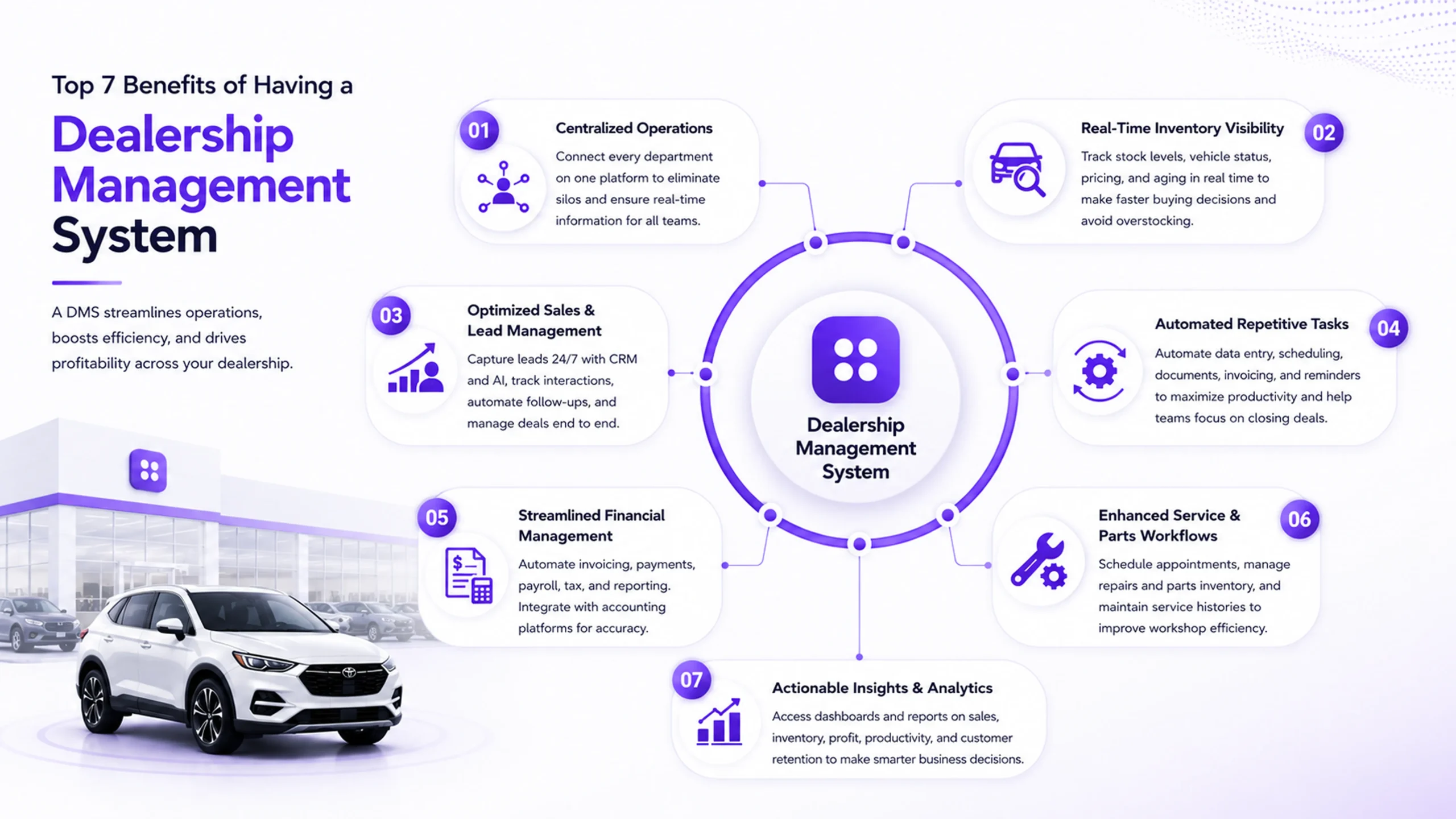
Top 7 Benefits of Having a Dealership Management System
A dealership management system (DMS) does more than simplify daily operations. It helps dealerships work smarter and grow efficiently. In fact, some DMS platforms support over 20,000 dealerships, proving how centralized systems can streamline operations, improve customer experiences, and scale with business growth.
1. Centralized Operations
The dealership management system eliminates fragmented tools by connecting every department, from sales and inventory to service and accounting, into one unified platform. This avoids data silos, reduces duplicate work, and ensures every team works with the same real-time information.
2. Real-Time Inventory Visibility
Whether running a new or used car dealership, DMS tracks and provides real-time visibility into stock levels, vehicle status, pricing, and inventory aging. This helps dealerships make faster purchasing decisions and avoid overstocking or stock shortages and availability confusion across different showroom locations.
3. Optimized Sales & Lead Management
Modern auto dealership management software includes CRM and conversational AI. These capabilities help dealerships capture leads 24/7, respond to common customer inquiries, track interactions, automatically schedule follow-ups, and manage deals from inquiry to delivery.
4. Automated Repetitive Tasks
DMS streamlines repetitive tasks such as data entry, appointment scheduling, document generation, invoicing, and customer reminders, maximising staff productivity. This allows your teams to spend less time on paperwork and focus on closing deals faster.
5. Streamlined Financial Management
A DMS software streamlines accounting by automating invoicing, payment processing, tax calculations, payroll, and financial reporting. Many solutions also integrate with accounting platforms, reducing manual reconciliation and improving financial accuracy.
6. Enhanced Service & Parts Workflows
For dealerships with service centers, a dealership management system helps schedule appointments, create repair orders, assign technicians, manage parts inventory, and maintain vehicle service histories. This improves workshop efficiency and shortens service turnaround times.
7. Actionable Insights & Analytics
Built-in dashboards and reports provide visibility into key metrics and data insights such as sales performance, inventory turnover, gross profit, technician productivity, and customer retention. These insights help managers identify trends and make more informed business decisions.
Top 10 Automotive Dealership Management Software
With dozens of DMS platforms available, finding the right solution can be challenging. Here’s a look at the top automotive dealership management software solutions that help dealerships streamline operations, improve efficiency, and support business growth.
1. Spyne
Spyne is an AI-powered automotive retail and operations platform that helps dealerships streamline inventory, service, customer engagement, and sales in one connected system. Dealerships can enhance and publish vehicle listings with AI, manage real-time inventory, schedule and track service workflows, capture and nurture leads through a built-in automotive CRM, and automate customer conversations using Vini AI across calls, SMS, WhatsApp, and chat.
Key Features
- AI-powered vehicle merchandising
- Inventory management
- Service scheduling & workflow tracking
- Automotive CRM
- Conversational AI (Vini AI)
- Marketplace and website integrations
- Real-time analytics
Best for: Independent dealerships, used-car dealers, and growing dealer groups looking to modernize their operations with AI.
2. CDK Drive
CDK Drive is one of the most widely used automotive dealership management software solutions among franchise dealerships. It offers comprehensive modules for sales, accounting, parts, service, and F&I while supporting OEM integrations and multi-location operations.
Key Features
- Complete dealership operations management
- Accounting and financial tools
- Parts and service management
- OEM integrations
- Digital retail support
Best for: Large franchise dealerships and enterprise dealer groups.
3. Dealertrack DMS
Dealertrack DMS is a cloud-based dealer management system that helps dealerships streamline vehicle sales, financing, registration, inventory, and accounting. Its seamless integration with lending and registration services makes it a popular choice among franchise dealers.
Key Features
- Digital deal management
- Inventory and accounting
- Financing integrations
- Vehicle registration tools
- Cloud accessibility
Best for: Franchise dealerships seeking an integrated sales and finance platform.
4. Reynolds & Reynolds
Reynolds & Reynolds has long been an industry leader in DMS software, offering robust solutions for dealership accounting, compliance, parts, service, and customer management. Its platform is widely adopted by large dealer groups that require enterprise-level functionality.
Key Features
- Advanced accounting
- Service and parts management
- Compliance tools
- Customer management
- Enterprise reporting
Best for: Large automotive dealership networks.
5. Tekion
Tekion is a cloud-native dealership management system built with a modern user interface and AI-driven workflows. It connects sales, service, CRM, accounting, and digital retail into a single platform, reducing manual processes and improving operational visibility.
Key Features
- Cloud-native architecture
- AI-powered workflows
- Digital retail integration
- Mobile access
- Real-time reporting
Best for: Dealerships looking to replace legacy DMS platforms with a modern cloud solution.
6. Auto/Mate
Now part of DealerSocket, Auto/Mate provides an easy-to-use dealer management software solution with strong accounting, inventory, service, and CRM capabilities. It is particularly popular among mid-sized dealerships seeking flexibility and ease of use.
Key Features
- Accounting tools
- CRM integration
- Inventory management
- Service scheduling
- Workflow automation
Best for: Mid-sized dealerships.
7. DealerCenter
DealerCenter is cloud-based used car dealership management software built primarily for independent dealers and Buy Here Pay Here (BHPH) operations. It combines inventory management, financing, CRM, accounting, and marketing into one platform.
Key Features
- BHPH management
- Inventory tracking
- CRM
- Financing tools
- Mobile application
Best for: Independent used car dealerships and BHPH dealers.
8. Frazer
Frazer is one of the longest-standing used car dealer software solutions on the market. Its straightforward interface and affordable pricing make it a preferred choice for smaller dealerships that need reliable inventory, accounting, and customer management without enterprise-level complexity.
Key Features
- Inventory management
- Customer database
- Accounting
- Collections management
- Vehicle history tracking
Best for: Small used car dealerships.
9. VinSolutions
VinSolutions is best known for its advanced CRM capabilities, but it also integrates with dealership operations to improve lead management, customer engagement, marketing automation, and sales performance.
Key Features
- Advanced automotive CRM
- Lead management
- Marketing automation
- Customer lifecycle tracking
- Performance analytics
Best for: Dealerships prioritizing lead generation and customer relationship management.
10. Dealer.cloud
Dealer.cloud is a cloud-based dealer management system that combines accounting, inventory, sales, and reporting into a single platform. Its real-time financial insights help dealerships monitor profitability and operational performance more effectively.
Key Features
- Real-time accounting
- Deal profitability tracking
- Inventory management
- Financial reporting
- Cloud deployment
Best for: Dealerships looking for stronger accounting and financial visibility.
How to Choose the Right DMS?
Want to invest in a DMS for your business but don’t know which dealer management solution is right for your business? No worries, we have prepared a checklist for you that will help you choose the right solution for your auto business. The right dealership management solution should support your dealership’s growth, integrate with your existing tools, and simplify workflows across every department. Whether you’re evaluating your first DMS solution or replacing a legacy platform, consider these factors before making a decision.
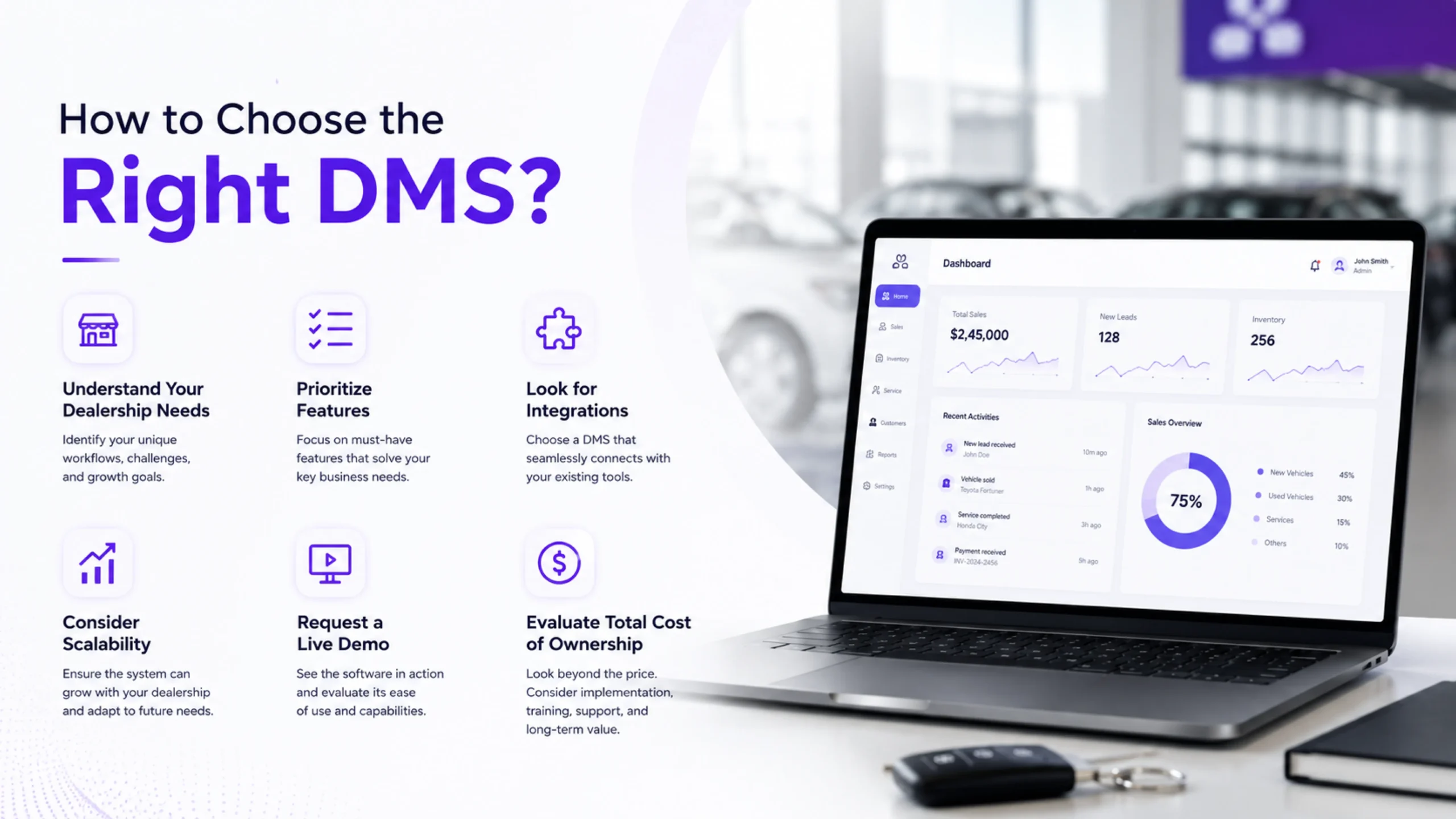
1. Understand Your Dealership Needs
The first thing you need to do is identify your dealership operational requirements. Having a better understanding of your business needs helps you choose solutions that can actually work for your business.
2. Prioritize Features
Make a list of must-have features based on your daily operations. Look for features such as inventory management, sales and F&I, service management, CRM, accounting, reporting, and automation. If you’re planning to digitize your dealership, consider platforms that also offer AI-powered car merchandising, customer engagement, and workflow automation.
3. Look for Integrations
Make sure your dealer management system integrates seamlessly with the software you already use, including CRM platforms, accounting tools, OEM systems, finance providers, website platforms, and digital retail solutions. Strong integrations reduce manual work and keep information synchronized across your dealership.
4. Consider Scalability
You have to look for a dealership management software that can scale as your business grows. So when you add more users, expand to multiple locations, or introduce new services, it can scale without requiring a complete system replacement.
5. Request a Live Demo
Never choose a DMS based solely on brochures or feature lists. Schedule a live demo and evaluate how quickly and effectively it handles tasks such as adding inventory, processing a sale, managing service appointments, or generating reports.
6. Evaluate Total Cost of Ownership
Compare more than the monthly subscription fee. Consider implementation costs, training, integrations, customer support, customization, and potential data migration charges. A slightly higher upfront investment may deliver better long-term value if it improves efficiency and reduces operational costs.
Spyne’s Dealership Management Software For Auto Dealerships
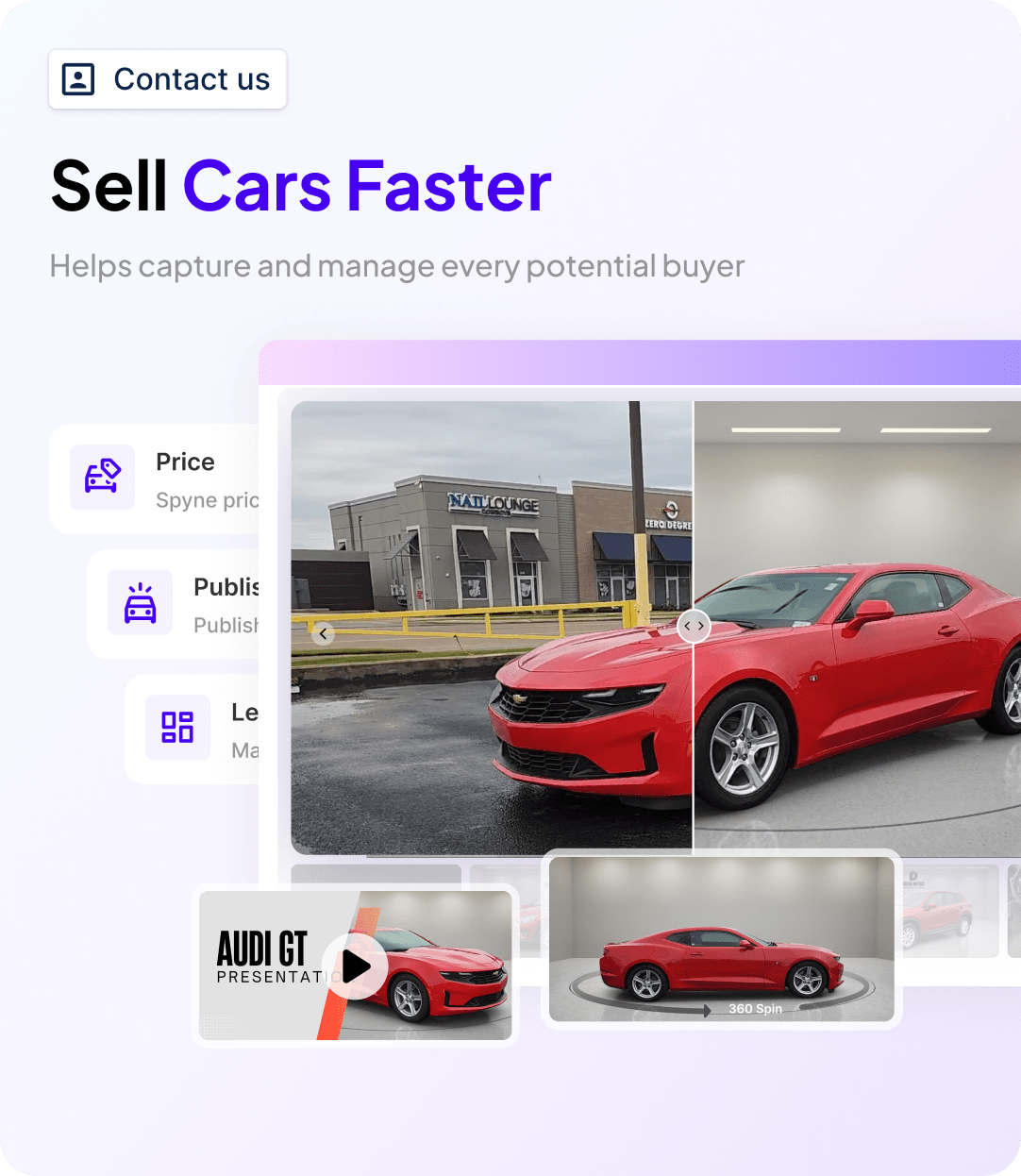
Disconnected tools affect the dealership’s performance, making it difficult to deliver a consistent customer experience. Spyne brings you an AI-powered all-in-one platform that helps you manage your inventory, engage customers, automate repetitive tasks, and sell more cars faster and smarter.
1. Inventory Management
Keep your entire inventory organized with real-time tracking of vehicle availability, pricing, stock movement, and listing status. A centralized dashboard makes it easy to monitor inventory across channels and ensure every vehicle is market-ready.
2. AI Merchandising
Create high-quality car listings in minutes using AI. Spyne’s Studio AI automatically enhances images, replaces backgrounds, masks number plates, generates vehicle descriptions, and prepares inventory for publishing across your website and marketplaces.
3. Automotive CRM
Capture leads from multiple sources and manage the entire customer journey in one place. The built-in automotive CRM tracks conversations, schedules follow-ups, and helps sales teams stay on top of every opportunity without manual effort.
4. Service Management
Keep your service department running on schedule with tools to book appointments, assign technicians, track job status, and manage service history all connected to the same inventory and customer records the rest of your dealership uses, so nothing gets re-entered twice.
5. Conversational AI
Vini AI handles all customer inquiries 24/7 via phone calls, SMS, WhatsApp, and web chat. It qualifies leads by understanding customer needs, tone, and behavior. Further, with instant, personalized, and human-like responses, it ensures that no lead goes unanswered.
6. Website & Marketplace Integrations
Sync your inventory seamlessly with your dealership website and leading automotive marketplaces. Any changes to pricing, availability, or vehicle details are reflected automatically, reducing manual updates and improving listing accuracy.
7. Real-Time Reporting & Analytics
Access live dashboards that track inventory performance, lead sources, sales activity, and operational KPIs. These insights help dealership managers identify trends, optimize workflows, and make informed business decisions.
8. Scalability
Whether you’re an independent used car dealer or a growing multi-location dealership, Spyne scales with your business. Its flexible platform supports expansion while integrating seamlessly with your existing dealership technology stack.

Conclusion
Investing in the right auto dealer management software streamlines your dealership’s operations, improves inventory control, enhances customer experiences, and supports long-term business growth. Choose a DMS software that aligns with your workflow and future goals. This will help you stay competitive in today’s automotive market.
Modernize your dealership with Spyne and discover how AI-powered inventory management, merchandising, CRM, and conversational AI can help you sell more vehicles with less effort. Book a demo now!