
The average U.S. dealership spends thousands per month generating inbound leads, then takes 47 minutes to respond to them. NADA data shows 56% of those leads arrive after hours, when no one responds at all. The first dealership to reply wins 78% of deals, not on price, not on inventory, on speed. That is not a staffing problem. It is a structural one, and no amount of BDC headcount solves a 2 AM web lead. This guide breaks down how conversational AI actually works inside a dealership, covering where it fits in the workflow, what deployment and ROI look like, and what separates platforms that move the needle from ones that don’t.
Most Dealers Are Deploying AI in the Wrong Place
AI adoption in automotive retail jumped from 28% to 39% in a single year, according to CDK Global’s 2026 study, the fastest single-year uptick the category has seen. And yet the failure rate on individual deployments remains high.
The reason is consistent: dealers implement AI as a marketing layer rather than an operations fix. A chat widget goes live on the website. It gets mentioned at the next 20-group. Six months later it has booked eleven appointments and nobody can explain why the number is not higher.
The stores seeing real outcomes are doing something different. They are deploying conversational AI where the volume of failed contacts is highest, after-hours inbound, peak-hour overflow, service calls that drop to voicemail, and measuring it against the one number that tells you whether the workflow actually changed: lead response time, before and after.
As Digital Dealer’s 2026 industry outlook noted, the dealerships winning this year are not the ones that tried AI. They are the ones that rebuilt how the store runs around it.
The Lead Response Problem Is Bigger Than It Looks on the CRM
Here is what the communication breakdown at most dealerships actually looks like at the operational level.
A BDC rep on a normal shift handles roughly 60–80 outbound contacts per day across calls, texts, and emails. During that same shift, the store is receiving inbound leads from six or seven sources simultaneously, the OEM site, Cars.com, AutoTrader, Facebook Marketplace, the store website, phone, and walk-in referrals. The rep cannot be the first responder on all of them. Nobody can.
So leads wait. Generic CRM auto-replies go out, the “thanks for your inquiry, we’ll be in touch” emails that Synthevo’s 2026 BDC analysis found achieve a 4% reply-back rate and a 2% appointment conversion. The buyer, who spent three weeks researching and has four other tabs open, closes yours.
The problem is not bad BDC reps. It is that the volume and time distribution of modern inbound is structurally incompatible with human-only first response. A 2 AM web lead needs a response at 2 AM. A Saturday lunch rush needs eight lines answered in parallel. Neither is a staffing solution. Both are AI use cases.
The downstream cost shows up in reviews before it shows up in the CRM. An analysis of 1.5 million dealership Google reviews found communication failures in 36.8% of all negative mentions, ahead of pricing, service quality, and wait times. That is not a customer satisfaction problem. It is a workflow problem that surfaces as a reputation problem.

What Conversational AI Actually Does Inside a Dealership
Conversational AI is not a BDC replacement. It is a coverage layer, handling the moments when human response is either impossible or economically impractical.
- After-hours inbound is the highest-volume, lowest-coverage gap. NADA places 56% of digital leads in this window. Vini AI by Spyne engages every one of those leads within 5 seconds of submission, qualifying intent, referencing the specific vehicle or service inquiry, booking the appointment directly into the DMS, and logging the full conversation to the CRM before the first human arrives in the morning.
- Peak-hour overflow is the second gap. A dealership fielding 40 inbound calls between 11 AM and 1 PM on a Saturday, with four service advisors and two BDC reps on shift, is structurally going to miss calls. Not due to poor execution, but because the math does not work. Vini AI handles overflow calls in parallel, with no hold time and no IVR tree.
- Multi-channel lead response is the third gap. A buyer who submits a lead on Cars.com, follows up on Facebook Marketplace, and then calls the store expects a coherent conversation across all three touchpoints. Most dealerships cannot deliver that because the channels are not connected. Vini AI unifies phone, text, chat, email, and Facebook Marketplace into a single conversation record; the human rep who takes over sees the full history, not three disconnected fragments.
What Vini AI is explicitly not built to do: close deals. Negotiation, trade appraisal, F&I product explanation, and the relationship judgment that moves a buyer off the fence still require a human. The AI’s job is to ensure a qualified, context-rich lead reaches that human instead of a voicemail box.
| Contact Scenario | Without Vini AI | With Vini AI |
| 2 AM web lead | Sits until Monday | Engaged within 5 seconds |
| Saturday call spike | Goes to voicemail | Handled in parallel, no hold |
| Multi-channel buyer | Fragmented across 3 reps | Unified conversation record |
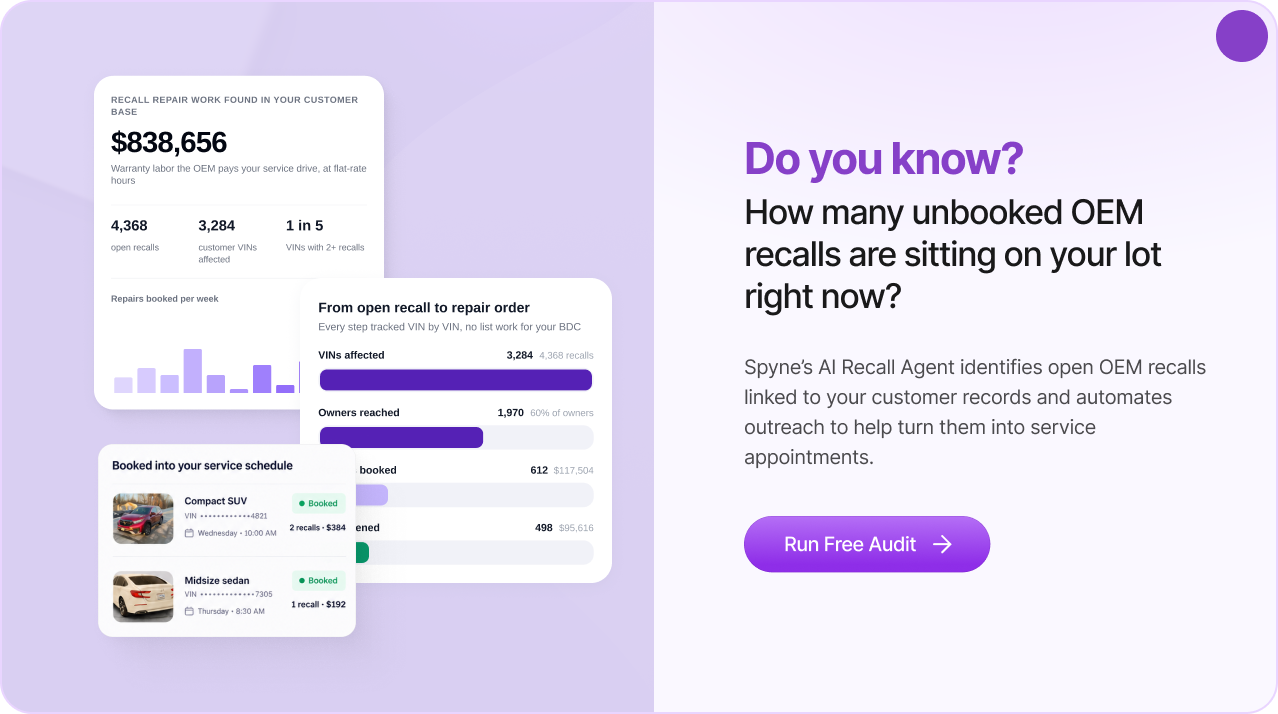
| Recall outreach at scale | Manual, inconsistent | Automated first contact through booking |
| After-hours appointment | Lost | Booked into DMS overnight |
What the Numbers Look Like at Stores Running It Today
Paragon Honda, one of the highest-volume Honda dealerships in the U.S., deployed Vini AI across inbound and outbound workflows and recovered $314,000 in 30 days, primarily from missed inbound calls and recall outreach that could not scale manually. The deployment produced a 48% appointment-to-sale rate and a 53% recall connect rate.
The pattern holds across Spyne’s 5,000+ dealership customer base. Measurable appointment recovery appears in the first 30 days, consistently. Full ROI, the platform cost covered by incremental booked ROs or sold units, typically occurs within 60–90 days of deployment.
CDK Global’s research puts the broader picture in context: dealerships running hybrid AI-plus-human models see 30–40% conversion lifts over manual-only BDC operations. Pure AI-only deployments with no human handoff plateau at 12–18%. The architecture matters. Vini AI’s speed on intake combined with a rep’s judgment on close is what produces the lift, neither does it alone.
3 Reasons Conversational AI Deployments Fail
Most AI for car dealerships vendors do not open with where their platforms fall down. It is worth naming these directly before you sign anything.
#1- Deploying it and walking away. Conversational AI requires ongoing calibration, inventory updates, service protocol changes, seasonal offer language. A platform trained accurately in January gives outdated responses by April without active maintenance. Ask every vendor: who owns post-deployment quality, and what does that actually look like week to week? Vini AI runs daily human QA reviews of call transcripts. Most platforms do not.
#2- Measuring volume instead of quality. The most common reason a dealer concludes AI “isn’t working” is measuring the wrong metric. AI-booked appointments with a show rate below 65% signal a qualification problem in the conversation, not a booking problem. Tracking show rate on AI-booked appointments separately from human-booked appointments surfaces within 30 days.
#3- Treating it as a website feature. A chat widget that only activates on the store website captures a fraction of available contact volume. The stores seeing the largest ROI deploy AI across all inbound channels simultaneously, especially phone, which remains the highest-intent channel in the purchase funnel. Vini AI answers inbound phone calls in under two rings. That single decision captures more volume than any chat widget.
Three Numbers to Pull From Your CRM Before You Demo Anything
Before evaluating any platform, run these on your last 30 days of CRM data. The answers will tell you more than any vendor deck.
- After-hours lead volume. Pull every lead that entered the CRM between 6 PM and 9 AM. What percentage of your total inbound is that? If it is near the NADA benchmark of 56%, the revenue case for after-hours AI coverage is already made before the first demo.
- Average first-response time. Your CRM logs this. If it sits above 15 minutes, you are losing deals to a competitor who responds faster, regardless of your price position, inventory depth, or OEM incentives.
- After-hours appointment rate. Of those after-hours leads, how many converted to booked appointments? If the answer is close to zero, that is recoverable revenue with a direct and calculable line to platform cost.
Inventory Visibility Is the Other Half of the Same Problem
The response gap in sales and service is the Vini AI problem. The equivalent problem on the inventory side is a Studio AI problem.
Cox Automotive research shows over 80% of buyers begin their vehicle search on third-party sites before contacting a dealership. The VDP is the first customer touchpoint, not the phone call, not the showroom walk. A unit sitting on lot for 10 days without a complete photo set is accruing $460 in holding cost while presenting worse than a competitor’s identical vehicle two miles away.
Studio AI by Spyne automates vehicle photography, image enhancement, and instant listing publication across all VDP channels. Where Vini AI ensures every lead generated by your inventory gets a fast, qualified response, Studio AI ensures the inventory generates the lead in the first place. The two products address consecutive moments in the same revenue cycle.

Closing Thoughts
Every month a store operates with a 47-minute average response time and no after-hours coverage is a month where 56% of inbound leads arrive when no human can respond, 78% of those buyers choose whoever gets there first, and the advertising budget, website spend, and carrying costs fund someone else’s gross.
The AI budget is not the cost. The wait is the cost.
If you want to see exactly how many appointments your store is losing to response time, broken down by channel, hour, and lead source, book a demo with Spyne. The numbers from your own CRM tend to make the case faster than anything else.