
Over 90% of U.S. dealerships now use some form of chat or messaging tool to engage buyers online, but most of those tools capture contact information without converting leads into scheduled visits, very few have one that books appointments.
That’s the gap this article is about. The best AI chatbot for a car dealership in 2026 is the one that closes the loop without human intervention, qualifying buyers, checking live inventory, and booking confirmed appointments directly into the DMS. The cheapest tool won’t do this. Neither will the most feature-rich one. For dealerships running on CDK, Reynolds, Dealertrack, DealerSocket, or Tekion, that means choosing an automotive-native platform with bi-directional DMS integration, not a generic SMB chatbot bolted onto the website. Of the eight platforms compared in this article, Spyne AI (Vini), Podium (Jerry), and Matador AI are the three that meet this bar, and the right choice depends on whether full omnichannel coverage, unified messaging, or SMS-first outbound is your primary need.
This guide covers:
- What an AI chatbot for a car dealership actually does and what most tools get wrong.
- The critical difference between appointment-booking bots and FAQ bots.
- A side-by-side comparison of the 8 best AI chatbots for dealerships in 2026.
- How leading platforms handle trade-in questions, DMS integration, and after-hours coverage.
- Pricing tiers, from free tools to full omnichannel AI BDC platforms.
- What to look for before you buy, and the questions to ask any vendor.
What an AI Chat Bot Actually Does for a Car Dealership?
An AI call bot for a dealership is a conversational AI layer that sits between your digital ad spend and your showroom floor. It answers inbound calls, responds to website chat and text inquiries, qualifies buyers by budget and timeline, pulls live inventory data from the DMS, and books appointments, without a BDC rep in the loop.
At the basic level, chatbots function as always-on FAQ systems that free staff from answering the same questions repeatedly. At the advanced level, they are appointment generation tools that produce a booked visit without any human involvement in the transaction.
The distinction matters because the ROI of a basic FAQ chatbot is measured in staff time saved. The ROI of an appointment-booking chatbot is measured in revenue generated. Dealerships that have evaluated their chatbot performance almost universally find that appointment booking capability is the feature that creates measurable revenue impact, and feature lists like inventory search and financing calculators create engagement without consistently driving conversion.
Automotive companies using AI-driven automation report efficiency gains of up to 50%. The difference between top and bottom performers is not whether they have a chatbot. It is whether the chatbot is wired into the scheduling system and authorized to book appointments without a human handoff.
What Separates Automotive Bots from FAQ Bots?
The technical difference is a live connection to the dealership’s scheduling system, and the authorization to confirm a time slot mid-conversation, without a human approving each booking.
Most generic chatbot platforms collect a name, phone number, and vehicle of interest, then pass the lead to a CRM queue for human follow-up. The problem: leads contacted within 5 minutes of submission convert at roughly triple the rate of leads reached after an hour. A bot that routes to a queue rather than booking on the spot is making the conversion problem worse, not better.
The stores consistently winning on lead-to-appointment rate have bots that are wired directly into their DMS calendar, no hand-off, no queue, no lag.

Top 8 AI Call Bots for Car Dealerships Compared (2026)
The table below compares platforms on the criteria that matter most for dealership operations: direct appointment booking, DMS connectivity, voice AI, and 24/7 coverage.
| Tool | Best For | Appt Booking | DMS Integration | Voice AI | 24/7 | Published Pricing |
| Spyne Vini AI | Full omnichannel AI BDC across sales, service, parts, finance | Yes, direct | Yes | Yes | Yes | Custom pricing |
| Podium Jerry | Multi-channel AI employee for text, voice, and webchat | Yes | Partial (CRM-first; DMS via integrations) | Yes | Yes | Core $399/mo, Pro $599/mo; AI Employee add-on priced separately |
| Matador AI | SMS-first omnichannel automation with voice add-on | Yes | Yes (DealerSocket, VinSolutions, CDK, Reynolds) | Yes (Call AI) | Yes | Custom |
| Kenect | Voice + texting platform for service-driven dealers | Yes | Yes | Yes | Yes | Custom |
| Fullpath | Data-driven website chat + voice agent on CDP backbone | Yes | Yes (via CDP layer) | Yes (Voice Agent) | Yes | Custom |
| Dealerbot.io | Inventory-search chatbot for dealership websites | Limited | Partial | No | Yes | Custom |
| HubSpot Chat | Basic rule-based bots inside the HubSpot CRM | Limited (via meeting links) | HubSpot CRM only; no DMS | No | Yes | Free (rule-based) / Starter from $15/seat/mo / AI Customer Agent requires Professional ($90+/seat/mo Service Hub) |
| Tidio | Generic SMB website chat with optional AI add-on | No native; via flows | None | No | Yes | Free / Starter $29/mo / Growth $59/mo / Tidio+ $749+/mo; Lyro AI add-on from $39/mo |
1. Spyne Vini AI
Best for: Dealerships that want a single conversational AI to cover inbound calls, chat, and outbound follow-up across sales, service, parts, and finance, with deep DMS, CRM, and IMS integration.
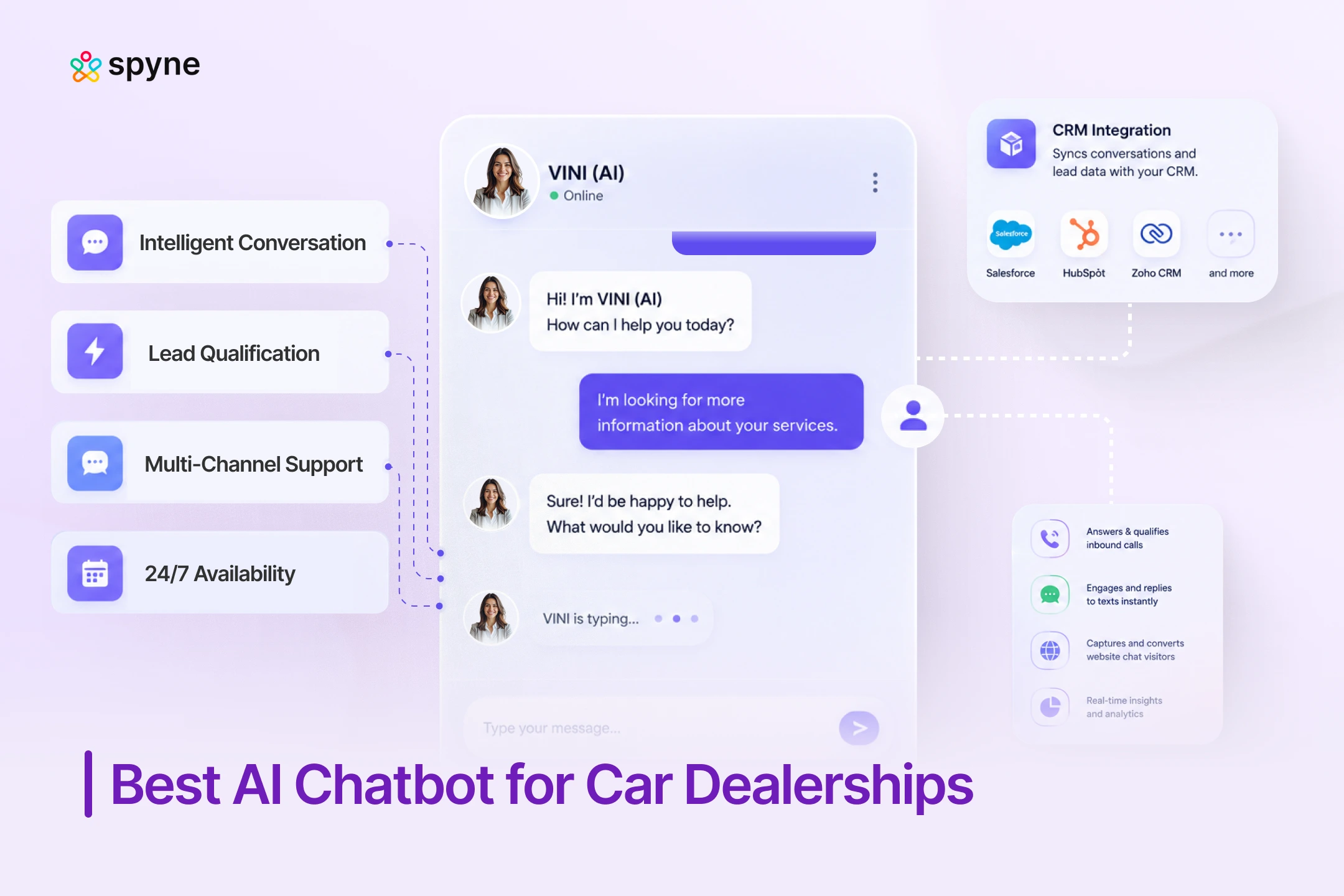
Vini A is Spyne’s automotive-native conversational AI platform built specifically for dealerships. It deploys dedicated agents across sales, service, BDC, parts, and finance workflows, handling phone, chat, and email from a single system. Vini answers and qualifies leads 24/7 in the customer’s preferred language, books appointments directly into the calendar, and syncs every interaction into the CRM with full conversation context attached for handoff.
Features:
- Inbound and outbound voice AI across sales, service, BDC, parts, and finance.
- Real-time appointment scheduling for test drives and service slots.
- Multilingual handling with customizable agent voice, tone, and script.
- Call overflow management and round-robin lead routing with context handoff.
- Automatic CRM updates, call recaps, transcripts, and action items.
- Recall outreach and cold-lead re-engagement workflows.
- VDP integration for inventory-aware conversations.
- Performance dashboards covering call volume, resolution, and conversion.
Integrations: 50+ integrations across DMS, CRM, and IMS, including a live Tekion integration.
Pros:
- Purpose-built for automotive, with department-specific agents rather than a generic chatbot
- Covers voice, chat, and email from one platform with shared context
- Multilingual support is included rather than tiered
- Brand customization extends to agent voice, scripts, and workflows
Cons: Trained exclusively on dealership flows for automotive, so it is not designed for use cases outside the auto retail vertical.
Pricing: Custom; pricing is scoped per dealership based on rooftops, call volume, and feature set.
2. Podium Jerry
Best for: Dealerships already standardized on Podium for messaging that want AI handling text, voice, and webchat in one inbox.
Podium’s AI Employee, branded Jerry, is an add-on to Podium’s customer engagement platform. It handles inbound leads across phone, text, email, social, and webchat, books test drives and service appointments, and hands off to sales when buyers are ready. Podium reports 6,000+ dealership customers and a partnership with FordDirect.
Features:
- 24/7 inbound lead response across phone, text, webchat, social, and email
- Appointment booking for sales and service
- Unified messaging inbox with review management
- Customizable playbooks per dealership workflow
- Integrations with major DMS and CRM systems via Podium’s platform
3. Matador AI
Best for: Dealerships running SMS-heavy outbound campaigns who also need inbound call coverage.
Matador is an automotive-specific conversational AI platform built around SMS-first lead engagement, with a Call AI product for voice. It handles both inbound calls and outbound text campaigns for sales and service, and is most commonly used for structured outbound workflows like lease expiration, unsold showroom takeover, and recall outreach.
Features:
- Call AI for inbound voice with appointment booking
- Text-first outbound campaigns and broadcast messaging
- Pre-built automotive automation workflows (lease end, recall, sales-to-service)
- CRM integrations including DealerSocket, VinSolutions, CDK, and Reynolds
- Sales Autopilot and Service Autopilot modules
4. Kenect
Best for: Service-focused dealers who want voice AI plus texting and reputation management in one platform.
Kenect is an automotive-specific platform combining Voice AI, conversational texting, payments, and review management. Kenect reports use by 10,000+ dealerships in North America. Voice AI functions as a 24/7 virtual receptionist that books service appointments directly into the DMS, while Service AI and Sales AI handle department-specific workflows.
Features:
- Voice AI for inbound call handling and DMS-integrated appointment scheduling.
- Two-way business texting from main dealership number.
- Service AI for repair updates, reminders, and approvals.
- Review generation and reputation management.
- Secure text-to-pay for parts, service, and deposits.
- DMS and CRM integrations (Lightspeed and others).
5. Fullpath
Best for: Dealerships that want their AI engagement layer sitting on top of a unified customer data platform.
Fullpath is a Customer Data Experience Platform (CDXP) for automotive that has expanded into multi-agent AI. Its agent ecosystem now includes a GPT-powered website chatbot (Omni Agent), a lead-handling agent for two-way SMS and email, and a Voice Agent for inbound and after-hours AI phone calls. All agents draw from Fullpath’s unified data layer across CRM, DMS, website, and ad platforms.
Features:
- GPT-powered website chatbot with first-party data grounding.
- Voice Agent for on- and off-hour phone interactions.
- Lead-handling agent with two-way SMS and email.
- Embedded Omni Agent inside CRM for internal team queries.
- Equity mining and VIN-level personalization.
6. Dealerbot.io
Best for: Dealers prioritizing conversational inventory search on the website.
Dealerbot.io is a website chatbot focused on natural-language inventory search. It connects to a live inventory feed (IMS) and lets shoppers ask plain-language questions like “do you have AWD SUVs under $40K” and receive matched results in chat. It also supports lead qualification and routes high-intent inquiries to CRM. It is not a voice AI platform.
Features:
- Conversational AI inventory search on dealership websites.
- Real-time IMS integration for stock-accurate responses.
- Lead qualification with CRM routing.
- Omnichannel deployment across web, SMS, and social.
- Custom branding to match dealership style.
7. HubSpot Chat
Best for: Small dealers already running HubSpot CRM that need basic lead-capture bots without buying a separate platform.
HubSpot offers two distinct chat products. Chatflows is a rule-based bot available on Free and Starter plans for FAQs and meeting bookings. Breeze Customer Agent is the AI-powered chatbot, but it requires HubSpot Professional or Enterprise plans, with each AI conversation metered against HubSpot Credits. There is no DMS integration; data lives only in HubSpot CRM.
Features:
- Free rule-based chatbot builder (Chatflows).
- Native integration with HubSpot CRM contacts and pipelines.
- Meeting link booking via HubSpot calendar.
- AI Customer Agent on Professional/Enterprise plans (credit-metered).
- Live chat handoff to human agents.
8. Tidio
Best for: Independent or small dealers wanting a low-cost generic website chat tool, not built for automotive.
Tidio is an SMB-focused live chat and chatbot platform with an optional AI agent called Lyro. It is not automotive-specific, has no DMS integration, and appointment booking depends on third-party calendar connections or flow logic. The free plan includes 50 conversations per month; AI capability is a paid add-on on most tiers.
Features:
- Free plan with 50 live chat conversations per month.
- Visual flow builder for rule-based automation.
- Lyro AI add-on for natural-language responses (paid).
- Shopify, WordPress, and Messenger integrations.
- Unified inbox for web, email, Messenger, and Instagram.
Pricing reflects what is published on each vendor’s website as of Q2 2026; figures may change.
How Does a Dealership AI Bot Handle Trade-In Questions?
Trade-in conversations are high-stakes. Buyers are often emotional about their vehicle’s value, and a clumsy or inaccurate response at this stage can kill a deal before it starts.
How AI bots handle trade-ins depends on their sophistication:
- Basic bots collect year, make, model, and mileage, then route the lead to the used car manager for a human valuation. Safe default, captures the data without risking an inaccurate quote.
- Mid-tier bots connect to third-party appraisal tools (KBB, Black Book) and surface an estimate range in-chat, shortening the path from first inquiry to a buyer walking in with their trade.
- Advanced bots like Vini AI handle trade-in qualification conversationally, capturing:
- Vehicle details (year, make, model, mileage, condition)
- Buyer’s timeline to sell or trade
- Replacement vehicle interest
How Much Does an AI Call Bot Cost for a Car Dealership?
Pricing across this category spans a wide range, depending on the depth of the platform:
- Free or low-cost tools (HubSpot, Tidio): Basic rule-based chatbots for FAQs and lead capture. Free tiers exist; paid plans for AI features start around $29/month (Tidio) or require HubSpot Professional at $90+/seat/month for AI capability. No DMS integration.
- Mid-tier published pricing (Podium): Core plan starts at $399/month, Pro at $599/month, with the AI Employee (Jerry) priced as a separate add-on. Best for dealers who want messaging + AI in one platform.
- Custom enterprise pricing (Spyne Vini AI, Matador AI, Kenect, Fullpath): Quotes are scoped around call volume, rooftop count, and feature set. Typically structured as volume-based or seat-based licensing. Reserved for full omnichannel AI BDC deployments.
Does the ROI Math Work?
For appointment-booking platforms, the math is straightforward:
- Average dealership repair order: $450–$520.
- One recovered service appointment per day: ~$3,150–$3,640 per week.
- Weekly revenue from a single recovered RO exceeds most platform costs for the entire month.
How to Choose the Right AI Chatbot for Your Dealership?
Most dealerships don’t fail at AI chatbot deployment because they pick a bad tool. They fail because they pick the right tool for the wrong problem.
The “best” chatbot for a single-rooftop independent used dealer is not the same as the best for a 15-store franchise group running CDK with a centralized BDC. Before evaluating vendors, work through these five filters in order:
1. Define the Primary Problem You’re Solving
Most chatbot pitches blur the line between three very different problems. Pick the one that’s costing you the most revenue today:
- Missed inbound leads (after-hours calls, unanswered webchats): You need a 24/7 voice + chat platform with appointment booking
- Slow lead response times (CRM leads sitting for hours): You need an AI for outbound calling that calls and texts within seconds of lead arrival
- BDC capacity ceiling (team can’t handle volume, especially in service): You need an AI BDC that handles routine inbound and routes the rest
Dealers who skip this step end up paying for omnichannel platforms when they only needed website chat or buying a chat-only tool when their real leak is the phone.
2. Confirm the Tool Is Built for Automotive
Generic SMB chatbots (Tidio, HubSpot Chatflows) cannot understand the language of car shoppers, integrate with a DMS, or check live inventory. They can capture an email, that’s it.
Automotive-specific platforms (Spyne Vini AI, Matador, Kenect, Podium, Fullpath) are trained on dealership workflows, understand VIN-level inventory questions, and connect to dealership tech stacks. If the bot can’t tell a Civic LX from an EX, it’s not a dealership chatbot.
3. Verify DMS Integration Depth for Your Specific DMS
“DMS integration” is the single most misrepresented feature in this category. Ask vendors three questions:
- Does the bot write back into our DMS scheduler, or just read from it? (Read-only ≠ appointment booking)
- Which DMS do you have native integration with CDK, Reynolds, Dealertrack, DealerSocket, Tekion? (Coverage varies dramatically by platform)
- Can you give me a reference customer on our exact DMS? (If they can’t, the integration is probably newer or shallower than advertised)
A tool with deep CDK integration may have only basic Reynolds support. Don’t take the marketing page at face value.
4. Test Voice Quality Before Signing
If voice AI is in scope, request a live demo on an inbound calling, not just a marketing video. Listen for:
- Latency between buyer speech and AI response (anything over ~800ms feels robotic)
- Handling of interruptions and clarifications (“Wait, I meant the 2023 model”)
- Natural handoff to a human when needed
- Whether the AI volunteers context (price, availability, alternative options) or just answers literally
Voice AI quality has improved dramatically in the last 18 months, but the gap between tier-1 and tier-3 platforms is still wide. Don’t buy on the deck.
5. Match the Pricing Model to Your Volume
The platforms in this category use four different pricing structures:
- Flat monthly (Podium, Tidio): Predictable, but caps on usage matter
- Per-seat (HubSpot): Cheap for small teams, expensive at scale
- Volume-based (Spyne Vini AI, Matador, Kenect): Scales with call/conversation volume, usually the best fit for high-volume dealerships
- Custom enterprise (Fullpath): Negotiated per deployment, typically for multi-rooftop groups
A 200-lead-per-month single store should not pay enterprise pricing. A 5,000-lead-per-month dealer group should not be on per-seat billing. Match the model to your actual volume.
Does an AI Call Bot Replace the BDC?
No. AI call bots handle the volume-heavy, repetitive work the BDC shouldn’t be doing: answering the same availability questions, leaving the same voicemails, booking straightforward service appointments. This frees BDC reps to focus on high-intent conversations that actually need a human.
Most dealerships start with after-hours coverage, letting the AI handle everything after the BDC closes. Once they see the appointment volume coming in overnight, they expand coverage. The starting point is additive, not a replacement.
Key Takeaways
The 8 platforms in this comparison serve very different dealership needs. Use this as a quick decision filter:
- If you want a single platform covering voice, chat, SMS, and email across sales, service, parts, and finance, Spyne Vini AI is purpose-built for this. It books appointments directly into the DMS, supports multilingual conversations, and is in production at 3,200+ dealerships across 40+ countries.
- If you’re already standardized on Podium for messaging, Podium Jerry is the path of least resistance. It bolts onto your existing inbox and handles text, voice, and webchat without adding another vendor.
- If your biggest leak is service department missed calls, Kenect is the strongest fit. Voice AI writes service appointments directly into the DMS, and the platform’s texting and reputation tools handle retention workflows.
- If your problem is outbound SMS speed-to-lead, not inbound capture, Matador AI is the right choice. Text-first workflows for lease expiration, recall outreach, and sales-to-service handoffs are pre-built.
- If you want AI engagement layered on top of a unified customer data platform, Fullpath fits dealer groups that already treat their CDP as the source of truth.
- If you only need inventory-search chat on the website, Dealerbot.io covers that use case at a lower price point, but expect to layer something else on top for voice and appointment booking.
- If you only need basic FAQ deflection inside your existing CRM, HubSpot Chatflows (free) or Tidio (from $29/month) will do the job. Neither is built for automotive, neither integrates with a DMS, and neither will book appointments without a workaround.

Final Thoughts
If you want a starting point, work backwards from your biggest revenue leak, missed calls, slow lead response, service capacity, or after-hours coverage, then match the platform to the leak. The right AI chatbot is rarely the most heavily marketed one; it’s the one built for the exact gap in your operation.
At Spyne, we build Vini AI for dealerships that want a single AI platform handling inbound calls, chat, and outbound follow-up across every department, with DMS-level appointment booking and full CRM context handoff. If you’re ready to see what that looks like in your own workflow, book a demo with Spyne.