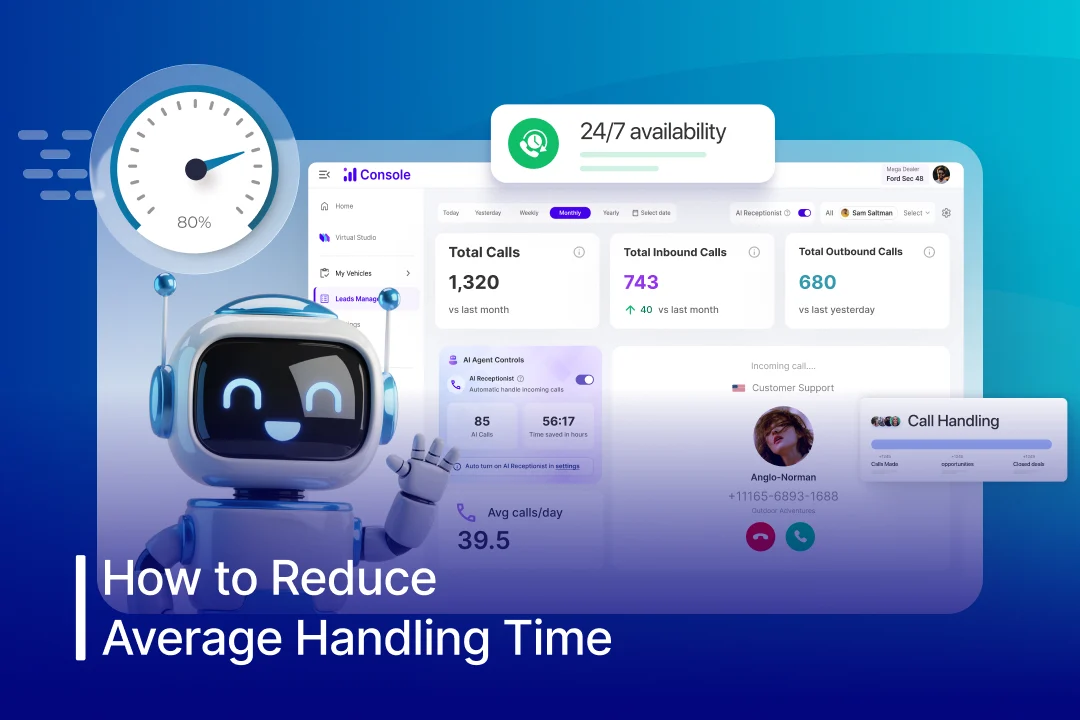

Call centers are constantly looking for ways on how to reduce average handling time (AHT) without sacrificing quality. The cross-industry average handle time (AHT) sits at 6 minutes and 10 seconds, and every extra second can drive up costs, impacting agent capacity, throughput, and operating budgets. Yet, blindly pushing for lower AHT is one of the fastest ways to hurt customer satisfaction (CSAT).
Agents rush to end calls, issues go unresolved, and customers call back, making dashboards look good while repeat contacts rise. In this blog, we deep dive into reducing average handle time the right way by focusing on what’s actually broken: across processes, tools, and information gaps, with proven strategies on how to reduce AHT effectively.
What is Average Handle Time (AHT)?
Average Handle Time (AHT), also referred to as average handling time, is a key contact center metric that measures the total time that an agent spends interacting with a customer on a particular interaction. It covers talk time, hold time, and after-call work (ACW), starting the moment an agent picks up and finishes the call, only when all the post-call activities are completed.
It’s one of the most monitored KPIs in BPOs and call centers since it stands at the crossroads of efficiency and customer experience. Improving AHT means reducing the time to resolution without compromising on quality. That is a fundamentally different objective than just minimizing handle time, which in most cases implies finishing calls in a hurry and leaving problems incomplete. One enhances your call center, the other improves your spreadsheet. Understanding this breakdown is the first step in learning how to reduce AHT without impacting customer experience.
Why Is It Important To Reduce AHT?
High AHT isn’t just an annoying performance metric you run after, but they have ripple operational effects across your team. High AHT in a call center is not a mere metric issue: it represents a multiplied operational burden that affects both costs, customer experience, agent performance, and revenue at the same time. This highlights why understanding how to reduce AHT is one of the most impactful changes a business can implement.
With higher average call handling time, employee expenses boom, queue times skyrocket, and employee burnout accelerates. Each additional minute per call translates to fewer interactions per agent per hour. This translates to either you increase the number of people on staff, or you provide slower service. They are both unacceptable in today’s cut-throat competition. These operational impacts make it critical to understand how to reduce AHT in a way that improves both efficiency and customer experience.
Enhanced Customer Satisfaction (CSAT)
One of the most effective ways to improve CSAT is by understanding how to reduce AHT without compromising resolution quality. Customers who call your business are looking to get their query resolved, so there’s an urgency to it. The more they wait, the more that friction builds to frustration. Reduced AHT translates to fewer seconds on hold, quicker issues being resolved, and an experience that is quantifiably improved, which in turn leads to customer loyalty and repeat business.
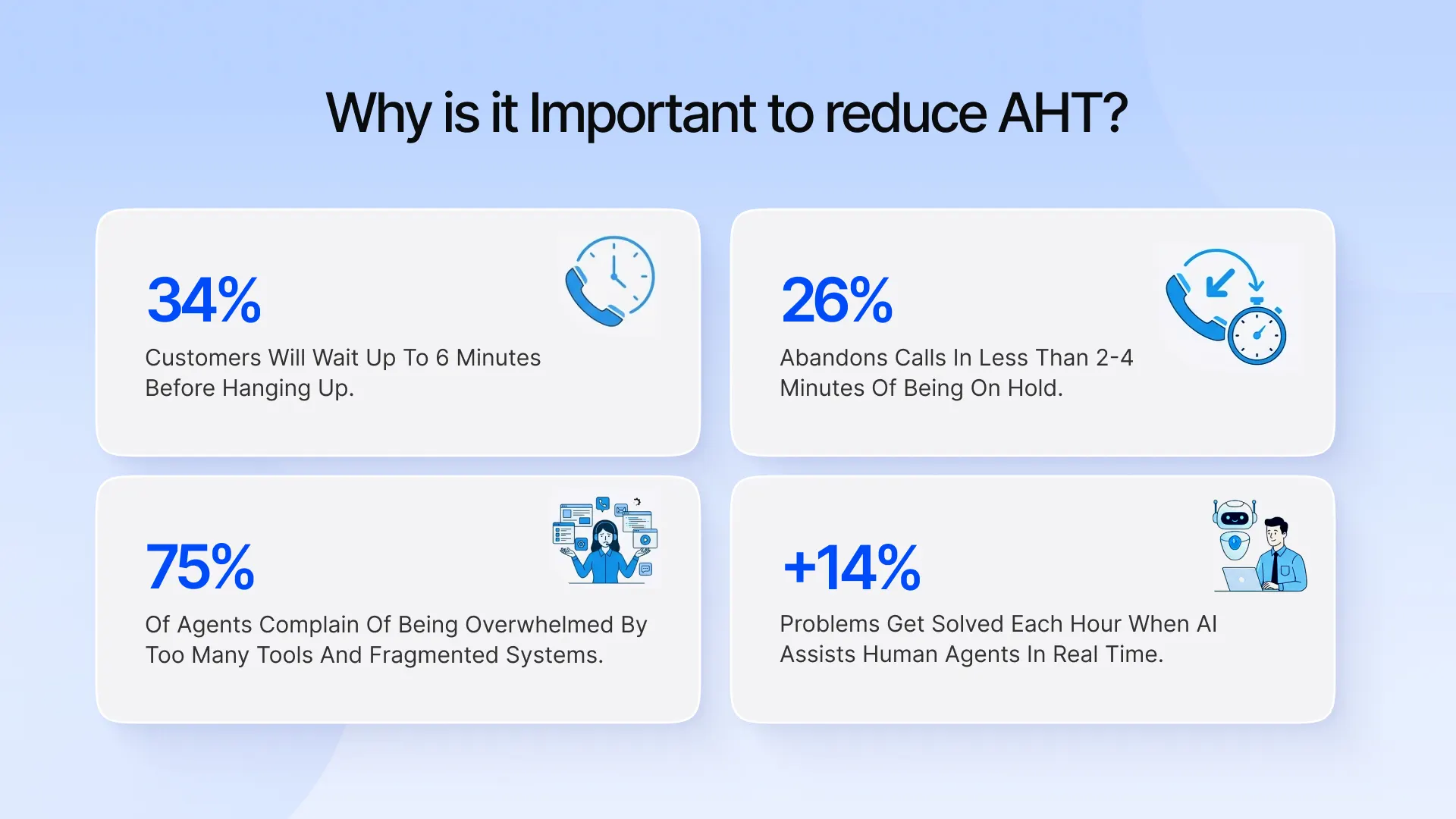
McKinsey claimed that organizations that deployed AI-enabled agents experienced a 9 percent decrease in issue handling time, which can be directly converted into a speedier resolution and higher CSAT scores. One of the most direct levers to enhancing AHT in customer service settings where customer satisfaction (CSAT) scores are a key KPI is improving AHT the right way.
Increased Productivity of the Agents
Streamlining the procedures that make AHT bloated, such as fragmented tools, bloated ACW, and unclear call scripts, will enable the agents to make more calls per shift without exerting more effort. This is the proper version of AHT enhancement, which is that an increase in call center AHT is frequently an indicator of problems in processes and tools rather than problems in agent capabilities.
The most effective way to understand how to reduce AHT is by redesigning processes and not by pressuring agents. Because productivity improves automatically when workflows are optimized.
Improved Agent Morale
Over three-quarters of leaders of call centers report that systems and information overwhelm their agents, according to a report published by Deloitte Digital that surveyed 600 senior leaders of contact centers. CX dive long, inefficient calls, which are caused by disjointed tools and undefined processes, not only harm customers but also scar the individuals dealing with them.
A plan of AHT improvement, eliminating actual friction in the agent workflow, lessens the cognitive load, enhances job satisfaction, and will directly result in the reduction of attrition. The average turnover of agents in 2023 was 52 per cent per year – an expense that most contact centers continually underestimate when they quantify the effect of high AHT.
Reduced Call Abandonment
Queues are inflated by high AHT directly. Customers waiting in the queue of the next available agent wait longer when there are agents who are stuck on longer calls, and they go. According to a 2021 TCN study, 34 percent of callers will wait up to 6 minutes to have an average talk; meanwhile, 26 percent of callers will leave after spending 2-4 minutes on hold.
Every lost interaction, every potential lost customer, and a metric that increases your benchmark of abandonment rate at the same time. It is a lost deal in high consideration and automotive sales settings as well. One of the most direct methods to cut call center hold time is to understand how to reduce AHT, in an attempt to ensure customers in the queue are long enough to obtain a solution.
Reduced Operational Costs
Each additional minute of AHT is directly costly. Increased average handling time of calls implies a reduced number of calls per agent per shift, implying increased headcount requirement or reduced service quality. Even a 30-second per-call improvement compounds into significant savings at scale. This is why learning how to reduce AHT is not just an efficiency play, but a direct lever on cost optimization. AHT is one of the most financially impactful indicators in the business since labor may contribute as much as 95 percent of the operating cost of a contact center.
And the impact compounds. Waiting times increase as customers in the queue are held up as agents engage on longer calls, leaving a pool of dropped calls, re-calls, and negative reviews that appear long after the operational problem was ‘fixed’ on paper.

How Does AHT Impact Customer Satisfaction?
There is no direct correlation between AHT and CSAT, and that’s exactly where most efforts around how to reduce AHT fail.
CSAT is typically calculated as:
CSAT = (Number of satisfied customers ÷ Total responses) × 100
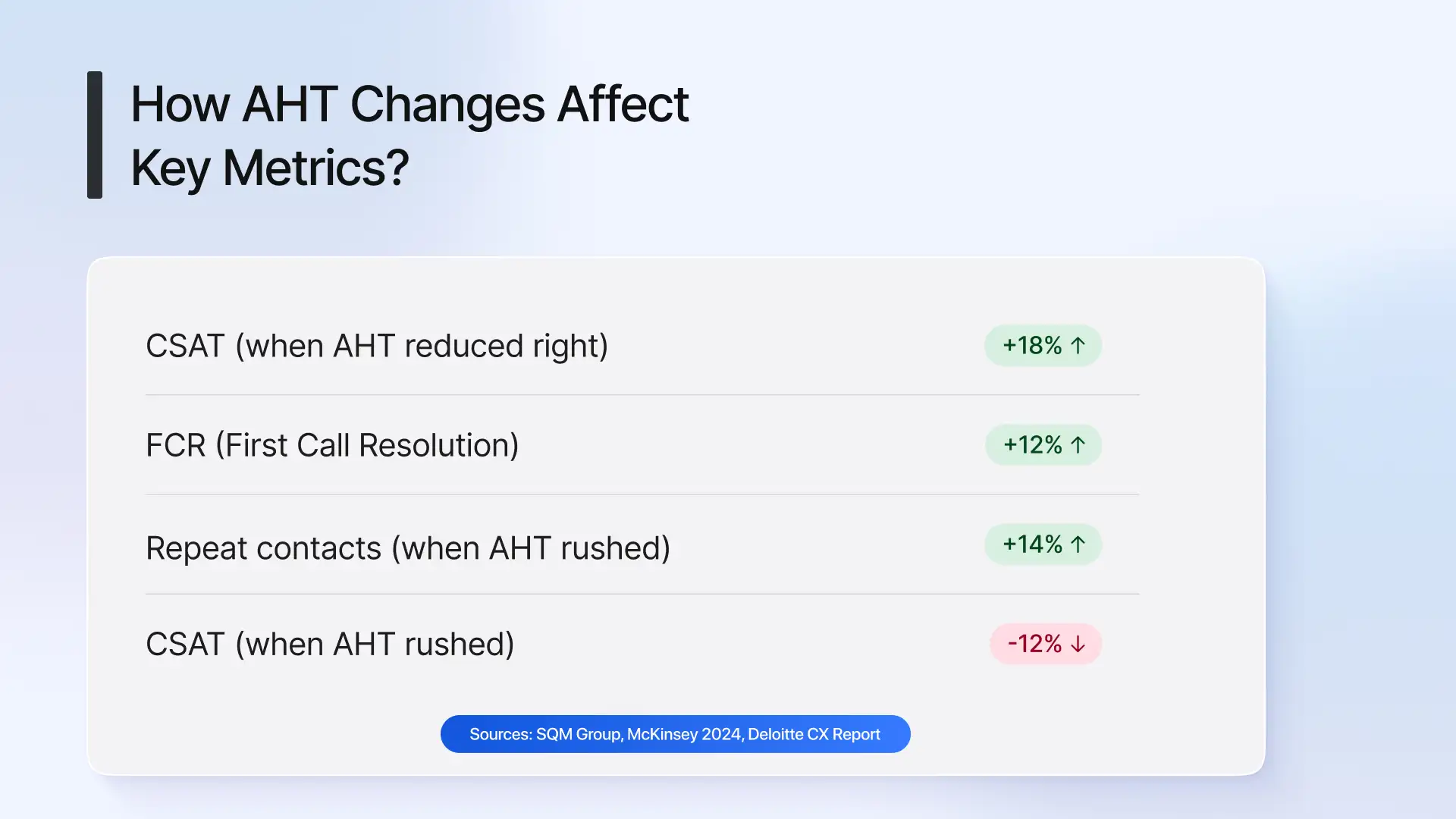
What actually matters is how AHT is reduced. When you reduce AHT by removing process friction and tool inefficiencies, both CSAT and First Call Resolution (FCR) improve because agents spend more time solving problems and not navigating systems. But when agents are pushed to simply finish calls faster, resolution quality drops. Customers call back, repeat contacts increase, and both CSAT and FCR decline.
Key Ways AHT Influences Customer Experience
- Faster Resolution, Higher Satisfaction: Customers value quick and effective resolutions. Lower AHT, when achieved correctly, means issues are resolved faster, leading to a smoother and more satisfying experience.
- Reduced Hold Time and Frustration: Long hold times are one of the biggest drivers of poor customer experience. Optimizing AHT reduces unnecessary delays, keeping customers engaged and less frustrated.
- Fewer Repeat Calls: When issues are resolved correctly the first time, customers don’t need to call back. This directly improves CSAT by reducing effort and frustration.
This shows that AHT impacts CSAT not by how quickly calls end, but by how efficiently and effectively customer issues are resolved. As a result, mastering how to reduce AHT the right way directly leads to better customer experience outcomes.
The 8 Most Common Reasons for a High AHT
Most guides list a dozen generic reasons, but in reality, high AHT usually comes down to a few recurring operational gaps. Identifying these root causes is critical if you want to understand how to reduce AHT effectively instead of just pushing agents to work faster.
1. Training and Knowledge Gaps
Agents who lack in-depth product knowledge or proper training struggle to resolve issues confidently. This leads to longer conversations, frequent holds, and escalations. In most cases, this is not an agent performance issue but a knowledge base and onboarding gap, where agents don’t have quick access to the right answers when they need them.
2. Complex or Technical Issues
Not all calls are equal. High-complexity queries, like technical troubleshooting or multi-step service requests, naturally take longer to resolve. These calls often require deeper probing, step-by-step guidance, and sometimes cross-team coordination. Trying to force shorter handle times here can hurt resolution quality and CSAT.
3. Inefficient Systems and Technology
One of the biggest drivers of high AHT is tool friction. When agents switch between multiple systems to find customer data, it creates dead time within every call. Common issues include slow or glitchy CRM systems, a lack of a unified customer view, and multiple tabs and disconnected tools. This not only increases hold time but also disrupts the flow of conversation.
4. Excessive After-Call Work (ACW)
After-call work is often overlooked but can account for 20-30% of total AHT. Manual tasks like writing notes, updating CRM records, and logging call outcomes add minutes to every interaction, especially at scale.
5. Poor Call Routing
When customers aren’t routed to the right agent the first time, resolution gets delayed. Agents spend extra time re-understanding the issue or transferring the call again. This leads to repeated explanations from customers, longer handle times, and a lower first call resolution (FCR).
6. Excessive Hold Times
Frequent holds are usually a symptom of deeper issues, like poor information access or lack of confidence. Agents often put customers on hold to look up information, consult colleagues, or navigate systems. Each hold adds friction and extends the overall call duration.
7. Lack of Proper Probing
When agents don’t ask the right questions early in the conversation, calls become longer and less efficient. This results in repetitive questioning, misdiagnosed issues, and back-and-forth clarification. Strong initial probing is critical to reducing unnecessary call length.
8. Customer-Related Factors
Sometimes, the cause lies outside operations. Certain customer scenarios naturally increase AHT, such as high-emotion or frustrated callers, language barriers, and cases requiring detailed explanations or education. These interactions require more time and empathy, making them inherently longer.
High AHT in chat processes and BPO environments often compounds the tool friction problem. Agents multi-tasking between chat windows, CRM tabs, and knowledge systems simultaneously without a unified interface can lead to larger losses in the long-term.
8 Common Mistakes to Avoid While Reducing AHT
High AHT is rarely caused by a single issue; it’s usually the result of both operational gaps and strategic missteps. If you focus only on what’s visible, like reducing talk time, without addressing the underlying drivers, AHT will inevitably creep back up. That’s why, when figuring out how to reduce AHT, avoiding these common mistakes is just as important as implementing the right strategies.
1. Prioritizing Speed Over Quality (Speed-First Mentality)
When agents are pushed to close calls quickly, conversations become rushed and ineffective. Issues remain unresolved, leading to repeat calls, lower CSAT, and declining NPS. Reducing AHT should never come at the cost of resolution quality.
2. Treating AHT as a Hard Quota
AHT works best as a diagnostic metric and not a strict target. When used as a hard KPI, agents optimize for speed instead of outcomes, cutting conversations short instead of solving problems. This often leads to lower first call resolution (FCR), higher repeat contact rates, and misleading performance data.
3. Neglecting Root Causes of Long Calls
Many teams try to reduce AHT by focusing only on talk time, ignoring why calls are long in the first place. Common overlooked drivers include inefficient workflows, poor knowledge access, and complex customer issues. Without addressing these, AHT reduction efforts remain temporary.
4. Inefficient Systems and Outdated Technology
Tool friction is one of the biggest contributors to high AHT. Agents switching between multiple systems or dealing with slow, disconnected tools lose valuable time during live calls. Typical issues include multiple logins and tabs, no unified customer view, and manual data entry. This increases hold time and disrupts conversation flow.
5. Inadequate Agent Training and Knowledge Gaps
Agents who lack product knowledge or process clarity take longer to resolve issues. This results in hesitation, frequent holds, and escalations. In most cases, this reflects weak onboarding, poor knowledge base access, or a lack of ongoing training, and not agent capability.
6. Inefficient Processes and Rigid Workflows
Overly complex scripts, unnecessary verification steps, and rigid workflows slow down resolution. Examples include too many approval layers, repetitive questioning, and a lack of clear escalation paths. Instead of guiding agents, these processes create friction and extend call duration.
7. Failure to Use Data and Call Analytics
Without analyzing call recordings or performance data, teams miss critical insights into where time is actually being lost. This includes long silences or unnecessary holds, repeated explanations, and ineffective call handling patterns. Modern contact centers use AI and analytics to identify and fix these inefficiencies proactively.
8. Ignoring Call Drivers and Demand Patterns
High AHT is often a symptom of why customers are calling in the first place. If businesses fail to address poor self-service options, repetitive or avoidable queries, and product or service gaps, they end up handling a higher volume of complex, time-consuming calls.
High AHT isn’t the problem itself; it’s a signal of deeper gaps in your processes, systems, and strategy that need fixing.
How to Calculate Average Handle Time?
The AHT formula is the same whether you’re in a BPO, an inbound call center, or a chat process:
AHT = (Total Talk Time + Total Hold Time + After-Call Work) ÷ Total Calls Handled
Example: If your agents collectively spent 3,000 minutes talking, 600 minutes on hold, and 900 minutes on ACW across 600 calls,
AHT = (3,000 + 600 + 900) ÷ 600 = 7.5 minutes
When calculating AHT in practice, calculate it by call type, not just as a single, overall number, since it can mask massive variation between query categories.
In chat processes, “talk time” becomes “response time.”
Ensure your formula accounts for multi-conversation handling if agents work on simultaneous chats. For AHT in BPO environments with multiple client programs, calculate per-program AHT to benchmark accurately against the right industry standard. Accurate calculation is essential before implementing any strategy for reducing AHT.
Measuring and Tracking Average Handle Time (AHT)
Average Handle Time (AHT) is measured by adding total talk time, hold time, and after-call work (ACW), then dividing it by the total number of calls handled. It’s a critical metric used to improve agent efficiency, reduce customer wait times, and benchmark performance against industry standards (typically around 6 minutes).
AHT Formula Breakdown
- Talk Time: Total time an agent spends actively speaking with the customer
- Hold Time: The time the customer is placed on hold during the interaction
- After-Call Work (ACW): Time spent on notes, CRM updates, and post-call tasks
How to Track AHT Effectively
While calculating AHT once gives you a baseline, continuous tracking is what reveals what’s actually working and what’s not.
- Use Automated Tracking Tools: Leverage CRM and call center software to automatically track AHT and generate reports. This eliminates manual errors and gives you accurate, real-time visibility into agent performance.
- Monitor Individual vs. Team AHT: Track AHT at multiple levels, including agent, team, and department.
- High individual AHT → potential training gaps
- High team AHT → process or system inefficiencies
- Real-Time Monitoring: Use live dashboards to monitor AHT as calls happen. Sudden spikes often indicate routing issues, knowledge gaps, or system delays that need immediate attention.
Build a Strong AHT Measurement Framework
To build a reliable and actionable AHT measurement structure, you need consistent tracking across agents, processes, and metrics.
- Real-time dashboards: Monitor AHT by agent, team, and call type in real time. Spikes signal routing issues or knowledge gaps, so catch them early.
- Trend analysis: Track AHT weekly and monthly to identify patterns like seasonal spikes, script changes, or post-training improvements.
- Agent-level breakdowns: Compare individual AHT against team averages to identify outliers and coaching opportunities.
- Paired metrics: Always track AHT alongside FCR, CSAT, and repeat contact rate. AHT alone never tells the full story.
- Track ACW separately: After-call work often behaves differently from talk time, especially when automation is introduced.
- Call recording reviews: Analyze calls with unusually high or low AHT to identify exact friction points like long holds, repeated explanations, or unclear scripts.
A Simple 30-60-90 Day Tracking Plan
First 30 days: Baseline AHT by call type and identify major gaps
Next 30 days: Implement improvements (routing, scripts, ACW automation) and monitor changes
Final 30 days: Validate results against CSAT and FCR, and refine where needed
8 Top Tips To Improve Average Handle Time
Here are proven strategies that actually move AHT in a meaningful way, especially if you’re looking for how to reduce AHT by fixing root causes and not forcing speed.
1. Fix Call Routing First
Misrouted calls are a double penalty: longer wait times for customers and inefficient handling by agents. Use smart IVR systems and skills-based routing to ensure the right calls reach the right agents from the start. This is one of the most foundational steps in learning how to reduce AHT at scale.
2. Build a Practical, Searchable Knowledge Base
A knowledge base only works if agents can use it during live calls. Focus on fast searchability, up-to-date information, and structured FAQs and workflows. This reduces hold time and improves resolution speed significantly.
3. Implement a Unified CRM System
Switching between multiple tools increases handle time unnecessarily. A single, integrated CRM interface gives agents full customer context instantly. This eliminates repetitive data entry, system toggling, and information gaps. A unified system plays a critical role in reducing AHT by eliminating unnecessary delays during live calls.
4. Automate After-Call Work (ACW)
ACW is one of the easiest areas to optimize. Use auto-summarization, CRM auto-logging, and predefined templates to reduce manual effort and cut minutes from every interaction without impacting conversation quality.
5. Use AI and Real-Time Agent Assistance
AI works best as a co-pilot and not a replacement. Deploy tools that surface relevant information in real time, provide next-best-action suggestions, and use speech analytics to detect bottlenecks. This reduces decision time and improves both AHT and resolution quality. AI-powered assistance is becoming central to reducing AHT in modern contact centers.
6. Invest in Continuous Training and Coaching
Well-trained agents resolve issues faster and more confidently. Focus on product and process knowledge, communication and probing skills, and coaching based on real call recordings, not assumptions. Ongoing training ensures agents handle queries efficiently, improving AHT while maintaining quality. Training builds the foundation for more advanced efficiency tools like AI or self-service.
7. Enable Call Deflection and Self-Service with Conversational AI
Not every query needs a human agent. Effective call deflection strategies reduce repetitive calls, allowing agents to focus on high-value interactions. Deploying AI call handling backed by conversational AI agents helps businesses:
- Handle routine inquiries via IVR, chatbots, or self-service portals
- Surface relevant customer information to agents in real-time
- Provide automated summaries and predictive next steps
- Reduce repetitive tasks like after-call work
As per McKinsey, organizations using these tools have seen up to a 14% increase in resolution per hour and a 9% reduction in time per issue. This approach is key to scaling how to reduce AHT without overloading human agents.
8. Optimize Call Handling and Internal Communication
Efficient conversations are structured conversations. Train agents to ask the right questions early (proper probing), guide the conversation toward resolution, and close calls confidently. At the same time, enable quick internal support via instant messaging with supervisors and real-time escalation support so agents don’t rely on long holds or transfers.
Key Takeaway for Agents: Start by focusing on active listening for the first 30 seconds to correctly identify the query type before deep diving into resolution mode. Misidentifying a caller’s need is the origin and, in this case, a key driver for unnecessary call length at the agent level.
Why Reducing AHT Matters For Dealerships in the Automotive Industry?
Now here’s where generic AHT advice starts to break down and where the stakes get significantly higher. A car dealership isn’t a retail contact center. The calls are high-stakes, high-complexity, and emotionally charged. This makes understanding how to reduce AHT even more critical in automotive environments.
A customer calling about financing on a $45,000 vehicle purchase is not the same as someone checking an order status. Neither is a service appointment call that requires cross-referencing technician availability, parts inventory, and warranty coverage simultaneously.
Automotive call center outsourcing faces a specific combination of problems that inflate AHT hard:
1. Multi-System Lookups
Agents toggle between DMS platforms, inventory systems, service schedulers, and CRM tools to answer a single question. Every system switch adds hold time and customers notice.
2. High Call Variability
Calls range from “What are your service hours?” to complex trade-in valuations and financing queries, with no clean way to segment them at the routing level. One call type takes 2 minutes. The next takes 15.
3. ACW Overload
Post-call notes, appointment entries, and lead logging are done manually; this adds minutes to every interaction across a high-volume call floor. At 200+ calls per day, that’s hours of recoverable time.
4. Missed and Mishandled Calls
When AHT is bloated, agents are stuck on calls longer, and incoming calls get missed. In automotive, a missed call on a vehicle inquiry is a lost deal worth tens of thousands of dollars. With advanced AI systems, you can automate a pipeline that ensures your dealerships never miss a call again.
The result: AHT in automotive runs significantly above the cross-industry average, and traditional call center optimization playbooks built for high-volume, low-complexity retail or telecoms environments weren’t designed for it. You need tools and processes built specifically for automotive complexity. Specialized automotive call center services help you understand how specialized automotive call center outsourcing approaches differ from generic BPO models.
How Spyne Helps Automotive Dealerships Reduce AHT?
Spyne’s conversational AI agent, Vini, is designed specifically to help dealerships understand how to reduce AHT in complex automotive workflows. Vini is trained on automotive data rather than being adapted from a generic contact center template. Here’s how Vini enables dealerships to reduce AHT:
1. Single Data Dashboard for Quicker Access
When agents are switching between different tools, the dealership’s average handling time (AHT) increases due to this to-and-fro, be it for answering a financing question or handling an inventory query. Spyne brings all of this data together within one screen, with one context, and zero hold time.
2. Automated After-Call Work
Post-call logging, appointment entry, and lead capture happen automatically, removing 2-5 minutes of ACW from every interaction without changing how agents talk to customers.
3. Intelligent sRouting for Automotive Query Types
Service appointments, financing queries, trade-in calls, and general inquiries get routed to the right agent or AI handler from the first second, not after a frustrating IVR loop.
4. AI Call Bot for Overflow and After-Hours
Spyne’s conversational AI agent handles routine inquiries through AI, so high-value calls always reach a human, and no lead goes unanswered.
5. 24/7 Real-Time Agent Assist
During live calls, Spyne’s AI call bot for car dealerships surfaces relevant inventory data, service history, and financing options in context, eliminating the holds that inflate AHT on complex automotive queries.
The goal isn’t to rush calls but to remove everything that inflates them unnecessarily so agents can have better conversations in less time, and no lead falls through the cracks because a call ran long. Explore how this works within the context of automotive BPO and business development centers, and what outbound call center KPIs you should be tracking alongside AHT.

Conclusion
Reducing average handle time is one of the most effective improvements a contact center can make, but only when it’s done for the right reasons and with the right tools. The most effective approach to how to reduce AHT is to focus on removing friction and not rushing conversations.
The strategy to lower AHT that actually works involves fixing your routing, consolidating your tools, automating your ACW, coaching with data, and deploying AI as a co-pilot and not a shortcut. Tracking AHT alongside CSAT and FCR at all times and setting benchmarks by call type and not generic data across domains is further necessary.
For automotive businesses, the standard playbook isn’t enough. The complexity of dealership calls comes at high stakes, multi-system, high variability demands purpose-built tooling that removes friction without removing the human quality that closes deals.
AHT is a signal, but resolution quality is the real goal, and that’s where Spyne comes in. By helping dealerships remove operational friction, Spyne enables faster, more effective customer interactions without compromising experience. If you’re looking for how to reduce AHT and improve your customer experience, the next step is simple: book a demo with Vini and see exactly where your time is going.