
| Executive Summary
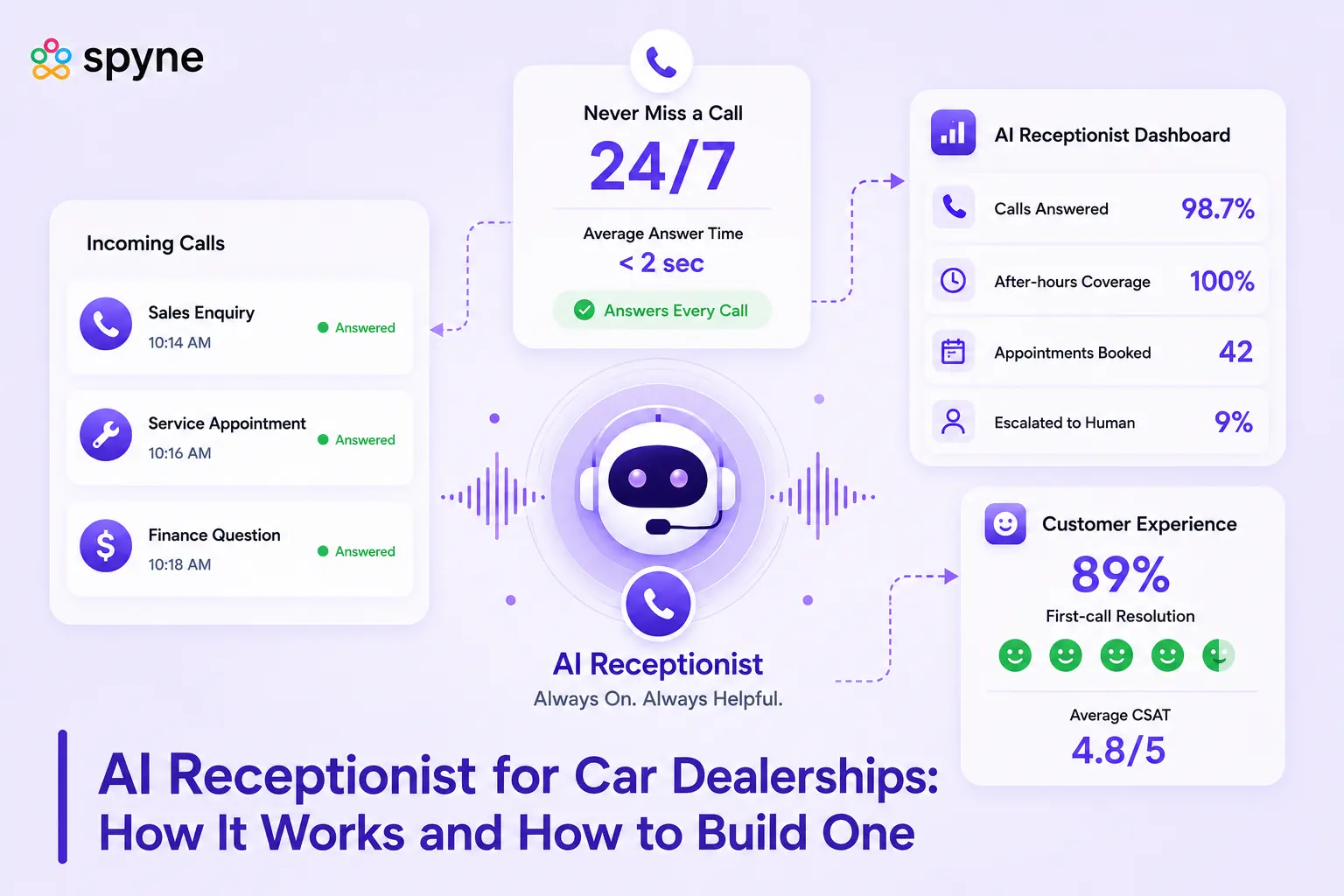
An AI receptionist for a car dealership is a conversational AI system that answers inbound calls, determines intent using natural language understanding, checks live DMS or CRM data, and resolves the request or hands it to a human with full context. Vini AI from Spyne responds in under five seconds and handles 70% of routine sales and service calls without a person on the line. Dealerships lose that revenue by default the moment a call goes to voicemail, since the caller is usually already dialing the next number on their list. |
Introduction
An AI receptionist for a car dealership answers inbound calls in real time, understands what the caller wants using speech recognition and natural language processing, pulls live scheduling or inventory data from the DMS, and either completes the request or routes the call to a live team member. Car Wars tracked roughly 53 million inbound service calls across its dealer network in 2025, and about 19 million were missed opportunities.¹ NADA 2026 data puts the average dealership sales connect score at just 62.39%.² This guide covers what an AI receptionist is, how it routes a call, what missed calls cost your store, how to implement one, how it compares to a human front desk, and how Vini AI closes this gap.
What Is an AI Receptionist for a Car Dealership?
An AI receptionist is a conversational, voice-based AI system that answers dealership phone lines, understands caller intent in natural language, and resolves the request or routes it to the right department with context attached. It is not a phone tree. CDK’s 2025 Service Shopper Study found 28% of service customers struggled to navigate phone menus and 26% got transferred at least once before reaching anyone useful.³
Example: A customer calls at 6:15 PM after service has closed, asking for an oil change on a Tahoe before the weekend. Vini AI checks the actual DMS bay calendar, offers two Saturday slots, locks the pick, updates the RO queue, and texts a confirmation, no one on the service team touches a keyboard.
That DMS-write capability, versus reading from a static script, is what separates a purpose-built dealership system from a retrofitted call-center bot.
How Does an AI Receptionist Actually Answer and Route a Call?
An AI receptionist answers a call, scores the caller’s intent within the first exchange, checks live DMS or CRM data, and either completes the request or transfers it with a summary attached so the customer never repeats themselves. Here is what happens at each stage.
Detecting Intent in the First Exchange
The system parses the caller’s words for intent signals: vehicle mentions, service type, urgency language. Car Wars data shows service calls peak Mondays 10 a.m. to noon, exactly when advisors are also handling walk-ins.⁴
The Live DMS/CRM Query
The AI queries scheduling and inventory systems in real time, a bidirectional write connection, not a read-only calendar. Vini AI can confirm a bay slot, check a VIN, or pull service history mid-call.
Routing and Prioritization Logic
Routine calls, service booking, inventory checks, hours, resolve without a human. High-intent signals, a specific VIN, a repeat caller with an open CRM deal, get prioritized routing to a live salesperson.
Handoff Design That Doesn’t Lose Context
On transfer, the receiving team member gets a text or screen-pop summary of the call. A caller forced to repeat themselves assumes the system failed, even if the AI did its part correctly.
How Much Do Missed Calls Actually Cost Your Dealership?
A missed call is not a neutral event, it is a repair order or a deal that converts somewhere else.
- Revenue per RO: NADA benchmark data puts average service and parts revenue per RO at roughly $466 to $470.⁵
- Industry-wide gap: Car Wars tracked 19 million missed opportunities out of 53 million inbound service calls in 2025, with only about 4 million appointments ultimately booked.¹
- Retention risk: J.D. Power’s 2026 CSI Study found stores hitting all ten measured service KPIs average a 979 satisfaction score, versus 632 for stores meeting only three, keeping customers informed of service status is one of those KPIs, and a missed call fails it before the customer ever reaches the lane.⁶
- Advisor bandwidth: the same study found 64% of customers want photo or video documentation during service, yet only 26% of mass-market customers get it, a sign advisor time is going to phone intake instead of the communication that drives retention.⁶
- Do the math on your own store: weekly missed calls × average RO value × 52. Most principals are surprised by the annual number once they actually run it.
How Do You Build or Implement an AI Receptionist at Your Dealership?
You implement an AI receptionist by scoping which call types go to AI versus a human, integrating it with your CRM and DMS through bidirectional write access, setting explicit escalation rules, training it on your dealership’s actual scripts and inventory, and running a supervised live period before full handoff.
- Audit two to four weeks of actual call reasons. Pull call tracking data or advisor notes to see what your calls are really about: service scheduling, status checks, sales inquiries, parts, recalls. CDK’s 2025 Service Shopper data shows 58% of service appointments are still booked by phone, so this channel carries real volume, not a shrinking edge case.³
- Define call types for AI versus human, in writing. Most dealerships start narrow: after-hours coverage only, or routine service scheduling only. Expansion happens once the AI proves out on the first use case.
- Integrate CRM and DMS with bidirectional write access. Confirm the system can write appointment confirmations and update repair orders directly. Verify compatibility with Xtime, CDK, Reynolds & Reynolds, VinSolutions, or DealerSocket.
- Set escalation rules before go-live. Decide explicitly what always routes to a human: billing disputes, trade-in negotiations, any customer complaint. Document these rules so the whole team has signed off, not just IT.
- Train on dealership-specific inventory and scripts. Feed the system your current service menu, live promotions, and the specific phrasing your team uses. A retrofitted call-center bot sounds wrong on real dealership calls because it was never trained on this vocabulary.
- Run a supervised live period, then expand. Vini AI’s standard rollout includes a supervised window where the system handles real calls with human monitoring before full autonomous deployment. Review call recordings weekly for the first month before expanding to more call types.
Dealerships that follow this order avoid the two failure modes that show up most often: an AI mishandling a call type it was never scoped for, and a demo-tested integration that breaks under real production call volume.
What’s Better: Human Receptionist or AI Receptionist?
Neither replaces the other outright. An AI receptionist wins on coverage, consistency, and cost per call. A human wins on emotionally complex or high-stakes conversations. The dealerships getting the best results run both, with AI absorbing volume and routine intake so the team’s time goes toward conversations that need a person.
| Factor | Human Receptionist | AI Receptionist |
| Coverage hours | Limited to shift hours | 24/7, including nights, weekends, holidays |
| Simultaneous calls | One at a time | Hundreds at once |
| Consistency | Varies with mood, training, staffing gaps | Same script quality on call one and call one thousand |
| Response speed | Depends on staffing and call volume | Sub-five-second answer, no hold queue |
| Cost structure | Salary, benefits, turnover, training | Flat or usage-based, scales with call volume |
| DMS/CRM data entry | Manual, prone to gaps or delay | Automatic, logged in real time |
| Language coverage | Limited to staff on shift | Multilingual by default in most platforms |
| Peak-hour reliability | Breaks down under simultaneous demand | Same performance at 10 a.m. Monday or 2 a.m. Sunday |
| Onboarding time | Weeks of hiring and training | Days to a few weeks of integration and training |
| Complex or emotional calls | Strong | Requires handoff to a human |
| Setup effort | Minimal, but ongoing payroll cost | Upfront CRM/DMS integration and training |
If your objection is “we prefer humans answering phones,” most dealerships that raise this start with after-hours coverage only, the lowest-risk entry point, since no daytime call ever touches the AI until the team is comfortable. Once they see it recovering calls that would have gone straight to voicemail anyway, they expand it. It is additive coverage, not a replacement for the team.
How Does Vini AI From Spyne Solve These Problems?
Every gap covered above, missed after-hours calls, inconsistent phone menus, lost context on handoff, is exactly what Vini AI is built to close.
- Answers in under five seconds. No hold music, no queue. Vini AI picks up on connection and handles the exchange in real time, matching the response speed data shows dealers need to keep a caller from dialing the next store.
- Handles 70% of routine sales and service calls autonomously. Oil changes, hours, inventory checks, and basic scheduling get resolved without pulling a service advisor or salesperson off the floor.
- Writes directly into the DMS, not just reads from it. Appointment confirmations and RO updates happen in real time, the same bidirectional integration distinction covered earlier in this guide.
- Passes full context on every handoff. When a call escalates to a human, the team member receives a summary of what the caller already said, so nobody repeats themselves.
- Runs a supervised go-live period by default. Vini AI’s implementation includes human-monitored live calls before full autonomous handoff, addressing the “we’re not sure about AI quality” objection directly rather than asking dealers to take it on faith.
- Proven at scale. Paragon Honda recovered $310,000 in missed opportunities in a single week after deploying Vini AI, a concrete outcome rather than a projected estimate.
Vini AI does not replace the BDC. It absorbs the after-hours and overflow volume so BDC staff spend their time on engaged, qualified buyers instead of answering every incoming call.
What Should You Look for When Choosing an AI Receptionist for Your Dealership?
Most products marketed broadly as “AI receptionist” were built for call centers, healthcare, or general small business and adapted for automotive afterward. Use this checklist before signing with any vendor:
- Bidirectional DMS/CRM write access, not read-only calendar checks. Confirm it can write appointment confirmations and update ROs, not just read a static schedule.
- Sub-five-second response time, verified under real call volume, not demo conditions.
- Automotive-specific training, not a retrofitted general-purpose script. Ask what the system was originally built to handle.
- VIN-aware conversation handling, so a recall or inventory question gets a real answer instead of a canned response.
- A defined supervised go-live period, rather than an immediate full handoff on day one.
- Recordings of real dealership calls, not scripted demos. Insist on hearing how the system handles a noisy, unusual, or off-script request.
- Warm handoff design, confirmed to pass full call context to the receiving human, not a blind transfer.
For a side-by-side breakdown of how leading platforms perform against these criteria, see the full comparison of AI receptionist platforms for dealerships.
Closing Thoughts
Every missed call is a repair order, a test drive, or a sold unit that walked to the next dealership on the caller’s list. Run the math from the cost section above against your own call volume and the number stops being abstract fast. Building an AI receptionist is not about replacing your front desk. It is about making sure the phone stops being the weakest link in an otherwise well-run dealership. See what Vini AI recovers in your first week of missed calls: book a demo with Spyne.