
| AI is becoming a practical part of dealership sales, helping teams respond to leads faster, maintain follow-up, qualify shoppers, and create more appointment opportunities. In 2026, platforms such as Spyne Vini AI, Fullpath, Gubagoo, Matador, and Conversica take different approaches to dealership sales automation. The right choice depends on your dealership’s lead volume, existing technology stack, sales process, and the specific bottlenecks you need to solve. More importantly, dealers should evaluate AI against measurable outcomes such as response coverage, qualified leads, appointment-set rates, show rates, and sold units. This guide compares leading AI platforms for dealerships, their core sales capabilities, ideal use cases, and the factors dealers should consider before choosing one. |
For dealerships, selling more cars is often less about generating additional leads and more about what happens after a shopper raises their hand. A lead that waits too long for a response, receives inconsistent follow-up, or never gets a clear path to an appointment can become a lost opportunity.
AI is changing how dealerships manage those moments. Sales teams can use AI to respond to inquiries, answer routine vehicle questions, qualify buyers, continue conversations after hours, and keep follow-up moving without adding the same workload to their sales or BDC teams.
But every AI platform works differently, and more features do not necessarily mean better sales results. This blog compares the leading AI sales platforms for car dealerships, what each platform offers, where they fit best, and how dealers can evaluate them against real sales outcomes.
Why Are Dealerships Using AI to Sell More Cars?
Dealerships are using AI to improve the speed, consistency, and coverage of customer engagement. The most valuable applications sit close to revenue, including lead response, qualification, follow-up, appointment setting, missed-call recovery, and reactivation.
Cox Automotive’s August 2026 AI in Auto Retail Tracker found that 82% of dealers use AI today. Forty percent use AI to automate routine or complex tasks, while another 40% use it to coordinate customer follow-up.
However, adoption does not automatically translate into revenue.
Cox found that 69% of dealers expect AI to contribute to sales or revenue growth, but only 22% of AI users currently report seeing sales or revenue growth from their AI investments.
Where AI Can Remove Sales Friction
A dealership AI platform can take responsibility for repetitive work such as:
- Responding to new internet leads
- Answering routine vehicle questions
- Capturing buying preferences
- Following up with unresponsive prospects
- Re-engaging older leads
- Coordinating test drives
- Handling after-hours inquiries
- Recording conversation context
- Routing high-intent shoppers to employees
For dealerships evaluating this category, AI sales assistants for car dealerships can help explain where conversational AI fits into the sales funnel.
What Should an AI Sales Platform Actually Do for a Dealership?
A dealership AI platform should handle repeatable customer interactions while giving salespeople better information when human involvement becomes necessary. The system should connect to dealership data, maintain context, and move shoppers toward a measurable next step.
1. Respond to Leads Quickly
A useful platform should engage new inquiries without waiting for a salesperson to become available. Speed matters, but the response also needs to be relevant to the shopper’s question, vehicle, and buying context.
2. Understand the Vehicle
AI should work with dealership-approved inventory information rather than guessing about vehicles.
Useful information can include:
- VIN
- Stock number
- Make and model
- Trim
- Mileage
- Listed features
- Published pricing
- Availability
- Similar vehicles
3. Qualify the Buyer
The system should capture information that changes the salesperson’s next action.
Useful qualification signals include:
- Vehicle of interest
- Purchase timeline
- Trade-in interest
- Financing interest
- Preferred appointment time
- Specific vehicle questions
- Buying intent
4. Maintain Follow-Up
Many sales opportunities require multiple interactions. AI can keep appropriate follow-up moving when salespeople are busy or when a prospect stops responding.
5. Book the Next Step
The system should make it easy for a qualified buyer to move toward a test drive, showroom visit, phone conversation, or another dealership-defined next step.
6. Know When to Hand Off
AI should not attempt to answer every question. It should recognize situations requiring human involvement and transfer the conversation with useful context instead of forcing the customer to start again.
Which AI Platforms Help Car Dealerships Sell More Cars Faster?
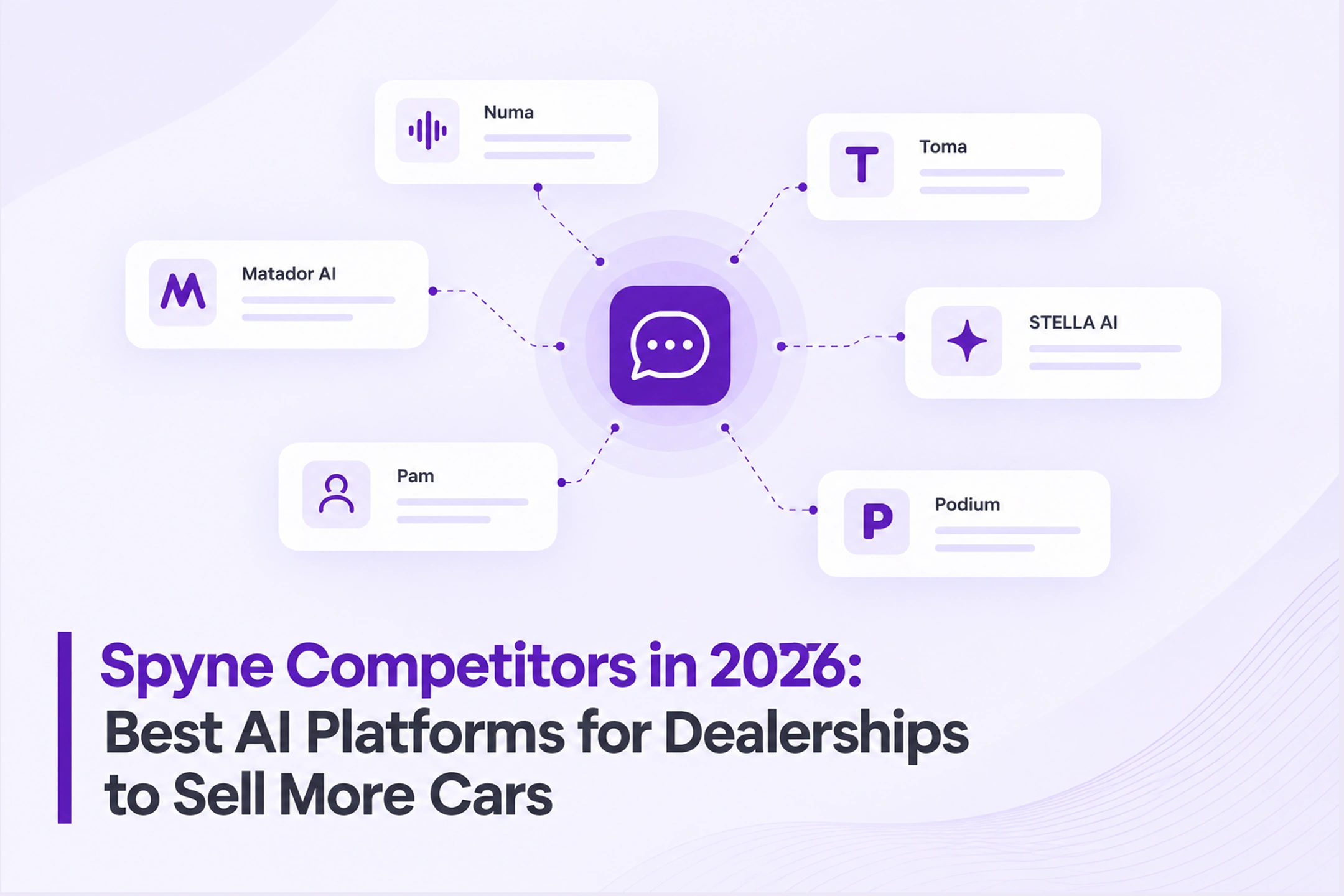
The leading platforms take different approaches to dealership sales automation. Vini AI emphasizes dealership-specific conversational workflows, Fullpath combines lead handling with customer data, Gubagoo connects customer intelligence with conversational and retailing tools, Matador focuses on lead response and follow-up, and Conversica supports automated sales and service conversations.
1. Spyne Vini AI: Built for Dealership Sales Engagement
Vini AI is Spyne’s conversational AI platform for dealership customer interactions. It helps dealerships engage leads, qualify buyers, answer supported vehicle questions, continue follow-up, and coordinate appointments across voice, SMS, chat, and other customer touchpoints.
Vini AI is designed to support dealership teams with:
- 24/7 lead engagement
- Inbound and outbound conversations
- Buyer qualification
- Vehicle and inventory questions
- Lead follow-up
- Appointment conversations
- Customer routing
- CRM-connected workflows
- Voice, SMS, and chat interactions
Vini can respond to inquiries around the clock, qualify leads, route high-intent prospects, and continue follow-up when a salesperson is unavailable.
Spyne also reports a 99.9% connect rate and a 33% lead-to-visit rate across its AI offering.
Where Vini Fits in the Sales Process?
Vini handles the repetitive conversation and workflow steps that often happen before a salesperson’s time creates the most value.
That can include:
- Engaging a new inquiry
- Understanding what vehicle the shopper wants
- Answering supported inventory questions
- Capturing buying intent
- Following up with prospects
- Moving appointment conversations forward
- Recording customer context
- Routing conversations that require human judgment
Dealerships can also explore Vini AI for dealerships to see how the platform supports sales, service, BDC, parts, and finance conversations.
For dealerships looking at AI beyond customer conversations, AI for car dealerships covers how Spyne brings conversational AI and dealership workflows together.
2. Fullpath: Best for AI Lead Handling and Customer Data
Fullpath’s current Lead Handling Agent uses AI to intake, engage, and qualify incoming dealership leads through SMS and email, with the goal of starting immediate follow-up and setting appointments. Its broader Agentic CRM also connects AI workflows with customer, inventory, and performance data.
Where Fullpath Stands Out
Its current AI ecosystem includes:
- Lead Handling Agent
- Task Builder Agent
- Omni Agent
- Voice Agent
- Agentic CRM
Fullpath’s Lead Handling Agent can engage incoming leads, qualify shoppers, attempt to set appointments, and allow dealership employees to step into conversations when human involvement is needed.
Best Fit
Fullpath is particularly relevant for dealer groups that want AI engagement closely connected to customer data and CRM workflows.
3. Gubagoo: Best for Conversational Commerce and Digital Retailing
Gubagoo combines conversational customer engagement with digital retailing and customer-data capabilities. Its Curator platform is designed to connect dealership data, identify high-intent shoppers, and activate customer information across sales and marketing workflows.
Key Capabilities
Gubagoo’s current platform includes capabilities around:
- Customer data unification
- AI-powered automation
- Website conversations
- Digital retailing
- Virtual retailing
- Customer engagement
- Lead handling
- Audience activation
Gubagoo’s 2026 product updates also emphasize identifying high-intent shoppers through website behavior and using that information to support sales engagement.
Best Fit
Gubagoo is worth considering for dealerships that want conversational engagement closely connected to website shopping and digital retailing.
4. Matador AI: Best for Fast Lead Response and Follow-Up
Matador’s current sales platform is built around AI Engage, AI Reply, and AI Follow-Up. These agents are designed to handle the first interaction with new leads, continue live conversations, move shoppers toward appointments, and revive quieter opportunities.
What Matador Emphasizes
Matador currently highlights:
- 30-second first response to internet leads
- AI-powered replies
- Automated follow-up
- Appointment engagement
- Lead reactivation
- Chat AI
- CRM integrations
Matador reports an 86.4% show rate on Matador-set appointments. That is a company-reported result rather than an independent industry benchmark.
Best Fit
Matador is particularly suited to dealerships where lead response and persistent follow-up are the primary sales bottlenecks.
5. Conversica: Best for Automated Sales and Service Conversations
Conversica’s automotive offering focuses on AI-powered customer conversations across areas including sales, service, and finance. Its newer 2026 positioning also emphasizes connecting customer, vehicle, sales, service, and conversation data to identify and activate revenue opportunities.
Where Conversica Fits
Its automotive use cases include:
- Sales lead engagement
- Lead nurturing
- Appointment scheduling
- Service engagement
- Customer reactivation
- Finance-related conversations
- Human escalation
Best Fit
Conversica is most relevant for organizations looking for an established AI conversation platform that can support multiple dealership workflows.
How Should Dealerships Compare AI Sales Platforms?
Dealerships should compare AI platforms against measurable sales problems rather than comparing feature lists. A platform that handles more channels is not automatically better than one that improves appointment conversion on the dealership’s highest-value lead sources.
Use This Evaluation Framework
| Area | Questions to ask |
| Lead response | How quickly does AI engage a new lead? |
| Coverage | What percentage of leads can it actually work? |
| Qualification | Does it capture information the salesperson can use? |
| Inventory | Can it access current dealership inventory? |
| Follow-up | How does it handle prospects who stop responding? |
| Appointments | Can it coordinate real dealership availability? |
| Handoff | What information reaches the salesperson? |
| Integration | Does it connect with the dealership’s CRM and DMS? |
| Reporting | Can management measure downstream outcomes? |
| Controls | Can the dealership define escalation and response rules? |
Test the Platform With Real Dealership Scenarios
A polished demo can hide operational problems. Before choosing a vendor, dealerships should test the platform using scenarios that reflect what sales teams actually handle.
Test:
- A new vehicle inquiry
- A vehicle availability question
- A pricing question
- A trade-in question
- An after-hours lead
- An unresponsive lead
- An appointment request
- A question requiring human escalation
The evaluation should focus on whether the system responds correctly, maintains context, follows dealership rules, and hands off the conversation cleanly.
What Should AI Handle, and What Should Salespeople Handle?
AI should handle repetitive communication, while salespeople should own conversations where judgment, negotiation, or relationship-building materially affects the outcome. The objective is not to remove people from the sales process. It is to reserve their time for interactions where human involvement creates more value.
AI Is Well Suited For
- First response
- Basic vehicle questions
- Lead qualification
- Appointment coordination
- Follow-up reminders
- Lead reactivation
- After-hours coverage
- Conversation summaries
- Routine status questions
Salespeople Should Own
- Negotiated pricing
- Complex trade discussions
- Deal structure
- Financing decisions
- Credit-sensitive questions
- Difficult objections
- Policy exceptions
- High-value negotiations
- Relationship-driven conversations
The Handoff Is the Critical Point
A salesperson should not receive a lead with nothing more than a name and phone number. A useful handoff should include:
- Customer name
- Vehicle of interest
- Questions already answered
- Buying timeline
- Trade-in information
- Appointment status
- Unresolved questions
- Conversation history
- Recommended next action
This is where AI lead conversion for car dealerships becomes more than automated messaging. The system has to help the salesperson continue the conversation rather than restart it.
How Should AI Handle Inventory, Pricing, and Offers?
AI should answer vehicle questions using current, dealership-approved information and escalate questions that require judgment or authorization. Inventory accuracy is particularly important because an incorrect answer can damage customer trust before the salesperson ever enters the conversation.
AI Can Support
- Vehicle availability
- VIN and stock information
- Trim and feature questions
- Published pricing
- Approved promotions
- Similar inventory
- Appointment availability
Human Teams Should Usually Handle
- Negotiated discounts
- Unpublished offers
- Trade valuations
- Complex financing
- Payment commitments
- Credit-specific decisions
- Deal structure
- Policy exceptions
The rule should be simple: AI can explain approved information, but it should not invent dealership policy or make commitments the dealership has not authorized.
How Should Dealerships Measure AI Sales Performance?
Dealerships should measure AI using the same sales outcomes they use for other lead sources. Conversation volume, message count, and response speed are useful operational metrics, but they do not prove that AI is producing revenue.
Core Metrics to Track
| Metric | Why it matters |
| Lead coverage | Shows how many opportunities AI actually works |
| Response time | Measures speed to meaningful engagement |
| Contact rate | Shows whether conversations become two-way |
| Qualification rate | Measures useful buyer information captured |
| Appointment-set rate | Connects conversations to store visits |
| Show rate | Measures appointment quality |
| Human handoff rate | Shows where AI needs employee involvement |
| Sold rate | Connects AI-worked leads to revenue |
| CRM accuracy | Measures quality of operational data |
| Cost per sold unit | Helps establish financial ROI |
Cox Automotive’s 2026 research provides an important warning. While 69% of dealers expect AI to drive sales or revenue growth, only 22% of AI users currently report seeing those outcomes.
That makes measurement critical. Dealerships should establish a pre-AI baseline and compare performance using the same lead sources, definitions, and sales outcomes after deployment.
How Does Vini AI Fit Into a Dealership Sales Workflow?
Vini AI is designed to handle the repetitive conversations that happen before and between higher-value salesperson interactions. It can engage inbound and outbound leads, qualify buyers, answer supported inventory questions, continue follow-up, coordinate appointments, and maintain customer context across dealership conversations.
A Typical Sales Use Case
A shopper submits an inquiry about a vehicle after dealership hours.
Vini can:
- Respond to the inquiry
- Identify the vehicle the shopper is interested in
- Answer supported questions using dealership information
- Capture buying intent
- Continue appropriate follow-up
- Offer an appointment
- Escalate questions requiring human judgment
- Preserve conversation context for the dealership team
The salesperson can then enter the conversation with useful information already captured.
Dealerships focused on phone opportunities can also explore AI voice agents for dealership sales teams to see how AI can support inbound and outbound conversations. For stores focused heavily on website engagement, automotive chat solutions can help capture shoppers while they are actively researching inventory.
What Should Dealerships Ask Before Buying AI?
Dealerships should ask vendors how the AI behaves in real dealership scenarios, not simply what features appear on a product page. The most important questions involve data access, escalation, integrations, response accuracy, reporting, and how the system affects the existing sales team’s workflow.
Sales Workflow
- How does the system respond to a brand-new lead?
- What happens when the customer stops responding?
- How does it identify high-intent shoppers?
- How does it handle after-hours inquiries?
Inventory
- Does the AI access live inventory?
- How often is inventory information refreshed?
- What happens when a vehicle sells?
- Can it recommend comparable vehicles?
Human Handoff
- What triggers an escalation?
- Does the salesperson receive the full conversation?
- Can managers define escalation rules?
- Can employees take over conversations directly?
Technology
- Which CRM systems are supported?
- Which DMS systems are supported?
- Does the platform write information back?
- What reporting is available?
Business Impact
- Which dealership KPIs can the platform improve?
- How is ROI measured?
- What baseline should the dealership establish?
- Which results are independently verified versus vendor-reported?

Conclusion
The best dealership AI platform is not necessarily the one with the most automation. It is the one that improves the specific parts of the sales funnel where opportunities are being lost. In 2026, that often means faster lead response, stronger qualification, consistent follow-up, better appointment coverage, accurate inventory conversations, and cleaner human handoffs. Vini AI, Fullpath, Gubagoo, Matador, and Conversica approach these problems differently, so dealerships should evaluate each against their existing technology stack and sales process. The goal is simple: give every serious buyer a timely, relevant next step while allowing salespeople to focus on conversations where human expertise drives the deal. Book a demo with Spyne to see how Vini AI can fit into your dealership’s sales workflow.
Inclusion does not imply endorsement, partnership, sponsorship, collaboration, certification, or affiliation with Spyne unless explicitly stated. Third-party product capabilities and performance claims may change over time and should be independently evaluated by dealerships before making purchasing decisions.