
| Executive Summary: AI service bookings fail when the customer conversation and the dealership’s authoritative scheduler stop sharing the same appointment state. Reliable booking requires the AI to retrieve current availability, identify the correct customer and vehicle, submit the appointment, receive a successful system response, and preserve that record through rescheduling or cancellation. Failed write-back can create false confirmations, while disconnected channels or weak customer matching can create duplicates. Because 61% of dealership service appointments are still booked by phone, dealers should evaluate AI on booking integrity, scheduler synchronization, duplicate prevention, and failure handling, rather than voice quality or appointment-setting claims alone. |
A customer can hear “your service appointment is confirmed” while the dealership scheduler shows something different. That risk matters at scale: NADA says U.S. franchised dealers wrote more than 276 million repair orders and generated over $164 billion in service and parts sales in 2025. Meanwhile, CDK reports that 61% of service appointments are still booked by phone, where 29% of shoppers report scheduling difficulty.
As dealerships add AI to calls, chat, text, and web scheduling, booking accuracy becomes an integration problem. This article explains how DMS and scheduler connections work, why duplicate and shadow appointments appear, what causes write-back failures, and how dealers should test AI scheduling before launch.
Why Service Booking Accuracy Matters More in 2026
Service scheduling sits inside one of the dealership’s largest revenue operations. NADA reports that America’s 16,990 franchised light-vehicle dealerships completed more than 276 million repair orders in 2025, with service and parts sales exceeding $164 billion.
The fixed-ops opportunity is growing, but retention is under pressure. Cox Automotive’s 2026 Fixed Operations and Ownership Study found average dealer service and parts revenue reached $9.23 million per store, up 33% since 2018. Yet dealerships’ share of service visits fell from 33% to 29% during the same period.
Scheduling friction is part of that customer experience. CDK reports:
- 61% of customers book service appointments by phone.
- 29% of service shoppers experienced difficulty scheduling by phone.
- Average dealership service hold time reached 9.3 minutes.
Pied Piper’s 2026 Service Scheduling Effectiveness Study adds another useful benchmark. Researchers submitted 4,163 service requests across every dealership within 31 large U.S. dealer groups, measuring more than 40 phone and website scheduling behaviors.
The question for dealers is therefore larger than whether AI can answer service calls. Can it convert that conversation into one valid appointment that exists inside the dealership’s actual scheduling environment?
How Does a Dealership AI Virtual Assistant Connect to the DMS for Scheduling?
A dealership AI virtual assistant connects to the system controlling service appointments through APIs or supported integration layers. That system may be the DMS itself, a DMS-native scheduling module, or a separate service scheduler connected to the dealership’s core systems.
This distinction matters because “DMS integration” does not automatically tell a dealer where appointment availability originates or where bookings are finally created.
A typical service appointment requires the AI to:
- Identify the customer’s service request.
- Retrieve or collect customer and vehicle details.
- Query the connected scheduling system for available times.
- Present eligible appointment options.
- Submit the customer’s selected appointment.
- Receive an acceptance or failure response.
- Confirm the booking only after the system accepts it.
- Record relevant activity in connected dealership systems.
The most important distinction is between capturing appointment intent and creating an appointment. An AI that records “customer wants Friday at 10:00” inside a CRM note has captured intent. An AI that successfully creates Friday at 10:00 inside the service scheduler has completed the booking.
For more detail on how dealership systems exchange customer and operational data, see Spyne’s guide to CRM and DMS integration.
How Vini AI Handles Dealership Service Scheduling
Vini AI is Spyne’s conversational AI platform for dealership workflows across phone, text, and web. Spyne publicly documents service functionality including appointment scheduling, real-time rescheduling, service reminders, and post-service follow-up.
For supported service implementations, Vini can:
- Handle inbound service conversations.
- Identify service and scheduling intent.
- Retrieve available appointment options through supported integrations.
- Book service appointments.
- Support real-time rescheduling.
- Manage service reminders.
- Continue post-service follow-up.
- Maintain relevant interaction context across supported channels.
- Synchronize appointment and customer information through supported dealership integrations.
Spyne documents more than 50 CRM and DMS integrations across its scheduling ecosystem, including platforms such as CDK, Reynolds & Reynolds, Tekion, VinSolutions, DealerSocket, and Xtime. Exact service actions should still be verified for each dealership configuration before rollout.
What Does “Confirmed” Actually Mean for an AI Service Appointment?
An AI service appointment should be considered confirmed only after the dealership system responsible for the appointment accepts the transaction.
Several stages can occur during one booking:
| Booking stage | What it means |
| Customer requests Tuesday at 10:00 | Preferred time captured |
| AI finds Tuesday at 10:00 | Slot appears available |
| Customer selects the time | Customer intent confirmed |
| AI submits appointment | Booking is being attempted |
| Scheduler accepts appointment | Appointment exists |
| Successful booking state returns | Customer can be told it is confirmed |
This difference matters because availability can change during the conversation.
Pied Piper found that customers of top-performing dealer groups could schedule an online appointment less than one week out 93% of the time, compared with 73% among the lowest-performing groups.
Consider a customer requesting Tuesday at 10:00. The AI retrieves that slot, but another customer books it online before the first transaction completes.
If the scheduler rejects the second request, the AI should offer another time. If it has already told the customer they are confirmed, the dealership has created a false confirmation.
That distinction should be part of every dealership AI acceptance test.
What Is the Difference Between DMS-Native and Third-Party Service Scheduling?
DMS-native scheduling operates within or closely alongside the dealership’s core DMS environment. Third-party scheduling runs through a separate service application that exchanges information with dealership systems.
| Area | DMS-native scheduling | Third-party scheduling |
| Appointment environment | Core DMS ecosystem | Separate service platform |
| Customer data | Usually tightly connected | Retrieved through integrations |
| Synchronization | Fewer external handoffs | Dependent on integration quality |
| Configuration | Defined by DMS environment | Often more specialized |
| Integration risk | Fewer separate systems | Additional API and mapping dependencies |
Neither architecture automatically produces better bookings.
What matters is whether the dealership can answer five questions:
- Which system owns current appointment availability?
- Where must the final booking be created?
- Where are customer and vehicle records stored?
- Which system manages appointment changes?
- Where should conversational outcomes be recorded?
This is why dealerships should not treat the DMS, CRM, and service scheduler as interchangeable terms.
That distinction becomes especially important when an AI BDC handles both sales and service calls. Sales and fixed-ops appointments use different calendars, data requirements, routing rules, and outcomes.
Why Do AI Service Bookings Create Duplicate Appointments?
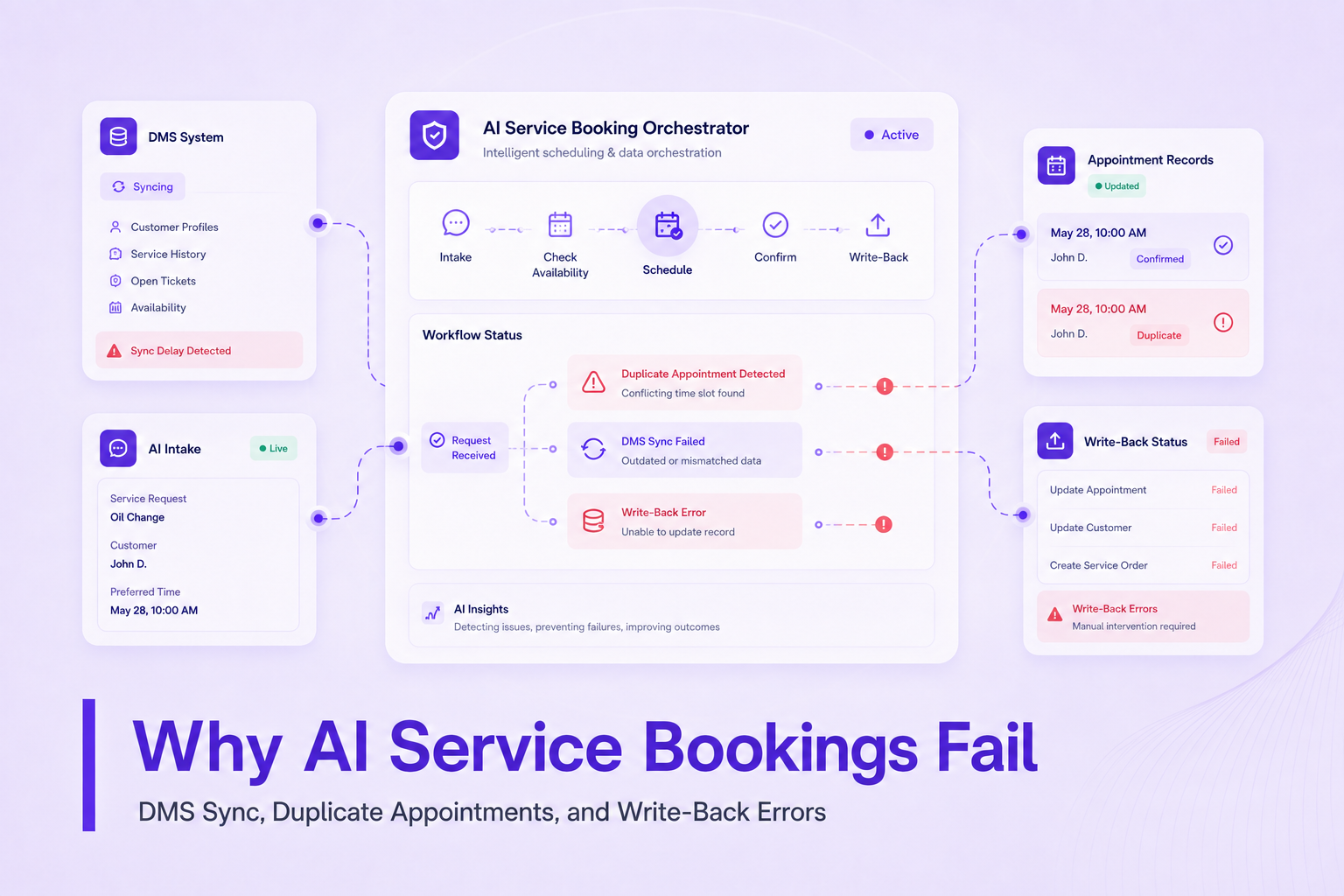
Duplicate service appointments occur when separate systems create multiple active bookings for the same customer and service request instead of maintaining one authoritative appointment record.
Common causes include:
- Website and phone channels using different availability.
- AI creating a booking outside the primary scheduler.
- Retry logic submitting the same transaction twice.
- Delayed synchronization between systems.
- Failure to match an existing customer or vehicle.
- A new booking being created during a reschedule.
- CRM activity being treated as an actual scheduler appointment.
Consider a customer who books an oil change through website chat, then calls to change the time.
If the phone AI cannot locate the first appointment and creates another instead, the dealership may now reserve two service slots for the same customer.
At NADA’s reported annual industry volume of more than 276 million repair orders, even a small level of appointment inconsistency can create meaningful operational cleanup across advisors, BDC teams, and service managers.
Dealers planning broader fixed-ops automation can also review Spyne’s guide to AI for franchise dealership fixed operations.
What Are Shadow Appointments?
In this article, shadow appointment describes a booking that appears confirmed somewhere in the customer journey but does not correctly exist inside the dealership’s authoritative scheduling environment.
It is useful to separate this failure from duplication:
- Duplicate appointment: more than one active booking exists.
- Shadow appointment: the customer believes a booking exists, but the scheduler does not contain the required valid record.
Common examples include:
- A requested time exists only inside chatbot history.
- Appointment intent is recorded in a CRM note.
- A scheduler rejects the booking but a confirmation still goes out.
- A website form submission is treated as a completed appointment.
The customer usually discovers a shadow appointment at the worst time: when arriving at the dealership.
That has retention implications. J.D. Power’s 2026 U.S. Customer Service Index Study found that when overall dealer-service satisfaction reaches 950 or higher, 86% of mass-market customers and 88% of premium customers say they definitely will return for paid service.
What Causes Service Appointment Write-Back Errors?
Write-back is the process of recording an action completed during an AI conversation inside the dealership system responsible for preserving or executing that action.
For service scheduling, write-back can include:
- Creating a new appointment.
- Changing an existing appointment.
- Cancelling a booking.
- Matching the correct customer.
- Associating the correct vehicle or VIN.
- Recording the requested service.
- Updating appointment status.
- Logging relevant customer interaction details.
Write-back can fail because of:
- Missing required fields.
- Invalid customer identifiers.
- Incorrect vehicle matching.
- Expired authentication.
- API timeouts.
- Unsupported appointment types.
- Field-mapping problems.
- Stale availability.
- Temporary platform outages.
- Downstream synchronization failures.
One distinction is especially important:
An AI being able to read dealership data does not prove it can reliably write dealership actions back.
Spyne makes the same distinction in its dealership AI guidance, describing bi-directional integration as the ability to read live scheduling data and write a confirmed appointment back into the connected system.
Dealers should therefore test availability lookup and appointment creation separately.
Spyne’s dealership AI buyer’s guide also recommends confirming whether a platform can read and write to the dealership’s specific DMS rather than accepting a general integration claim.
Why Real-Time Availability Matters for AI Service Scheduling
AI scheduling is reliable only when the appointment options shown to customers accurately reflect the dealership’s current scheduling environment.
Availability can change from several places:
- Advisors booking manually.
- BDC agents scheduling calls.
- Website bookings.
- AI phone bookings.
- OEM applications.
- Customer rescheduling.
- Appointment-type restrictions.
- Shop-capacity changes.
The need for channel consistency is clear in 2026 research.
Pied Piper found approximately two-thirds of service customers still prefer scheduling by telephone, although online scheduling continues to grow. CDK separately reports that 61% of customers book service appointments by phone.
The scheduling experience also varies considerably by dealership. Customers at the highest-performing dealer groups reached a service associate within one minute 65% of the time, compared with 42% among low-performing groups.
Phone and digital scheduling therefore cannot behave like independent appointment inventories.
The channel may change. The appointment state should not.
For the retention implications of service communication, see Spyne’s guide to AI-driven dealership service retention.
How Should AI Handle Service Rescheduling and Cancellations?
Reliable scheduling requires managing the complete appointment lifecycle.
When a customer wants to reschedule, the AI should first find the existing booking rather than assuming a new appointment is needed.
The workflow should then:
- Verify the existing appointment.
- Confirm the customer and vehicle.
- Retrieve new eligible appointment times.
- Apply the requested change.
- Release the previous slot.
- Verify the updated booking.
- Send an accurate new confirmation.
Cancellation requires similar discipline. The original appointment should be updated or cancelled in the system responsible for the booking.
Pied Piper’s 2026 study found the top-performing dealer groups gave customers a clear way to cancel or modify online bookings 95% of the time. Among lower-performing groups, 26% of customers lacked a clear path to modify or cancel their booking.
That difference matters because an abandoned appointment still consumes capacity if the underlying record remains active.
Vini AI publicly supports appointment scheduling, real-time rescheduling, service reminders, and post-service follow-up across supported dealership workflows.
How Do You Connect a Dealership Service Scheduler to the Website and Phone System?
A dealership’s website, phone system, and AI should reference the same scheduling environment wherever its technology stack supports that architecture.
The customer may start through different channels, but the underlying appointment state should remain consistent.
For a website interaction, the AI or booking experience should retrieve available service times from the connected scheduler, collect the required customer and vehicle information, and submit the selected appointment. The website should not operate a separate calendar that can drift from what dealership staff see.
Phone scheduling follows the same principle. An AI voice agent can identify the caller’s need, check supported availability, collect required details, and submit the selected appointment. The customer should receive confirmation only after that booking succeeds.
The operational goal is therefore simple:
Phone, chat, text, and website interactions should create and manage appointments against one reliable scheduling state, rather than functioning as competing calendars.
For a broader explanation of customer-facing AI versus basic chat tools, see Spyne’s guide to automotive virtual assistants.
How Vini AI Connects Service Conversations to Dealership Scheduling Workflows
Vini AI provides the conversational layer across supported dealership interactions while connected dealership systems maintain the underlying operational records.
For service departments, this can include:
- Inbound calls: Identify service intent and handle common appointment requests.
- Digital conversations: Continue service interactions across supported text and web channels.
- Availability checks: Retrieve eligible appointment options through supported integrations.
- Appointment booking: Submit customer selections into connected scheduling workflows.
- Rescheduling: Modify supported existing appointments instead of creating unrelated bookings.
- Reminders: Continue communication before scheduled service.
- Follow-up: Maintain engagement after supported service interactions.
- Connected records: Synchronize relevant customer and appointment information with supported dealership systems.
Spyne’s certified Tekion integration provides a concrete example. Vini brings calls, chat, service reminders, appointment scheduling, and follow-up communication into Tekion ARC, with customer records, appointment data, and interaction history synchronized between the systems.
Dealers comparing these capabilities with other platforms can review Spyne’s conversational AI platform comparison.
What Should Happen When an AI Cannot Complete the Booking?
When the connected scheduling system cannot confirm a booking, the AI should not tell the customer that the appointment is confirmed.
Instead, the workflow should:
- Preserve the customer information already collected.
- Preserve vehicle and service details.
- Explain that the booking could not be completed.
- Avoid inventing appointment availability.
- Prevent uncontrolled repeated submissions.
- Escalate the request when human support is appropriate.
- Preserve enough context for an employee to continue the conversation.
Failure handling matters because service customers have alternatives.
Cox Automotive found that dealership share of service visits has declined to 29%, even while average dealer service and parts revenue has reached $9.23 million. General repair providers now compete aggressively on convenience and access.
Cox also found 80% of new buyers want to service at the selling dealership, yet only 30% have their first appointment scheduled.
A failed booking therefore risks losing more than one appointment. It can weaken the dealership’s first opportunity to establish service retention.
What Should Dealerships Test Before Letting AI Book Service Appointments?
Dealerships should test the normal booking path and intentionally test failure scenarios before giving AI live service traffic.
| Test | What to verify |
| New booking | Correct appointment appears in scheduler |
| Slot taken during conversation | AI receives updated availability |
| Duplicate submission | Second booking is prevented |
| Reschedule | Existing booking changes correctly |
| Cancellation | Original appointment is cancelled |
| Invalid customer details | Failure is handled safely |
| Wrong vehicle match | Incorrect VIN is not attached |
| Scheduler outage | AI does not falsely confirm |
| Write-back failure | Booking remains unconfirmed |
| Phone booking | Correct scheduler rules are used |
| Website booking | Same appointment state is referenced |
| Retry after outage | Duplicate record is not created |
The purpose of this matrix is to expose failures that a standard vendor demo may never show.
A strong test should intentionally break the happy path.
Dealerships implementing AI can incorporate these checks into Spyne’s 90-day AI implementation roadmap, which covers integration, testing, go-live, and post-launch measurement.
How Should Dealerships Evaluate AI Service Scheduling Platforms?
Dealerships should evaluate AI service scheduling based on booking integrity, integration depth, state synchronization, and failure handling rather than whether a vendor says it can book appointments.
Before signing, ask:
- Which system supplies appointment availability?
- Is availability retrieved live or periodically synchronized?
- Which system creates the final appointment?
- What response proves booking succeeded?
- How are existing appointments identified?
- How does the platform prevent duplicate submissions?
- Can customers reschedule existing appointments?
- Can cancellations release the original capacity?
- How are customers and vehicles matched?
- What happens when write-back fails?
- What happens when the scheduler is unavailable?
- Which actions work on our exact technology configuration?
Integration support should be evaluated at the action level rather than the logo level.
A vendor saying it “integrates with CDK” is less useful than confirming whether the dealership’s exact configuration supports availability lookup, appointment creation, modification, cancellation, and successful write-back.
Spyne’s guide to comparing dealership AI platforms provides a broader framework for evaluating integrations, oversight, compliance, and rollout.
How Vini AI Supports Dealership Service Appointment Workflows
Vini AI connects dealership customer conversations with supported operational workflows rather than treating calls, texts, or web interactions as isolated contacts.
For service departments, Vini supports:
- Inbound service conversations across supported channels.
- Appointment scheduling during customer interactions.
- Real-time rescheduling for supported workflows.
- Service reminders before scheduled visits.
- Post-service follow-up after completed visits.
- CRM and DMS connectivity across supported dealership systems.
- Customer context continuity between supported interactions.
- Shared dealership infrastructure across sales and service workflows.
Spyne publicly states that Vini supports more than 50 CRM and DMS integrations across its dealership ecosystem. Its documented scheduling integrations include platforms such as CDK, Reynolds & Reynolds, Tekion, Xtime, VinSolutions, DealerSocket, and Dealertrack. Dealers should confirm exact service capabilities for their configuration before launch.
Spyne’s Tekion integration is the clearest public example of the model. Calls, chat, appointment scheduling, service reminders, and follow-up run alongside synchronized customer and appointment data inside Tekion ARC workflows.
For dealers assessing broader fixed-ops options, see Spyne’s comparison of the best AI tools for dealership fixed ops.
What Makes an AI Service Booking Reliable?
Reliable AI service scheduling comes down to five operational requirements.
1. Current Availability
The AI retrieves appointment options from the appropriate dealership scheduling environment rather than maintaining an unrelated calendar.
2. Authoritative Booking
The selected appointment is created in the system the dealership relies on to manage service appointments.
3. Verified Write-Back
The AI receives a successful transaction response before telling the customer the appointment is confirmed.
4. Consistent Appointment State
Booking, rescheduling, cancellation, reminders, and follow-up continue to reference the correct underlying appointment.
5. Safe Failure Handling
When required systems or information become unavailable, the AI communicates the correct status and uses the dealership’s approved fallback workflow. Reliable dealership AI is therefore defined less by how naturally it talks about an appointment and more by whether the dealership can trust the appointment after the conversation ends.
Conclusion
AI service scheduling should be judged by what reaches the service lane, not what sounds successful during the conversation. Dealers already process more than 276 million repair orders annually, while Cox Automotive shows dealership share of service visits has fallen to 29%.
A false confirmation, duplicate booking, or failed reschedule adds friction in a business where convenience directly affects retention. The operational standard is simple: the customer’s appointment should match the record the service team sees. Vini AI connects supported service conversations with dealership scheduling and customer workflows so automation leads to usable dealership action.
Book a demo with Spyne to see how Vini AI can automate service appointment workflows across your existing dealership technology stack.