
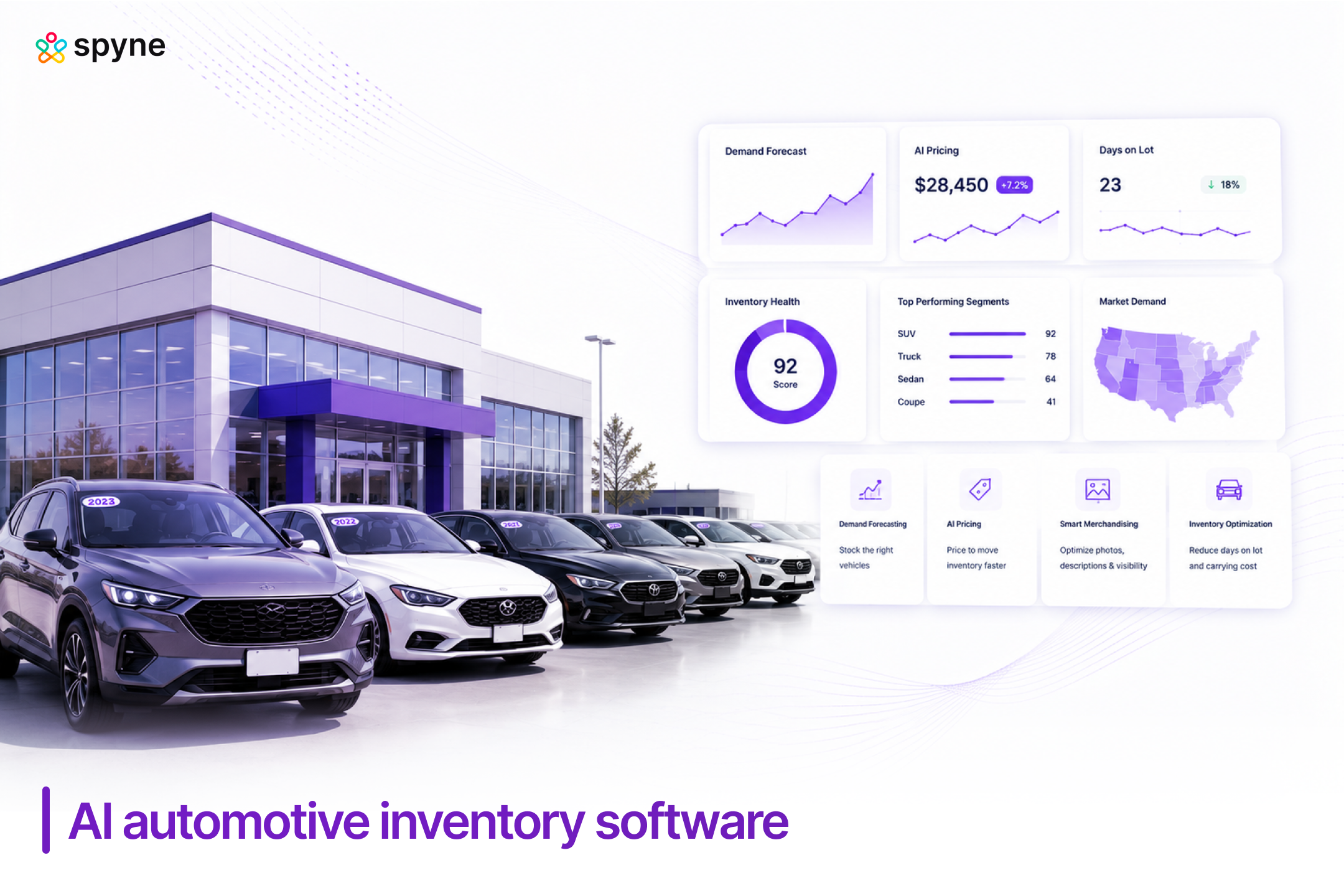

EXECUTIVE SUMMARYAI automotive inventory software applies machine learning to demand forecasting, pricing, and merchandising so dealerships stock the right vehicles and move them faster. Cox Automotive’s 2025 AI Readiness study found 81% of dealers believe AI is a permanent part of auto retail, and dealers who have fully adopted it are 50% more likely to report revenue growth and higher profitability, per Cox Automotive’s 2026 NADA analysis. This guide covers how AI automotive inventory software works, the strategies dealers use it for, and how leading platforms compare. |
A unit that sits 60 days on the lot is not just slow, it is bleeding money every single day through floor plan interest and depreciation. Most dealers still price and reorder inventory on gut feel and a weekly spreadsheet. AI automotive inventory software replaces that guesswork with daily, VIN-level recommendations on what to buy, how to price it, and when to move it before it goes stale. Here is how the technology actually works, what it costs to ignore it, and how the top platforms stack up.
What Is AI Automotive Inventory Software?
AI automotive inventory software is a category of dealership technology that uses machine learning to manage vehicle stock instead of relying on manual spreadsheets or static reorder rules. Instead of reviewing inventory once a week, the system continuously reads market data, local demand signals, and a vehicle’s age on the lot, then recommends what to buy, how to price it, and when to discount it. Most platforms in this category sit on top of, or alongside, a dealership’s existing DMS and pull in feeds from auction data, marketplace listings, and the dealer’s own sales history. The output is not a report someone has to interpret. It is a specific action: reprice this VIN, feature that VIN in ads, stop restocking this trim.
For most dealerships, AI automotive inventory software shows up in three places: acquisition (what to buy and from where), pricing (what to charge as the unit ages), and merchandising (how the listing looks and where it gets promoted). A platform that only does one of these is solving a third of the problem.
This is also why dealers researching an AI car dealer inventory software comparison often end up disappointed with a single-feature tool. A platform strong on pricing but weak on merchandising still leaves photography and listing quality as a manual bottleneck, and a platform strong on merchandising but blind to market pricing still lets units sit priced wrong for weeks. The strongest shortlist candidates cover at least two of the three functions natively, not through a bolt-on integration announced after the fact.
How Does AI Improve Automotive Inventory Management?
AI improves automotive inventory management by replacing static thresholds with predictions that update daily. Instead of “reorder when we hit five units,” the system forecasts how many units of a specific trim and color will sell in the next two to three weeks based on local search volume, comparable listings, and seasonal patterns, then flags the gap before it becomes a missed sale.
The same models also catch problems humans miss until it is too late. A vehicle that is getting fewer online views than similar units in week one is a signal, not noise, and AI automotive inventory software can surface that signal on day 7 instead of day 45. That earlier warning is the difference between a small reprice and a fire-sale discount.
Dealers asking how AI improves car dealer inventory day to day usually care less about the underlying model and more about what changes on their desk each morning. In practice, it means a shorter list of units that need a manager’s attention instead of a full lot review, and a pricing suggestion that already accounts for what three competing dealers are charging for the same trim this week.
Three mechanisms drive most of the improvement:
- Demand forecasting: Models trained on local market data predict which trims, colors, and price bands will move fastest in a specific ZIP code, not a national average.
- Dynamic pricing: Pricing adjusts based on live competitor listings, days on lot, and reconditioning cost, instead of a manager manually dropping price every two weeks.
- Aging and risk alerts: The system flags units trending toward stale status while there is still room to act, rather than after they cross 60 or 90 days.
Derek Hansen, Cox Automotive’s SVP of Dealer, Lender and Inventory Management, made the underlying point plainly in a March 2026 conversation with Car Dealership Guy: AI is not magic, and the quality of a dealer’s data determines the quality of the recommendation it gets back.
AI Inventory Management Strategies Dealers Are Using in 2026
Dealers getting real value from this technology are not buying a tool and walking away. The AI inventory management strategies that actually move gross share a few habits.
1. Segment inventory by risk, not just age
Not every 45-day unit is the same problem. A well-priced sedan in high demand needs a small nudge. An overpriced niche trim needs a real markdown or a wholesale exit. AI models rank units by how likely they are to sell in the next 14 days, so managers work the riskiest units first instead of the oldest ones.
2. Let pricing update daily, not weekly
Weekly repricing meetings are already out of date by Wednesday. Dealers who tie pricing to live market data see fewer units cross the 60-day mark because the correction happens while it is still cheap to make.
3. Feed the model clean data
AI inventory management strategies fail fast when the underlying data is wrong. Duplicate listings, missing options, and stale photos all degrade forecast accuracy. Cleaning up feed data before rollout is the single most valuable step most dealers skip.
4. Tie acquisition to the forecast, not the auction sheet
Buyers who source vehicles based purely on what looks cheap at auction often restock trims that are already overrepresented on the lot. Forecast-driven acquisition closes that gap by flagging the trims actually selling in-market.

AI Automotive Inventory Tips for Getting Started
Dealers new to this category tend to make the rollout harder than it needs to be. These AI automotive inventory tips reflect what separates a smooth adoption from a stalled one.
- Start with one workflow: Pricing or aging alerts alone deliver measurable results within a quarter. Trying to automate acquisition, pricing, and merchandising simultaneously slows the rollout and makes it harder to see what is working.
- Audit your data feed first: Incomplete VIN data, missing photos, or duplicate listings will produce weak recommendations no matter how good the model is.
- Set a review cadence, not a set-and-forget rule: AI recommendations still need a manager’s sign-off on judgment calls, like whether to hold a unit for an upcoming trade-in match.
- Measure days on lot and gross together: A tool that shortens days on lot but erodes gross is not actually solving the problem.
- Train the team on why, not just how: Adoption stalls when staff do not trust the pricing suggestion. Showing the underlying market data behind a recommendation builds that trust faster than a mandate does.
Most of these tips exist because dealers skip straight to the software and skip the groundwork. Understanding how AI improves car dealer inventory before rollout, not after, is what separates a smooth quarter from a stalled pilot that gets quietly shelved.
Best AI-Powered Automotive Inventory Software for Dealers
The best AI-powered automotive inventory software for dealers depends on whether the priority is live-market pricing, computer vision merchandising, or an all-in-one operating system. Cox Automotive’s vAuto remains the standard for VIN-level dynamic pricing at franchise scale. Lotlinx focuses on identifying and rescuing at-risk inventory before it goes stale. Tekion offers an AI-native dealer management system that unifies inventory with sales and service data. Spyne Inventory Management is built for dealers whose biggest bottleneck is merchandising speed and listing quality rather than enterprise-wide pricing algorithms.
Running an AI car dealer inventory software comparison across these platforms only works if it accounts for what each one does not cover, not just its headline feature. A pricing-first platform still needs a separate merchandising workflow. A merchandising-first platform still needs a way to catch pricing drift on aging units. The table below breaks down where each platform’s AI actually adds value, so the comparison reflects operational fit rather than marketing claims.
| Platform | Primary AI Strength | Best Fit | Pricing |
| Spyne Inventory Management | Computer vision merchandising, AI listing generation, reconditioning visibility | Dealers who need faster, better-presented listings without a full DMS overhaul | Customized |
| vAuto (Cox Automotive) | Live-market VIN-level dynamic pricing | Franchise dealers and large groups optimizing pricing at scale | Connect with Sales Team |
| Lotlinx | At-risk inventory detection and targeted ad spend | Dealers with chronic aging-inventory problems | Connect with Sales Team |
| DealerSocket | AI-enabled CRM and inventory insights bundled with DMS tools | Dealers wanting inventory and CRM data in one system | Connect with Sales Team |
| CDK Global | Inventory data integration across DMS and dealer operations | Larger stores standardizing data across multiple departments | Connect with Sales Team |
Spyne Inventory Management: AI Automotive Inventory Software for Dealership Merchandising
Spyne Inventory Management is built for the part of AI automotive inventory software that most platforms treat as an afterthought: getting a vehicle from acquisition to a market-ready listing without a week-long bottleneck at the photo bay. It fits into daily operations right after a trade-in or auction unit arrives, before it can be priced, marketed, or synced to any marketplace.
1. AI-powered vehicle merchandising
Computer vision turns smartphone photos into consistent, studio-quality images with background cleanup and multiple angles, so a trade-in can go live the same day instead of waiting on a photographer.
2. Automated listing descriptions
The system generates VIN-based descriptions from decoded trim, options, and condition data, cutting the manual copywriting step that slows down every new arrival.
3. Inventory health monitoring
Dashboards flag units trending toward stale status based on days on lot and listing engagement, so managers can act before a vehicle needs a steep markdown.
4. Reconditioning visibility
Tracks where each unit sits in the recon pipeline, so a vehicle is not sitting “ready” on paper while it is still in the shop.
5. Multi-marketplace publishing
Updates pricing, photos, and status across the dealer website and third-party marketplaces from a single source, reducing listing mismatches.
6. Aging and pricing alerts
Surfaces units approaching risk thresholds with enough lead time to reprice before the unit becomes a loss.
7. DMS-aligned data flow
Keeps inventory records consistent with the dealership’s core system, reducing the manual reconciliation that causes pricing and status errors.

Conclusion
AI automotive inventory software is no longer an experimental add-on. It is the difference between reacting to a stale unit and preventing one. Dealers who forecast demand, price dynamically, and merchandise faster are already seeing the payoff Cox Automotive documented in its 2026 dealer research: more revenue, tighter margins, and fewer units aging past the point of easy recovery. The dealers still running weekly spreadsheets are the ones funding their competitors’ turn rate. Stop guessing what will sell and start acting on what the data already shows. See Your Next Trade-In Priced and Listed the Same Day. Book a demo today!