
Executive SummaryDealership lead management software captures, routes, and tracks every customer inquiry from first contact to closed deal. McKinsey’s January 2025 research found that 56 percent of dealership leads arrive after business hours, with only 37 percent addressed within the first hour. DAS Technology’s 2025 NADA study shows 78 percent of buyers choose the first dealership that follows up. The right platform closes that gap through automated routing, AI lead scoring, and structured follow-up across every channel and rooftop. |
Most dealerships believe they have a lead problem. The actual problem is a response problem. A McKinsey report published in January 2025 found that 56 percent of new dealership leads arrive after business hours, and only 37 percent get addressed within the first hour. By the time a rep logs in Monday morning, buyers have moved on. Dealership lead management software exists to prevent exactly this. This guide covers how it works, which strategies high-volume and franchise dealers use, and how the leading platforms compare.
What Is Dealership Lead Management Software?
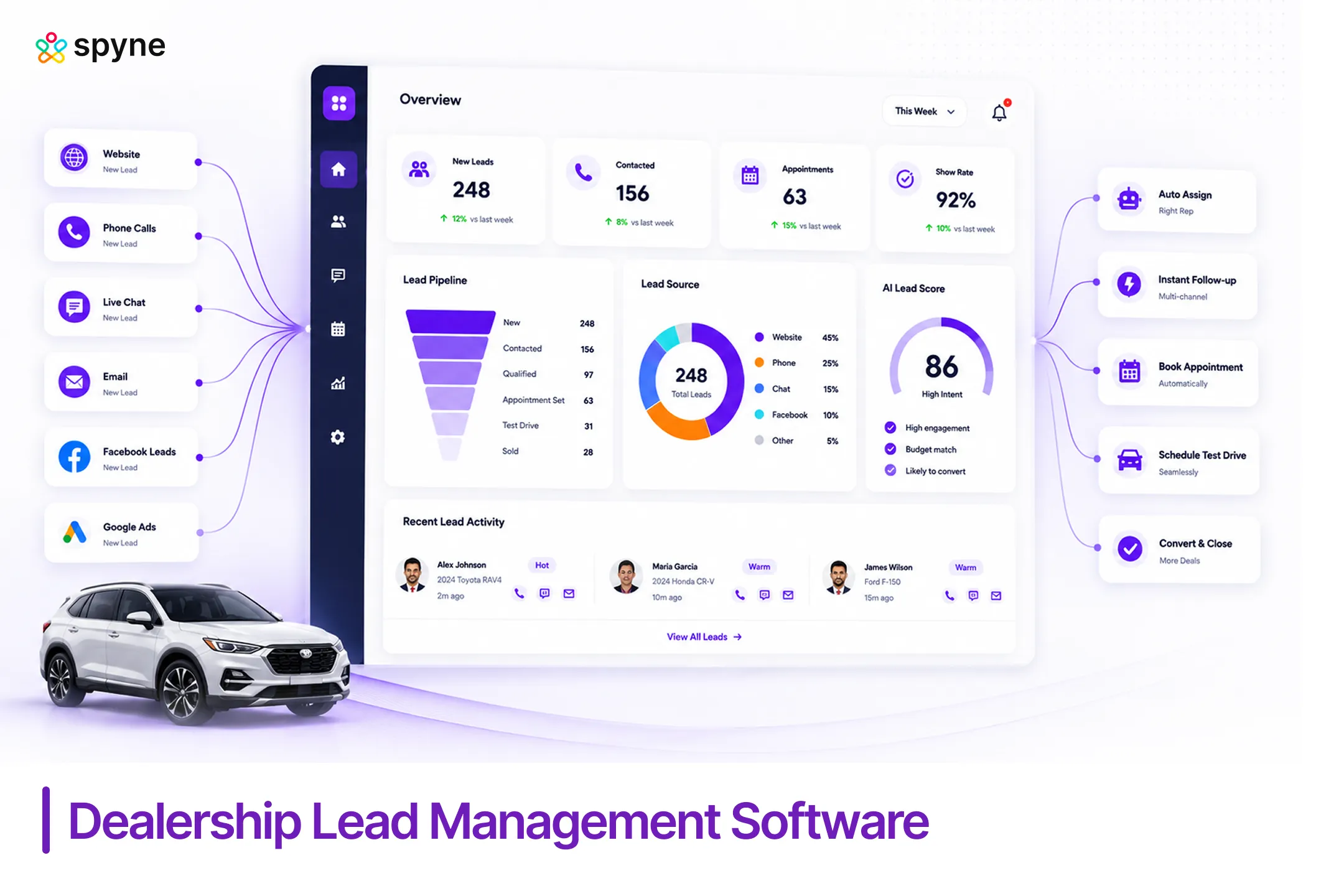
Dealership lead management software is a centralized system that captures every sales inquiry a dealership receives, assigns it to the right salesperson, and tracks it through every stage of the buying journey until the deal closes or the lead goes cold. It connects leads from the website, third-party listing sites, OEM portals, social platforms, and phone systems into one working queue instead of a dozen disconnected inboxes.
The scale of the problem is easy to underestimate. NADA data shows that across 16,957 franchised dealers in 2024, roughly 900 vehicles were sold per store annually, a year-round lead stream that never stops. And the systems meant to manage that stream frequently do not talk to each other. A January 2025 survey from eLEND Solutions, published on DrivingSales, found that 56 percent of dealers encounter data gaps between their CRM, DMS, and finance management systems more than a quarter of the time, with 96 percent agreeing that profits are directly determined by their sales process. Dealership lead management software exists to close that gap.
How Does Automotive Lead Tracking Software Work?
Automotive lead tracking software works by moving every inquiry through six connected stages: capture, routing, profile creation, follow-up automation, pipeline tracking, and reporting. Each stage hands the lead to the next automatically, so a salesperson never re-enters the same customer information twice.
| Stage | What Happens |
| 1. Lead capture | Pulls in inquiries from the website, marketplaces, social, phone, chat, walk-ins, and OEM portals |
| 2. Lead routing | Assigns the lead to a rep based on rules like vehicle type, location, availability, or workload |
| 3. Profile creation | Builds a record with contact info, vehicle interest, budget, trade-in, and financing details |
| 4. Automated Lead Follow-up | Triggers emails, texts, or task reminders so the rep follows up at the right moment |
| 5. Pipeline tracking | Moves the lead through stages: New, Contacted, Test Drive, Negotiation, Sold, Lost |
| 6. Reporting | Measures response time, conversion rate, rep performance, and source ROI |
The breakdown in practice is measurable. A CBT News report drawing on a 50,000-mystery-shop dataset found the average U.S. dealership takes three hours and eleven minutes to return phone calls and two hours and twelve minutes to reply to texts. Top-performing stores respond across all three channels in just over one minute. That is not a staffing gap. It is a process and software gap, and it costs real revenue every day it goes unaddressed.

Dealership Lead Management Tips for High-Volume Sales Floors
Dealership lead management for high volume sales floors comes down to removing decisions from individual reps and putting them into rules the software enforces automatically. DAS Technology’s 2025 NADA study found that 61 percent of dealers now respond to leads within 15 minutes, up sharply from 16 percent in 2018, and that 78 percent of car buyers ultimately choose the first dealership that follows up with them.
1. Set a hard response SLA, not a guideline
Five minutes during business hours is the standard target for dealership lead management for high volume floors. CBT News mystery-shopping data shows best-in-class stores consistently responding in just over one minute across phone, email, and text. Past five minutes, the odds of converting that lead drop significantly.
2. Route by rules, not by whoever is free
Assign leads by vehicle type, source quality, or rep specialty. Round-robin routing that ignores rep expertise consistently underperforms structured assignment.
3. Split high-intent and low-intent queues
A shopper requesting a test drive on a specific VIN is not the same lead as a generic contact form submission. High-volume teams that treat both identically burn time on the wrong ones.
4. Build a structured follow-up cadence
Day 1, 3, 7, 14. Most deals are not lost on the first call. They are lost on the fourth one that never happened.
5. Review lost-lead reasons weekly, not quarterly
These dealership lead management tips only produce results when someone examines why leads go cold while the pattern is still actionable. These strategies only hold when the dealership lead management software enforcing them runs automatically in the background, not as a manual checklist.
Dealership Lead Management Strategies for Franchise and Multi-Rooftop Groups
Franchise and multi-rooftop groups need automotive lead management strategies that run consistently across every store, not strategies that depend on one strong GM. The right dealership lead management software makes that consistency possible even under dealership lead management for high volume conditions across a large group with mixed staff and experience levels.
1. OEM compliance and co-op tracking
Manufacturers require portal leads to be logged and answered within a set response window to stay eligible for co-op advertising dollars. DealerSocket supports OEM lead integration across nearly 80 manufacturer program certifications, which is part of why it appears repeatedly in franchise-group CRM evaluations. Software should track this automatically, not rely on a manager remembering.
2. Consistent lead source definitions across rooftops
If one store classifies a Facebook inquiry as hot and another calls the same inquiry cold, group-level reporting becomes a dealership lead management comparison between incompatible data sets. Standardizing definitions is a prerequisite for any meaningful cross-store analysis.
3. Centralized visibility with store-level control
Group leadership needs one dashboard across rooftops. Individual GMs still need to manage their own daily queue without waiting on a corporate approval chain for routine decisions.
4. Cross-rooftop ownership rules
When the same shopper inquires at two stores in the same group, which store owns the lead must be defined by written policy before the situation arises, not resolved ad hoc after it happens.
Best 5 Automotive Lead Tracking Tool for Franchise Dealerships
There is no single best automotive lead tracking tool for franchise dealerships that fits every group. The right answer depends on two things: which DMS ecosystem the dealership already runs on, and how many rooftops need to feed into one reporting layer.
1. Spyne Automotive CRM
Spyne Automotive CRM AI lead scoring and routing work independently of which DMS a rooftop runs. This makes it a realistic fit for franchise groups growing through acquisition or operating different systems at different stores. It is not the strongest fit for groups needing deep, certified OEM portal integration out of the box. Cox and CDK-native platforms lead on that dimension.
2. VinSolutions
VinSolutions links a shopper’s anonymous website browsing history directly to their CRM record the moment they identify, through a feature called VinLens. It also includes Vinessa, a virtual contact assistant that sets appointments and updates records in both English and Spanish. VinSolutions announced a Predictive Insights feature at NADA 2026, claiming dealers using it acquire roughly 37 percent more trade-ins. That figure comes from the vendor, not independent verification.
3. DealerSocket
DealerSocket pairs its CRM with RevenueRadar, an equity-mining tool that scans the customer database across 11 targeting categories to surface high-probability repeat buyers. It supports nearly 80 OEM program certifications, which matters for franchise groups that need audit-ready compliance reporting across every brand they carry.
4. Elead
Elead is purpose-built for structured call tracking and BDC follow-up at scale. CDK-native dealer groups tend to default to it because DMS and CRM integration requires less configuration than most alternatives.
5. AutoRaptor
AutoRaptor is best suited for independent and smaller dealerships that need straightforward lead tracking without the complexity of enterprise CRM platforms. It offers an intuitive interface, customizable sales pipelines, and quick deployment, making it a practical choice for lower lead volumes. However, it lacks the multi-rooftop reporting, OEM compliance capabilities, and enterprise integrations that franchise dealer groups typically require.
Dealership Lead Management Software Comparison
This dealership lead management comparison covers the platforms franchise and high-volume dealerships evaluate most frequently. Choosing by DMS ecosystem fit produces better outcomes than choosing by feature list, because the same platform that is a strong fit for a Cox-ecosystem group is often wrong for a CDK group with different integration requirements.
| Platform | Best For | Strength | Consideration |
| Spyne’s Automotive CRM | DMS-agnostic groups, AI lead scoring | Fast setup, flexible across mixed tech stacks | Less native OEM portal depth than Cox or CDK-tied tools |
| VinSolutions CRM | Cox Automotive ecosystem dealers | VinLens behavior tracking, bilingual AI assistant, 4.2/5 on G2 | Best value mainly inside the Cox stack |
| DealerSocket CRM | Large multi-rooftop groups, OEM compliance | Equity mining, ~80 OEM certifications, broad feature suite | 3.8/5 on G2; support quality is the top complaint post-acquisition |
| Elead CRM | CDK Drive, high-volume BDC | Strong call tracking, structured follow-up | Requires disciplined process to deliver full value |
| AutoRaptor | Independent and smaller dealers | Simple, affordable lead tracking | Limited depth for large franchise operations |
Common Mistakes in Dealership Lead Management
These mistakes appear regardless of which dealership lead management software a store runs. Most get worse, not better, under dealership lead management for high volume conditions.
1. Treating every lead the same regardless of source quality
A shopper who browsed three inventory pages and requested a specific test drive is not the same lead as a generic contact form submission. Routing urgency and rep assignment should reflect that difference.
2. Running lead handling through a shared inbox with no routing rules
Without automated assignment, some leads get worked twice, and others never get worked at all. The eLEND Solutions survey published on DrivingSales found this kind of cross-system gap affects the majority of dealers on a regular basis.
3. No mobile access for sales reps
A lead notification sitting unread on a desktop for two hours defeats the entire point of automated routing. On a high-volume floor, mobile access is not optional.
4. Leaving leads unassigned overnight and on weekends
McKinsey’s 2025 research shows more than half of incoming leads arrive during those gaps. Most dealerships have no BDC coverage to catch them.
5. Skipping the lost-lead audit
Dealerships track lead volume and conversion rate but rarely document why individual leads went cold. Without that data, the same avoidable mistakes repeat month after month.
Spyne Automotive CRM: Lead Management Software Built for Dealerships
Spyne Automotive CRM systems address a specific operational problem: capturing every incoming lead, getting it to the right person fast, and keeping follow-up consistent regardless of how many rooftops, lead sources, or tech systems a dealership runs. It is designed for dealerships that need lead data, pipeline visibility, and rep accountability in one place rather than across separate tools that do not talk to each other.
1. AI-based lead scoring
Each lead is ranked by likelihood to convert based on source quality and behavioral signals. A BDC handling high volume can prioritize the shopper who browsed three trim pages and submitted a test-drive request over one who filled out a generic contact form, without a manager making that call manually.
2. Automated lead routing
Incoming leads are distributed to available reps in real time based on dealership-set rules such as vehicle type, lead source, or rep availability. A multi-rooftop group can route SUV inquiries to SUV-certified reps without manual intervention on every assignment.
3. Conversational AI follow-up
Spyne’s conversational AI “Vini AI” engages new leads immediately, confirming vehicle availability and pricing before a human rep picks up the conversation. This covers the after-hours and weekend gaps where most dealerships have no BDC on duty, which McKinsey’s 2025 data identifies as the highest-volume lead arrival window.
4. Unified omnichannel inbox
Leads from the website, classifieds, social platforms, and third-party marketplaces route into one dashboard. Reps work one queue, not five separate platform logins.
5. Sales performance analytics
Response time, lead-to-sale conversion, and source ROI are visible in real time. A GM overseeing multiple rooftops can identify which store is letting leads sit too long before the problem shows up in monthly reports.
6. Flexible DMS and CRM integration
Spyne connects with existing dealership systems without requiring custom middleware. For franchise groups running different DMS environments across rooftops, this flexibility avoids a forced standardization that may not be operationally realistic.

Conclusion
Dealership lead management software is not optional infrastructure for any store processing meaningful lead volume. McKinsey shows when most leads arrive and go cold. NADA shows who wins them. CBT News mystery-shopping shows how far the average dealership falls behind the best performers. Whether the priority is dealership lead management tips for a single high-volume rooftop or dealership lead management strategies across a multi-store franchise group, the platform that actually produces results is the one with the best routing logic, the most consistent follow-up, and the clearest visibility into what happens to every lead from the moment it arrives.
See how Spyne’s automotive CRM helps dealerships capture, route, and convert more leads. Book a demo.