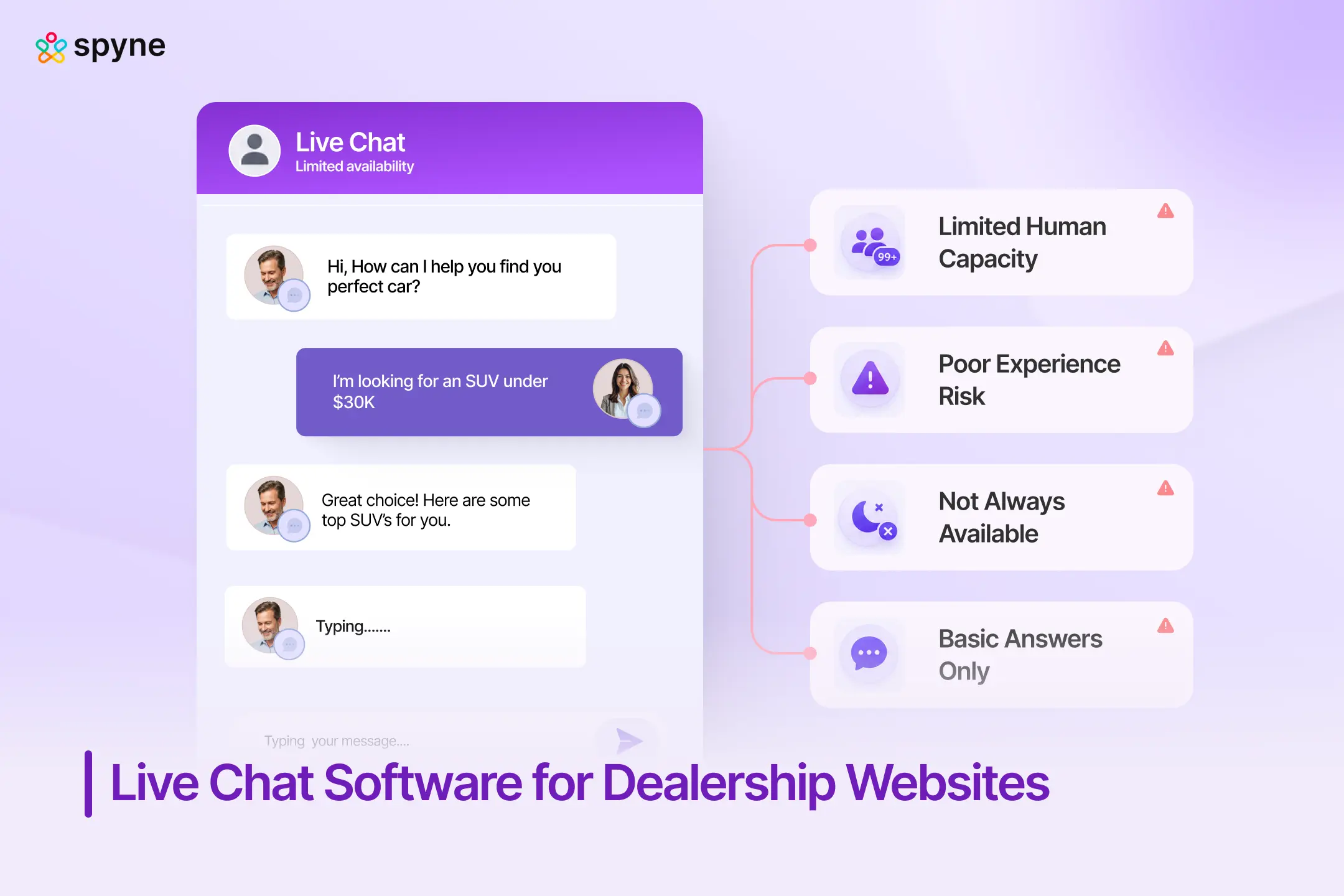

Thirty-five to forty percent of dealership website traffic arrives after your BDC goes home. That is not a fringe window, it is Saturday night, Sunday morning, and every weekday after 6 PM: the exact hours of the car buyers comparison-shop without a salesperson in the room. Live chat was supposed to solve this. For most stores, it has not. Not because chat is the wrong tool, but because human-staffed chat inherits the same coverage ceiling as every other staffed function. This article covers what the conversion data actually shows, where traditional live chat structurally fails regardless of vendor, and what the dealerships booking the most chat-originated appointments are doing differently in 2026.
TL;DR- Live Chat for Car Dealerships in 2026
| Tool | Best For | AI Depth | In-Chat Scheduling | DMS Access | Starting Price |
| Vini AI (Spyne) | High-volume dealers, multi-rooftop groups | Full AI, no staffing needed | Direct | Real-time | Custom (demo) |
| Podium (Jerry AI) | Dealers needing SMS + chat + reviews unified | AI-primary + human escalation | With reminders | Via integration | ~$399/mo + add-on |
| Gubagoo ChatSmart | Franchise stores wanting managed human agents | Human-led + AI assist | Sales and service | Agent-assisted | Custom (quote) |
| CarChat24 | Dealers who want fully outsourced chat ops | Human operators, 24/7 | Via operators | Agent-assisted | Custom (quote) |
| Tidio | Independent lots testing chat for the first time | Basic AI chatbot | Not native | Not available | From $24.17/mo |
If you run high inbound chat volume and need coverage outside staffed hours, start with Vini AI or Gubagoo. If your primary need is unifying SMS, chat, and review management in one inbox, Podium fits better. Tidio is a testing tool, not a dealership-grade solution.
What Live Chat Actually Does Inside a Working Dealership?
Most vendors describe live chat as a ‘lead capture tool.’ That framing is too narrow, and it is part of why most implementations produce mediocre results. A dealership chat tool is doing five distinct jobs simultaneously, and failing at any one of them creates a leak in the pipeline.
The five jobs dealership chat must complete:
- Capture, intercept a visitor on a VDP (vehicle detail page), inventory page, or service scheduling page before they close the tab and move to the next AutoTrader result
- Qualify, determine, within three to four exchanges, whether this is a buyer ready to visit in the next 72 hours or someone gathering information for a purchase three months out; the follow-up cadence for each is completely different
- Answer accurately, provide current pricing, trim availability, financing range, and trade-in ballpark; an agent who cannot answer these from live DMS data creates doubt, not confidence
- Book, propose and confirm a specific test-drive or service slot directly in the conversation, without a “someone will follow up to confirm” gap
- Log, push the full conversation transcript, lead source, vehicle of interest, and intent signals to the CRM automatically, not as a manual task that depends on whether the agent remembered
A tool that completes jobs one through three but fails at four and five is a conversation tool, not a lead conversion tool. The distinction matters because the industry benchmark for mishandled leads is already alarming: the Foureyes 2025 Automotive Dealer Benchmarks Report, analyzing over 1.1 billion dealer website visits, found 43.2% of sales leads were mishandled, including missed calls, no-CRM-logging, and lapsed follow-up.
The Four Types of Dealership Chat Tools
“Live chat for dealerships” is not a single product category anymore. The 2026 market has split into four distinct shapes, and conflating them is what makes most software shortlists useless.
- Website intake widgets are the traditional chat bubble on the dealer site or VDP, Gubagoo ChatSmart, CarChat24, Vini AI, Podium. Their job is to capture and convert the buyer who landed on the site from organic search, paid Google Ads, or an inventory portal click. This is still where the majority of high-intent inbound traffic arrives, and it is the category this article focuses on.
- DM and messaging bots handle buyers who arrive through Instagram DMs, Facebook Messenger, or WhatsApp, increasingly common for dealers running click-to-message campaigns or organic social content featuring inventory. A website widget does not reach this traffic at all.
- Digital retail platforms layer chat functionality on top of a financing or deal-building workflow, AutoFi, Roadster, CarNow. Their primary job is moving an interested buyer toward a soft credit application and a deal jacket, not initial intake.
- Consumer-facing auto AI are tools that buyers use before they ever contact a dealership, CarGurus’ AI assistant, Edmunds’ tools. Useful to understand as context; not relevant to dealer operations.
This guide covers the first category only. If more than 25% of your monthly inquiries are arriving through social DMs rather than your website, layer a DM tool on top, but solve the website intake gap first.
Why Do Most Dealership Live Chat Implementations Fail?
The tool selection conversation almost always starts in the wrong place. Most dealerships evaluating chat ask “which vendor should we use?” before answering “what specifically breaks at our store without this?” The gap between those two questions is where the implementation fails.
#1- The Coverage Math
The Cox Automotive Car Buyer Journey Study documents that 65% of buyers now establish contact with a dealership before visiting in store, up from 20% in 2009. The research phase is predominantly digital, and it does not align with business hours. Demand Local’s 2026 live chat benchmark analysis confirms that roughly 25% of potential buyers now prefer chat as their first point of contact, a channel preference large enough to influence staffing models, not just software procurement.
Human-staffed chat covers the hours when the BDC is logged in. After-hours is structurally uncovered. The Dealership Customer Experience Statistics report puts the cost of missed after-hours service calls alone at over $1 million annually per rooftop. That figure does not include missed sales inquiries.
#2- The Response Speed Problem
This is not nuanced: 80% of leads move on if not answered within five minutes. Podium’s own dealership data corroborates this. Foureyes found that 65% of sales leads who returned to a dealer’s site after an initial inquiry did not hear back within 24 hours, and the majority were not contacted until eight or more days later. The same report found 60% of buyers purchased within the first three days of their initial inquiry.
A chat system that captures a lead at 9:45 PM on a Tuesday and routes it to the BDC email queue for next-morning follow-up is not a chat system. It is a contact form with a different entry point.
#3- The Appointment Booking Gap
This is the most common process failure in dealership chat, and it is the one that most directly suppresses ROI. An agent who qualifies a buyer and identifies strong intent, but cannot book a slot directly into the scheduling system, creates a handoff gap. The buyer is told someone will confirm the appointment. That confirmation takes hours, sometimes a day. The Foureyes data makes the consequence of that delay explicit: by the time the confirmation arrives, 60% of buyers have already decided.
#4- CRM Logging as an Afterthought
The Foureyes 2026 Benchmarks Report tracked a steady six-year increase in leads never logged to CRM: 10.6% in 2020, rising to 15.2% in 2025. Chat is the channel most vulnerable to this because logging often depends on an agent manually copying transcript data into the CRM after the conversation ends. When volume spikes or agents are handling multiple chats, this step gets skipped.
How to Score a Live Chat Tool for a Car Dealership?
Most software evaluations end at feature checklists. A better framework scores tools against the operational failures described above, weighted by how directly each failure maps to appointment volume.
| Evaluation Dimension | Weight | What to Test |
| After-hours coverage | 30% | Does it operate without any human logged in? |
| Response speed | 25% | Is first response under 60 seconds at all hours? |
| In-conversation scheduling | 20% | Can the buyer book a specific slot without a follow-up call? |
| DMS / inventory accuracy | 15% | Does it query live inventory, or answer from a static script? |
| CRM auto-logging | 10% | Is every interaction pushed to CRM automatically, with source data? |
Scoring note: A tool that scores well on feature marketing but requires a human to be logged in for any of the top three dimensions fails the coverage test regardless of its other capabilities. After-hours coverage, response speed, and in-conversation scheduling are not enhancements, they are the baseline requirements for a chat tool to produce measurable appointment lift.
The 5 Live Chat Tools Worth Shortlisting for Car Dealerships in 2026
1. Vini AI by Spyne
Best for: High-volume stores and multi-rooftop dealer groups that need 100% inbound coverage with zero staffing dependency.
Vini is purpose-built for automotive dealerships, not a generic customer support tool adapted for the car business. It answers 100% of inbound calls, chats, and web inquiries instantly, around the clock, querying the DMS in real time to surface current pricing, trim availability, and inventory details. Appointments are booked directly in the conversation, without a handoff. Every interaction is auto-logged to the CRM with lead source, vehicle of interest, and intent signals attached.
The operational case for Vini is structural rather than incremental: it removes human availability from the coverage equation entirely. After-hours, BDC peak overflow, lunch breaks, and staffing gaps all fall inside its coverage window, not outside it.
- Coverage model: Fully AI-native, no human required for any part of the intake flow
- Inventory access: Live DMS query on every conversation; no static pricing sheets
- Scheduling: Direct, in-conversation booking to existing scheduler (CDK, Xtime, and others)
- CRM + DMS: Native integrations with CDK, Dealertrack, VinSolutions, DealerSocket
- Reported outcome: 26% appointment conversion rate from AI-handled inbound; most rooftops report 5–10x ROI within 90 days from recovered after-hours and overflow leads alone
- Pricing: Custom.
2. Podium (Jerry AI)
Best for: Dealers who want SMS outreach, website chat, inbound call handling, and review management inside one platform.
Podium’s AI agent, branded Jerry 2.0, is trained on a decade of real dealership conversations and operates across website chat, SMS, inbound phone, and Google Business Messages from a unified inbox. It surfaces live inventory, current OEM incentive data, and iPacket links mid-conversation. Podium reports 7,000+ dealership clients and a validated partnership with FordDirect. An OpenAI partnership study published in December 2025 documented 45% higher conversion rates for businesses using Jerry, with one dealership recording a 60.7% close rate from test-drive appointments booked via the AI.
- Coverage model: AI-primary with human escalation capability; 24/7 on AI-handled volume
- Channel reach: SMS, website chat, phone, email, Google Business Messages, unified inbox
- Scheduling: In-conversation with automated no-show reminder sequences
- CRM integration: DealerSocket, VinSolutions, Elead, and others natively
- Review management: Automated review solicitation and response generation included
- Pricing: Core platform from ~$399/month; Jerry AI Employee add-on ~$99–$399/month depending on configuration. Dealership-tier pricing requires direct contact.
3. Gubagoo ChatSmart
Best for: Franchise dealers who want trained human agents backed by AI assistive technology, with a virtual retailing layer available.
Gubagoo’s model is hybrid: trained human chat specialists run the conversations, with AI assistive technology providing real-time inventory data, vehicle history, credit check access, and trade-in valuations in-agent to use during the chat. Agents complete a five-week training program with ongoing F&I upskilling. The BEAST intent-scoring engine runs in the background, ranking buyer urgency in real time and flagging high-intent visitors for immediate escalation. Gubagoo also offers a virtual retailing layer that lets a buyer start a deal structure online and complete it in-store without re-entering information.
- Coverage model: Managed human specialists + AI assistive tools; 24/7 agent availability
- Integrations: 80+ native integrations including major CRMs, HubSpot, Car Wars, Apple Business Chat, AutoTrader SMS
- Scheduling: In-chat for both sales and service
- Differentiator: BEAST intent scoring, virtual retailing, F&I-trained agents
- Where it costs more: The human model means higher per-conversation cost than AI-native tools at scale
- Pricing: Custom.
4. CarChat24
Best for: Dealers who want fully outsourced chat operations with automotive-trained human operators and minimal in-house management overhead.
CarChat24 operates as a managed service, the operators are CarChat24 employees, not dealership staff. They are trained on dealership-specific processes: financing conversations, trade-in valuations, inventory feature explanations, service lane scheduling. Proactive triggers are configurable by VDP dwell time. The platform includes video walk-around capability via mobile app, SMS integration, Facebook Messenger support, and Google Analytics lead tracking. CarChat24 states its managed chat service converts 6 out of 10 website visitors into actionable sales leads.
The structural limitation is the same as any human-managed service: concurrency. One trained operator can handle two to three simultaneous chats before response quality degrades. At high-volume hours, wait times climb, which is exactly when conversion drops.
- Coverage model: Fully managed human operators 24/7; dealership has no chat staffing responsibility
- Video capability: Live video walk-arounds via the CarChat24 mobile app
- CRM delivery: Lead data delivered to your CRM; no manual agent-to-CRM step required
- Language support: Enterprise-level multilingual translation tools included
- Constraint: Human concurrency limits create response time risk during traffic spikes
- Pricing: Custom.
5. Tidio
Best for: Independent used-car lots or small dealerships testing the chat category before committing to an automotive-specific platform.
Tidio is a general-purpose AI customer support platform, not an automotive product. Its AI agent, Lyro, automates up to 67% of routine customer queries and works across website chat, email, and social platforms. It does not offer DMS connectivity, live inventory querying, or direct scheduling system integration. The trade-off it offers is price accessibility and fast deployment, a dealer can have Tidio live in under a day with no integration work required.
That accessibility is also its ceiling. A buyer asking “Is the 2022 F-150 XLT you have listed still available?” will get a generic response unless the dealer has manually scripted an inventory-aware answer. At scale, that scripting maintenance becomes its own operational overhead.
- Coverage model: AI chatbot (Lyro) with human agent fallback; available 24/7
- DMS / inventory: Not available natively; requires custom development to connect inventory data
- Scheduling: No native dealership scheduler integration
- Best use case: FAQ handling, after-hours lead capture form replacement, basic inquiry triage
- Pricing: Starter $24.17/month (annual); Growth $49.17/month; Plus $749/month; Lyro AI add-on from $29/month for 50 conversations; free plan with 50 AI conversations included.

How to Measure Live Chat ROI at a Car Dealership?
Track four numbers, and only four:
- Chat-to-appointment rate, what percentage of engaged chat conversations result in a booked slot. Industry benchmark for optimized chat: 15–25%. Below 10% means a process failure, not a traffic problem.
- Appointments from chat per month, the absolute volume, not conversation volume. High conversation count with low appointment count means you are capturing interest and losing it.
- Average gross profit per chat-originated vehicle sale or service RO, revenue context that justifies or challenges the platform cost.
- Monthly platform and staffing cost, total investment including any managed agent fees.
Divide revenue from chat-originated appointments by total monthly cost. A properly configured tool with direct scheduling capability should reach positive ROI within 60 to 90 days.
The most common measurement mistake in dealership chat is reporting total conversation volume to management instead of appointments set. Conversations are an activity metric. Appointments are the outcome metric. The two are related but not interchangeable, and confusing them masks the process failures described above.
Closing Thoughts
Here is what the 2026 benchmark data makes clear: live chat underperforms not because buyers do not want to use it, but because most implementations cannot deliver the two things buyers expect, an immediate answer and a confirmed next step. When both are present, chat-to-appointment rates sit in the 20–26% range. When either is missing, they fall below 10%.
That gap is not a software selection problem. It is a coverage infrastructure decision. After-hours response, sub-60-second reply time, and in-conversation scheduling all need to work without depending on who is currently logged in.
Book a demo with Spyne to see what your current coverage gap is costing you per month.