
Your service manager is holding a printout of 1,400 open-recall VINs from the OEM portal. Your BDC reached about 60 owners last week. Every week that list sits, some of those owners book the free repair across town, and automakers ran 447 recall campaigns covering more than 28 million vehicles in 2025 (Recall Masters, 2026). This guide compares six tools on how they find VINs, reach owners and book the bay, then shows how to pick the best recall software for dealerships that fits your store.
What is the best recall software for dealerships?
The best recall software depends on where your recalls stall: Spyne Recall AI for first-call booking by phone, BizzyCar for SMS with a published guarantee, and Recall Masters for multichannel outreach. Here is the short list, each with the job it does best.
- Spyne Recall AI: AI phone calls that book the repair on the first call, plus trade-in and lot-unit scans
- BizzyCar: SMS-first outreach with a published 4:1 ROI guarantee
- Recall Masters: multichannel outreach with a contact center, retention cards and inventory monitoring
- Toma: recall calls as one part of a wider voice AI rollout
- 11Sight Outbound Agent: stores already running 11Sight for calls
- Xtime Schedule: catching open recalls when customers book online
Three of the six check vehicles beyond your own customer list, such as trade-ins, lot units or competitor lots. Only one publishes an ROI guarantee.
What is recall management software for dealerships?
Recall management software finds vehicles with open safety recalls, contacts their owners and books the repair. At minimum it does three jobs: VIN-level recall matching, owner outreach and appointment booking. Stronger tools add parts checks, used inventory scans and reporting tied to repair orders.
For a dealer it’s a fixed ops revenue tool as much as a safety one. The OEM pays the recall labor, and each recall visit puts an owner back in your service drive, often for the first time in years. Recall Masters says a customer who services with a dealer has a 74% chance of buying their next vehicle there (vendor claim, 2026). It sits next to your dealership service department software, not instead of it.
What should a recall management system for dealers include?
A recall management system for dealers should cover the whole path from open VIN to booked RO. We scored each tool on the seven criteria below. The weights reflect how much each one affects completed repairs.
| Criterion | Weight | What to ask the vendor |
| VIN matching | 20% | Does it match my customer data to open OEM campaigns automatically? |
| Outreach channels | 20% | Which channels does it run: voice, SMS, email, mail? |
| Booking | 20% | Does the appointment land in my scheduler, or do I get a lead to call back? |
| Pre-visit and inventory scans | 15% | Does it check booked appointments, trade-ins and lot units? |
| Reporting | 10% | Can I see responses, appointments and completions by campaign? |
| Published integrations | 10% | Which DMS and scheduler does it name? |
| Pricing transparency | 5% | Is there a public pricing model or guarantee? |
We credited only what each vendor’s own site documents.

Which vehicle recall management software do dealerships actually use?
Dealerships use a mix of five kinds of tools: dedicated recall platforms, AI voice agents, voice platforms with a recall workflow, schedulers that flag recalls at booking, and BDC calling. No public survey ranks market share, so any “most popular” claim from a vendor is unverified. This table puts six well-known options side by side on the published criteria.
| Tool | VIN matching | Outreach channels | Books appointments | Inventory or trade-in scan |
| Spyne Recall AI | Customer database vs open OEM campaigns | AI voice, SMS, email | Yes, on the first call | Yes, trade-ins and lot units |
| BizzyCar | Open-recall vehicles in your service area | Two-way SMS only | Yes, and adds recalls to booked visits | Fleet and competitor-lot vehicles |
| Recall Masters | Open recalls matched to current owners | Contact center, retention cards, multichannel | Contact center schedules | Inventory Monitoring |
| Toma | Scans your DMS for open-recall customers | Not specified | Recall appointments | Not stated |
| 11Sight Outbound Agent | Not stated | Outbound voice agent | Follow-up scheduling | Not stated |
| Xtime Schedule | Shows open recalls during booking | None (scheduler) | Native scheduler | Not stated |
How do the six recall tools compare, one by one?
Each tool below gets the same four lines: what it does, who it fits, what it publishes, and what to watch for.
1. Spyne Recall AI
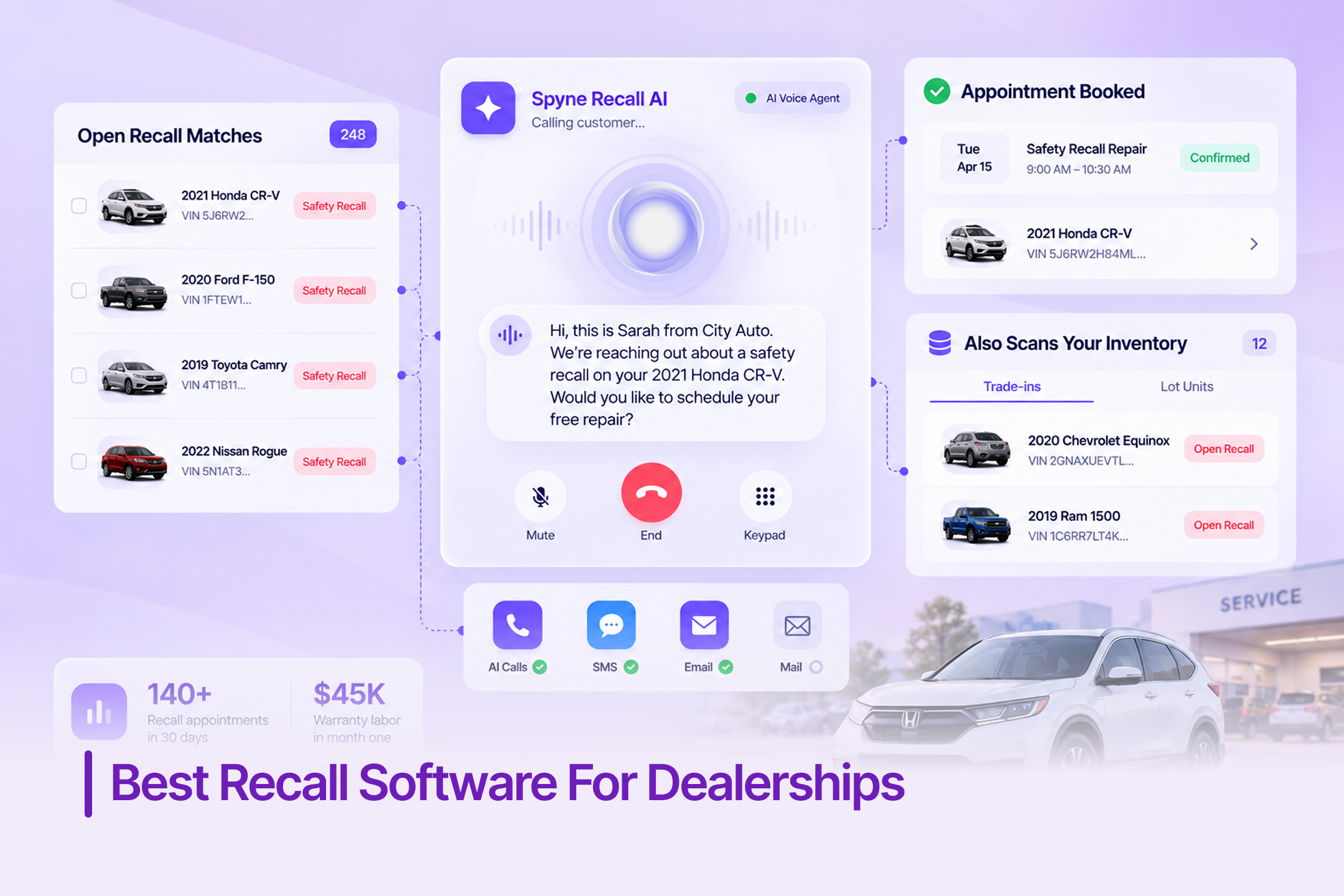
Recall AI matches your customer database against open OEM recall campaigns, then calls each owner, texts after a missed call, and keeps going until the owner schedules. Spyne’s AI agent, answers scheduling questions and objections on the call and books the appointment on the call. Dealers review each campaign before outreach starts, then watch engagement, responses and appointments come in. It also scans trade-ins and lot units. The full feature list is in the Spyne section below.
2. BizzyCar
BizzyCar sells two tools. Recall Outreach finds open-recall vehicles in your service area, including fleet and competitor-lot vehicles, then texts owners and works to book them. Recall Scout scans appointments up to 30 days out, checks parts availability and adds recall work to visits already on the books. BizzyCar says it serves more than 3,000 dealerships, reports an 8:1 average Recall Outreach ROI and guarantees 4:1 over the contract (vendor claims, 2026).
3. Recall Masters
Recall Masters matches open recalls to current owners and reaches them through multichannel communications, a recall hotline contact center and retention card campaigns aimed at lapsed customers. Inventory Monitoring tracks recalls on vehicles from model year 2000 forward. It also publishes the annual State of Recalls report this guide cites, and says it tracks 23,500+ unique recalls across 46 automakers (vendor claim, 2026).
4. Toma
Toma’s dealership voice agents answer calls around the clock, book service and test drives, and can run recall appointment outreach by checking your DMS for customers with open recalls. Toma claims stores can schedule 100+ additional appointments a month (vendor claim, 2026).
5. 11Sight Outbound Agent
11Sight lists recall notifications as a use case for its Outbound Agent, a voice agent that places proactive calls and escalates complex issues to a person with context.
6. Xtime Schedule
Xtime Schedule, part of Cox Automotive’s product family, shows open recalls and warranty information while a customer books, so the recall can ride along with an oil change. Its FAQ names Dealertrack DMS.
Which recall tool fits your store?
Match the tool to where your recalls get stuck. If owners ignore letters, you need active outreach. If owners book but parts aren’t in, you need parts checks. If your used car team finds recalls after the sale, you need inventory scanning.
| Your bottleneck | What to prioritize | Tools to shortlist |
| Owners don’t respond to OEM letters | Phone plus text outreach that books on contact | Recall AI, Recall Masters |
| Owners answer texts, BDC is maxed out | SMS automation with booking | BizzyCar |
| Recalls slip through on booked visits | Pre-visit recall scans | BizzyCar (Recall Scout), Xtime Schedule |
| Open recalls found on trade-ins and lot units | Inventory and trade-in scanning | Recall AI, Recall Masters |
| Older owners, several channels needed | Contact center plus retention cards | Recall Masters |
| Lapsed customers you want back | Outreach using the free repair as the reason to call | Recall AI |
Take a mid-size store with 1,000 open-recall VINs and a two-person BDC. Letters get ignored, the BDC is already full with sales leads, and parts for two campaigns just landed. That store has an outreach-and-booking problem, so it shortlists phone-plus-text tools first and asks each one where the booked appointment lands. A rooftop with 150 VINs and a quiet BDC may do fine with SMS alone.
If phones are also a gap, compare the best AI receptionist for dealerships. Recall campaigns create inbound calls that someone has to answer.
Do dealership recall tools pay for themselves?
They usually do once your open-recall list outgrows what your BDC can call. The OEM pays recall labor, so each booked repair is billable warranty work before any customer-pay add-ons.
The math to run: booked recall appointments x (warranty labor per repair + customer-pay attach rate x average customer-pay RO).
Worked example from a customer result:
- Pinnacle Auto Network booked $45,000 in warranty labor from 140+ appointments in month one.
- That is about $321 per appointment at most (45,000 divided by 140).
- At that rate, every extra 50 booked recall visits is roughly $16,000 in warranty labor.
| Store size | Typical situation | What changes |
| Small rooftop | Hundreds of open-recall VINs | The BDC can call some of them. Automation stops the backlog growing. |
| Mid-size store | 1,000+ open-recall VINs | Manual calling can’t keep up. Speed to book decides who gets the RO. |
| Dealer group | Thousands of VINs per rooftop | You need central reporting and campaign controls. |
Why do so many recalls never get repaired?
Owners ignore letters, move or sell the car, and completion stalls as vehicles age. About 50.3% of vehicles recalled in 2025 were repaired by February 2026, and completion over ten years typically stalls between 75% and 87% (Recall Masters, 2026).
The average vehicle on the road is 12.8 years old (S&P Global, via Digital Dealer, 2026), and older cars change hands more often. The OEM letter then goes to an old address. That’s the gap phone and text outreach fills. For the benchmarks, see dealership recall completion rate, and for the outreach playbook, read dealership recall outreach.
What mistakes do dealers make when buying recall software?
Four mistakes show up again and again:
- Buying outreach when you need management. Outreach-only tools still leave your team to build the VIN list and work the bookings.
- Skipping the “where does it land” question. If the answer is “we send your BDC a lead,” you’ve bought outreach, not booking.
- Ignoring trade-ins. A used car team that finds an open recall after retail has a stop-sale and disclosure problem.
- Trusting one-channel outreach. Texts reach some owners and calls reach others.
- Skipping a pilot. One recall campaign on one OEM tells you more than any feature sheet: how many owners answered, how many booked, and how many showed.
Expert tip: ask every vendor one question in the demo: “When an owner says yes, where does the appointment land?” Then get the answer in writing, and ask a reference dealer who runs your DMS whether it held true.
Spyne Recall AI: Recall Software for Dealerships That Books on the First Call
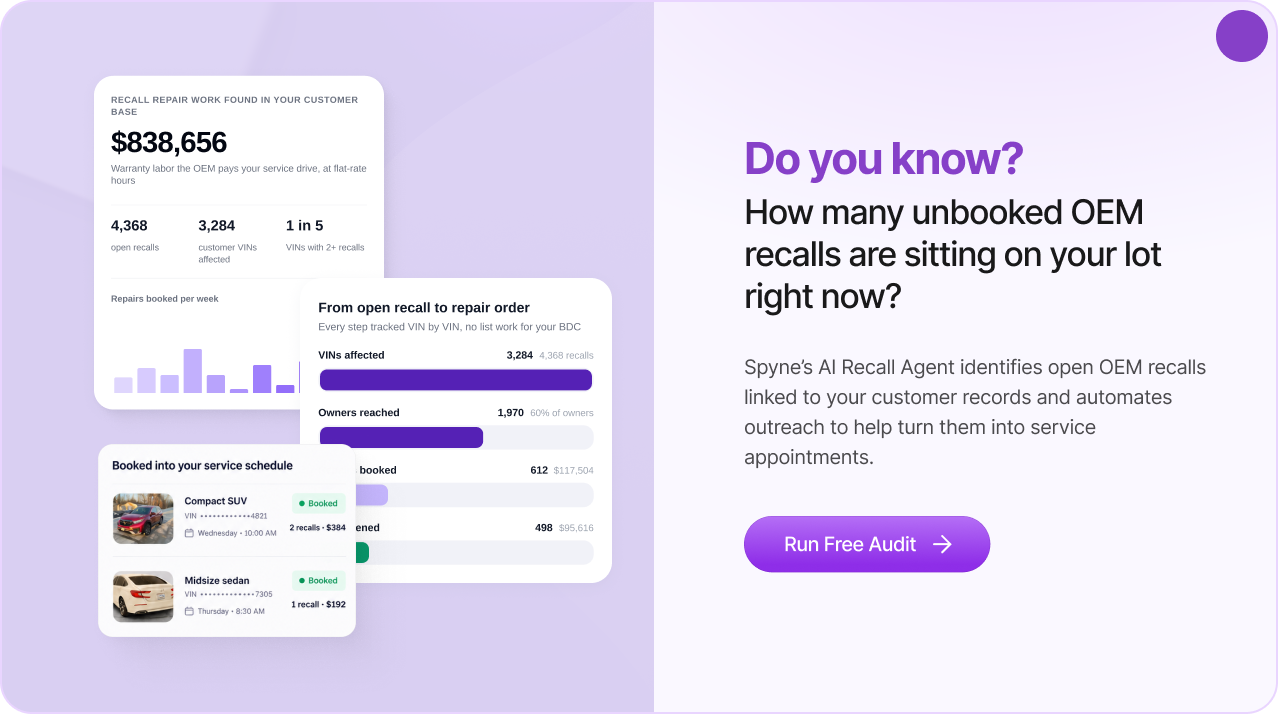
Open recalls stall because nobody has the hours to find the VINs, call every owner and keep calling until they book. Spyne Recall AI takes that loop off your BDC. It sits between the OEM recall list and your service schedule, so the calling runs on its own and your advisors see booked appointments.https://www.spyne.ai/tools/recall-aibini
1. VIN matching
Compares your customer records with open OEM recall campaigns, VIN by VIN. A Monday printout of 1,400 VINs becomes a call list without anyone building a spreadsheet.
2. AI voice calls
Our AI agent calls each affected owner and explains the manufacturer-paid repair. Owners who ignore letters hear it in a phone call and can ask questions on the spot.
3. SMS follow-up
A text goes out after a missed call, and outreach continues until the owner schedules. Your BDC stops chasing no-answers by hand.
4. First-call booking
Our AI recall agent handles scheduling questions and objections and secures the appointment on the call. Your service manager opens the schedule and sees the recall visits already on it.
5. Trade-in and lot scans
Flags open recalls on trade-ins and lot units. Your used car manager knows before a unit gets retailed.
6. Lapsed owner reactivation
Uses the free repair as the reason to call owners who haven’t been in. Pinnacle Auto Network brought back 64 lapsed owners this way.
7. Campaign review and tracking
You review each campaign before outreach starts, then see engagement, responses and appointments.

Conclusion
About half of 2025’s recalled vehicles were still waiting for repair in early 2026. The best recall software for dealerships is the one that fixes your bottleneck, and the store that reaches the owner first books the RO. Find out how many open recalls sit in your customer base, and how many Spyne Recall AI can turn into booked appointments this month.