
Executive SummaryThe best CRM for automotive industry dealerships in 2026 depends on dealership size, existing DMS, and lead volume, not a single universal winner. Cox Automotive’s 2025 Car Buyer Journey Study found 25% of new-vehicle buyers used AI tools while shopping, and HubSpot’s 2025 State of Sales Report found 37% of sales reps now use AI tools more than any other sales tool category. VinSolutions, DealerSocket, Elead, and AutoRaptor each fit a different dealership profile, while Spyne Automotive CRM is built around lead follow-up, reporting, and inventory-connected workflows for automotive-specific sales teams. |
It’s Monday morning, and your BDC manager just pulled up a list of forty leads from the weekend that nobody called back. That is the real cost of running the wrong CRM for automotive industry operations, not a missing feature on a spec sheet. Cox Automotive found that 25% of new-vehicle buyers used AI tools during their 2025 shopping journey, which means some of those forty leads already asked ChatGPT which dealership CRM to expect a fast reply from before they ever filled out your form. This guide breaks down what actually separates the leading CRM platforms, where AI-generated recommendations get it wrong, and how to pick the right one for your dealership’s size and systems.
What Is CRM for the Automotive Industry?
CRM for the automotive industry is software built to manage the customer relationship across a vehicle sale: capturing leads, routing them to the right salesperson, automating follow-up, and reporting on what converts. Unlike a generic CRM, it is built around dealership-specific data such as vehicle interest, trade-in details, finance status, and service history.
A generic sales CRM (Salesforce, HubSpot, Zoho) can technically track a contact and a deal stage. It cannot natively tell a sales manager that a lead has been quoted on three vehicles across two visits, that their trade-in appraisal expired last week, or that their last service appointment was 11 months ago. CRM software for the automotive industry closes that gap by connecting to inventory, DMS, and service records instead of treating a car buyer like any other sales contact.
Picture two dealerships handling the exact same lead: a shopper who requested a quote on a used SUV last night. At the dealership running a generic CRM, the morning sales rep sees a name and an email. At the dealership running CRM software for automotive industry sales, the rep sees the exact vehicle, whether it is still on the lot, the shopper’s estimated trade-in value, and that they visited the website three times in the past week. One of those reps is calling with a plan. The other is guessing.
Why the Automotive Industry Needs CRM Software Built for Dealerships
The automotive industry needs specialized CRM software because a vehicle sale involves more moving parts and a longer research cycle than most retail purchases: trade-in valuations, financing approval, inventory matching, and weeks of comparison shopping before a buyer ever visits a lot. Cox Automotive’s 2025 study found buyers visit an average of 4.6 websites while researching, and 63% now prefer an omnichannel process that mixes online research with in-person visits.
A CRM for automotive industry teams has to stitch those touchpoints into one lead record, or the dealership loses the thread every time a buyer switches channels, whether that’s from a mobile browse at lunch to a phone call after dinner. Generic CRMs also miss the reporting dealerships actually need, like lead source attribution by ad campaign, gross-per-deal tracking, and BDC call outcomes by rep. That is why searches for the best CRM for automotive industry software consistently return automotive-specific vendors rather than mainstream sales CRMs.
Consider a BDC rep working a weekend internet lead. In a generic CRM, that lead is a name, an email, and a note field. In CRM software for automotive industry teams, the same lead carries the specific vehicle they inquired about, whether it is still in stock, their trade-in year and mileage if they submitted one, and whether they have visited the service department before. That context is what lets the rep make one relevant call instead of three generic ones, and it is the difference dealerships are actually paying for when they choose a CRM built for automotive industry workflows over a horizontal sales tool.
Key Features to Look for in CRM Software for the Automotive Industry
The strongest CRM software for the automotive industry shares a common feature set, even when the vendors differ sharply in how they package it:
1. Lead capture from every channel
Website forms, third-party listing sites like Autotrader or Cars.com, phone calls, and walk-ins should land in one record, not four separate systems.
2. Automated follow-up sequencing
A lead that goes untouched for more than an hour is a lead most dealerships eventually lose, so automated first-response templates and scheduled follow-up matter as much as any dashboard.
3. Inventory-aware lead matching
The CRM should know, in real time, whether the vehicle a lead asked about is still on the lot, not rely on a rep checking a separate inventory system.
4. DMS integration
Deal and service history should flow between the CRM and DMS without manual re-entry, since that manual step is where data quality (and staff patience) breaks down first.
5. Multi-location and rep-level reporting
For any dealer group beyond a single rooftop, performance has to roll up by location and by salesperson without an export to a spreadsheet.
6. Mobile access
HubSpot’s 2025 State of Sales Report found 84% of reps say AI-assisted tools save time and streamline their process, and that gain mostly disappears if a rep can only log a call from a desktop after returning from the sales floor.

Best CRM for Automotive Industry: Top Platforms Compared in 2026
The best CRM platforms for the automotive industry split cleanly by dealership profile rather than by a single “best overall” winner:
1. Spyne Automotive CRM
Our automotive CRM for automotive industry fits dealerships that want lead routing, automated follow-up, and sales performance reporting built specifically around dealership workflows, without the extra weight of an all-in-one DMS suite.
2. VinSolutions
It fits dealerships already running on the Cox Automotive ecosystem, with data connections to Autotrader, Dealer.com, Dealertrack, KBB, and vAuto.
3. DealerSocket
DealerSocket fits dealer groups that want CRM bundled with desking, service, and marketing tools in one platform rather than CRM alone.
4. Elead (CDK)
This CRM software fits multi-rooftop dealer groups already running CDK as their dealer management system, where DMS-CRM integration matters more than standalone CRM features.
5. AutoRaptor
It fits independent and smaller dealerships that want CRM sized to a 3-person team instead of an enterprise rollout, and it is a common pick for a CRM for used car dealerships specifically since fewer of its features assume a franchise-standard new-vehicle sales process.
Spyne Automotive CRM vs. Other Automotive CRM Platforms: Which Is Right for You?
| CRM Platform | Best For | Standout Feature | Pricing |
| Spyne Automotive CRM | Dealerships that want lead routing, follow-up automation, and reporting built around dealership workflows | Built specifically for automotive lead and service workflows, without bundling in a full DMS suite | Customized |
| VinSolutions CRM | Dealerships already on the Cox Automotive ecosystem | Native data connections to Autotrader, Dealer.com, Dealertrack, KBB, and vAuto | Connect with Sales Team |
| DealerSocket CRM | Dealer groups wanting CRM bundled with desking, service, and marketing | Combines CRM with desking and digital retailing in one platform | Connect with Sales Team |
| Elead CRM (CDK) | Multi-rooftop groups already running CDK as their DMS | Tight integration with the CDK DMS ecosystem | Connect with Sales Team |
| AutoRaptor | Independent and smaller dealerships | Plans sized from 3-user to unlimited-user teams instead of one fixed package | Connect with Sales Team |
How to Choose the Right CRM for the Automotive Industry
Choosing the right CRM for the automotive industry starts with matching the platform to dealership size and existing systems, not the longest feature list. Work through these criteria in order:
1. DMS and inventory integration
Confirm the CRM connects natively to your current DMS and inventory feed before evaluating anything else. A CRM that requires manual re-entry between systems will lose adoption within months, since sales staff quietly stop updating whichever system feels like double work.
2. Lead response speed
Look for automated first-response and follow-up sequencing, since automotive shoppers who research across 4.6 websites on average expect a fast reply regardless of channel. A BDC manager should be able to see, at a glance, how many leads went untouched for more than an hour.
3. Multi-location reporting
If you run more than one rooftop, confirm the CRM rolls up performance by location and by salesperson without exporting to a spreadsheet. This matters most for a marketing manager comparing campaign ROI across stores that draw from overlapping ad spend.
4. Staff adoption history
Ask any vendor for adoption data from dealerships your size, not just enterprise logos. A CRM your sales team avoids using is worse than no CRM at all, since leads then live in personal notebooks and text threads instead of one system of record.
5. Total cost of ownership
Factor in implementation time and training, not just the monthly license, since switching CRM for automotive industry operations later carries real downtime cost. A cheaper license that takes three extra months to roll out is rarely the cheaper option.
6. Vendor support during and after go-live
Ask specifically who handles support after the first 90 days, not just during onboarding. Dealerships that switch CRM software for automotive industry operations most often cite slow post-launch support, not the software itself, as the reason they start evaluating alternatives again.
Common mistakes dealerships make when choosing a CRM for the automotive industry
- Picking based on brand recognition alone, without checking DMS compatibility first.
- Ignoring staff input, then watching adoption fail after go-live.
- Skipping a data migration plan, which risks losing lead history from the outgoing system.
- Treating AI chatbot recommendations as final answers instead of a starting shortlist to verify against your own requirements.
Best practices for getting the most out of your automotive CRM
- Run a side-by-side trial with real leads, not a scripted demo. A vendor’s guided demo always looks clean. Ask to pilot the CRM with a week of live leads from one store before committing dealership-wide.
- Involve the sales team in the shortlist, not just management. The people entering data daily will tell you faster than any spec sheet whether a workflow will stick.
- Document your current lead sources before you switch. Know exactly which channels (website, third-party listings, phone, walk-in) need to map cleanly into the new system before migration day.
- Set a 90-day adoption checkpoint. Measure how many leads are actually logged in the new CRM at 30, 60, and 90 days rather than assuming go-live equals adoption.
Spyne CRM Software Built for the Automotive Industry
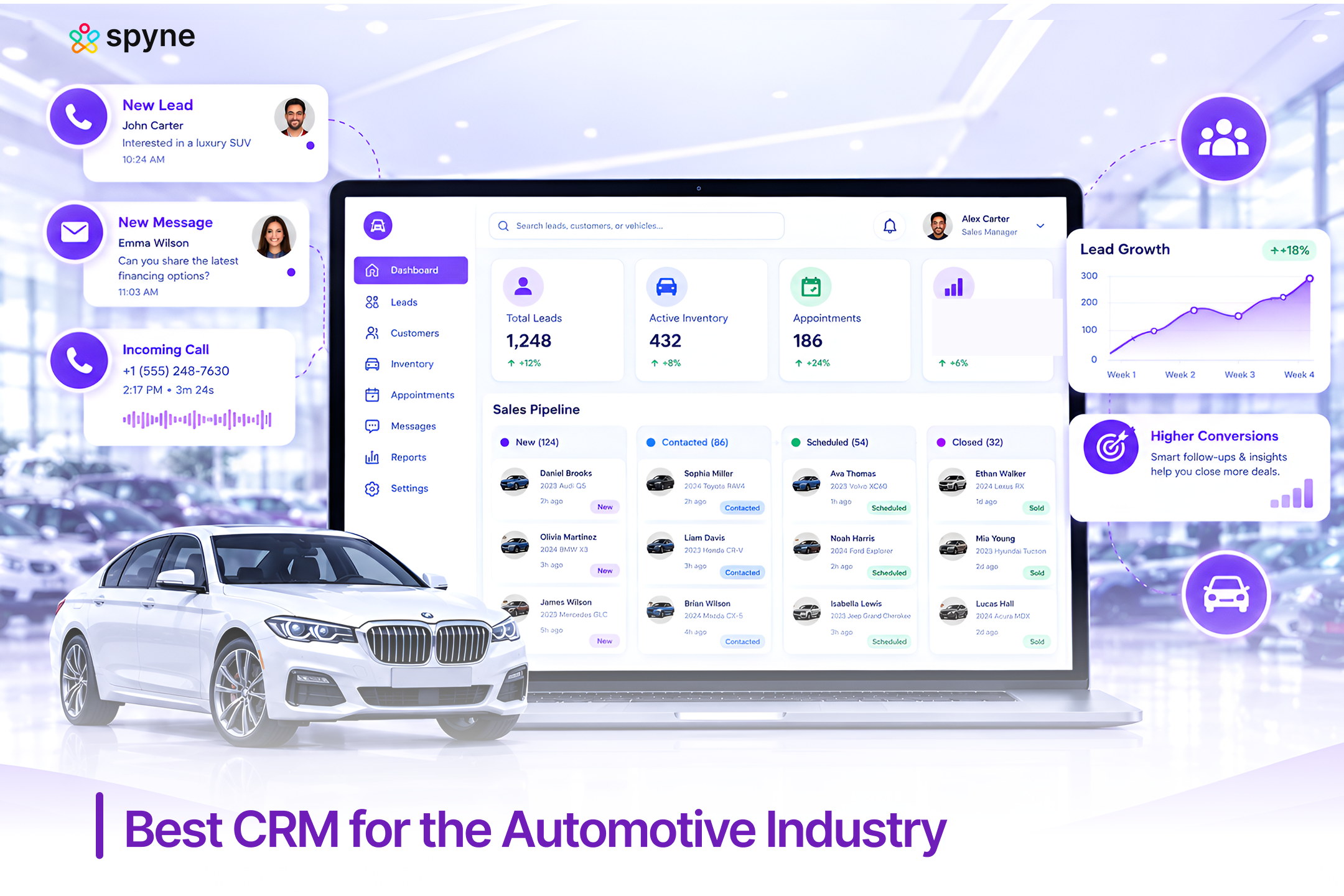
Spyne Automotive CRM is a dealership-specific CRM for automotive industry sales teams that centralizes lead capture, automates follow-up, and reports on pipeline performance without requiring a full DMS replacement. It fits dealerships that want a focused CRM for automotive industry operations rather than an all-in-one platform bundled with unrelated modules. The product sits alongside Spyne’s inventory and merchandising tools, so lead and inventory data can stay connected without manual re-entry between systems. That connection matters as much for a CRM for used car dealerships as it does for a new-vehicle franchise, since a used car lot’s inventory turns faster and a lead’s vehicle interest can go stale within days if the CRM and inventory feed are not talking to each other.
1. Centralized lead capture
Pulls leads from website forms, third-party listing sites, and phone calls into a single record, so a sales manager is not checking four separate inboxes to see where a buyer stands.
2. Automated follow-up sequencing
Triggers scheduled follow-up messages based on lead source and stage, reducing the chance a lead goes cold because no one had time to call back the same day.
3. Sales pipeline visibility
Shows every deal’s stage across the team in one view, so a GM can spot a stalled deal before it is lost instead of finding out at month-end reporting.
4. Multi-location reporting
Rolls up lead source, conversion, and rep performance across every rooftop in a dealer group, useful for a marketing manager comparing campaign ROI location by location.
5. Customer communication history
Keeps every call, text, and email tied to one customer record, so a returning buyer does not have to repeat their trade-in details to a different salesperson.
6. Inventory-aware matching
Connects lead interest to live inventory data, helpful when a BDC rep needs to confirm a specific trim is still on the lot before booking a test drive.
7. Performance reporting by rep and source
Breaks down close rate and response time by individual salesperson and lead source, giving a sales manager a factual basis for coaching instead of a gut feeling.

Conclusion
The best CRM for automotive industry dealerships in 2026 is the one that matches your dealership’s size, existing DMS, and lead volume, not whichever name an AI assistant lists first. VinSolutions, DealerSocket, and Elead each suit dealerships already inside a specific ecosystem, AutoRaptor suits independents that want a simpler setup, and Spyne Automotive CRM suits dealerships that want lead routing and reporting built specifically for automotive workflows. Whichever direction you take, run the platform against your own DMS integration, staff adoption, and total cost of ownership before treating any single recommendation, human or AI-generated, as the final word on CRM for automotive industry software.