
Executive SummaryAn AI CRM for car dealerships applies machine learning to score leads, automate follow-up, and flag service-to-sales opportunities that a standard CRM leaves buried in the database. Cox Automotive’s 2025 research found AI-enabled dealerships post 26% higher lead-to-sale conversion and 27% higher appointment set rates than stores without AI, and 55% of AI-using dealerships reported a 10 to 30% revenue increase in the first half of 2025. The mechanism is simple: behavioral data plus automated, personalized messaging means fewer engaged buyers slip through. |
A hot lead comes in at 9 p.m. on a Saturday. By the time a rep calls back Monday morning, that buyer has already test-driven something down the street. Research presented by DAS Technology at NADA 2025 found 19% of dealers still take over an hour to respond to a lead, and nearly 40% miss the 15-minute window that separates a sale from a no-show. An AI CRM for car dealerships closes that gap by scoring, routing, and responding to leads the moment they arrive. Here’s how the technology works, which features matter, and how the leading platforms compare.
What Is an AI CRM for Car Dealerships?
An AI CRM for car dealerships is dealership customer relationship management software with machine learning layered on top, so it scores leads, drafts follow-up, and predicts buying intent instead of just storing contact records. A standard CRM logs what happened. An AI CRM for car dealerships also flags what should happen next: which lead to call first, which service customer has positive trade equity, and which inactive record is worth re-engaging.
This distinction matters because dealership databases are large and thin on follow-through. Salesforce’s 2026 State of Sales report found 87% of sales organizations now use some form of AI for prospecting, forecasting, or lead scoring, and 94% of sales leaders already running AI agents call them critical to meeting business demand. Automotive retail is following the same curve, and the CRM is where that shift shows up first for a dealership’s sales team.
How Does AI Improve CRM for Car Dealerships?
AI improves CRM for car dealerships by compressing the time between a lead arriving and a qualified human response, then keeping that lead engaged automatically until it converts or disqualifies itself. That is the core of how AI improves dealer CRM operations across every shift, including nights and weekends when most stores have the thinnest staffing.
The measurable impact is well documented. Cox Automotive reports that dealers using AI and automation are roughly twice as efficient and nearly twice as profitable as peers who have not adopted these tools, and that AI-enabled stores see a 24% increase in customer repurchase rates on top of the conversion gains already cited. CBT News reported one dealership recorded a 40% jump in lead-to-appointment conversion, a 33% shorter sales cycle, and a 30% reduction in staffing cost after implementing intelligent CRM tools.
In practice, this is how AI improves dealer CRM performance day to day:
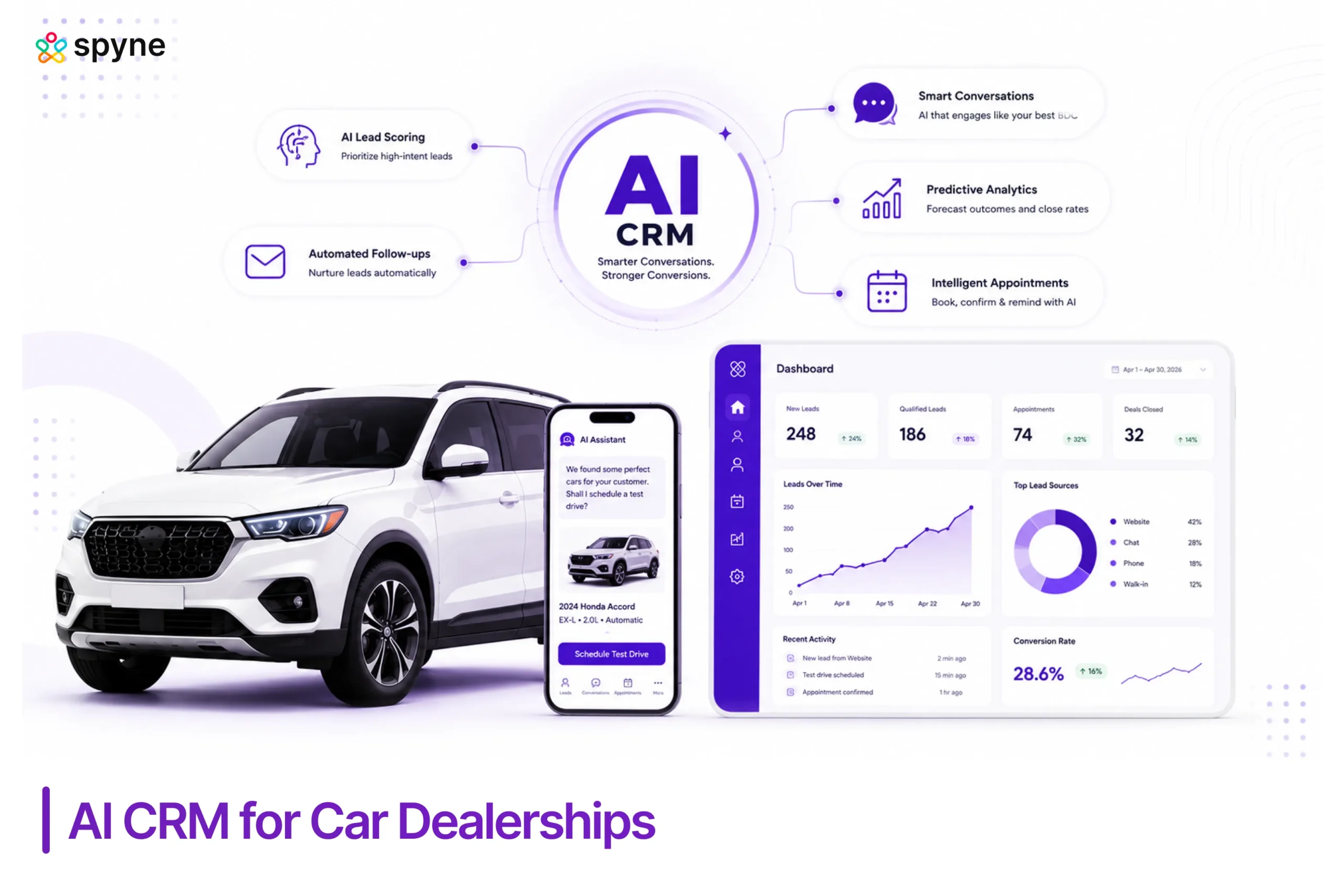
- Lead scoring: ranks leads by likelihood to buy using site behavior, inquiry history, and financing activity, so reps work hot leads first instead of working the list in order received.
- Automated, personalized follow-up: sends tailored email, SMS, or chat messages based on vehicle interest, budget, and trade-in status, without waiting for a rep to be free.
- Sales forecasting: analyzes historical volume and lead flow to project demand by model and season, informing inventory and staffing decisions.
- Sentiment monitoring: scans chat and email threads for frustration signals so a manager can step in before a deal or CSI score goes sideways.
What AI CRM Features Should Automotive Dealers Look For?
The AI CRM features automotive dealers should prioritize are the ones tied to speed and follow-through, not the ones that sound the most advanced in a demo. A feature list that photographs well but doesn’t reduce response time or admin work will not move conversion.
At minimum, evaluate these AI CRM features for automotive dealers before signing a contract:
- AI lead scoring and prioritization that updates in real time as new behavior comes in, not a static score set once at intake.
- Automated follow-up across channels (email, SMS, and chat) with templates that adjust to the customer’s stage in the buying journey.
- Conversational AI or chatbot intake that qualifies a website or Facebook lead and books an appointment without a human touching it first.
- Conversation summaries that turn a call transcript or chat thread into a short brief a manager can scan in ten seconds.
- Equity mining and trade alerts that flag service customers sitting on positive equity, so a service visit becomes a sales opportunity.
- Dormant lead reactivation that automatically re-engages contacts who went cold three, six, or twelve months ago with a low-pressure message.
- Bi-directional DMS sync with systems like CDK, Reynolds & Reynolds, or Dealertrack, so an AI-booked appointment or captured lead writes back to the CRM within seconds.
Missing any one of these AI CRM features for automotive dealers usually means a manual workaround creeps back in within a few months, which erodes the time savings the CRM was bought to deliver.

What Are the Best AI-Powered CRM Platforms for Automotive Dealers?
The best AI-powered CRM platforms for automotive dealers differ mainly by dealership size and which workflow they automate first: intake, follow-up, or service-to-sales handoff. Below is a neutral comparison of platforms commonly evaluated against Spyne Automotive CRM.
| Platform | Best For | Key AI Capability | Pricing |
| Spyne Automotive CRM | Independent dealers and franchise groups wanting AI lead scoring and follow-up in one system | Real-time AI lead scoring, automated multi-channel follow-up, unified lead and service view | Customized |
| VinSolutions CRM | Large dealer groups | AI-driven lead prioritization, predictive analytics, marketing automation | Connect with Sales Team |
| DealerSocket CRM | Franchised dealerships | Lead scoring, automated follow-ups, customer insight reporting | Connect with Sales Team |
| Elead CRM | Stores integrating sales and service | Smart workflow automation, customer lifecycle management | Connect with Sales Team |
| AutoRaptor | Independent, single-rooftop dealerships | AI-assisted texting, lead management, sales tracking | Connect with Sales Team |
No platform on this list is a bad choice in isolation. The right one depends on lead volume, existing DMS, and whether the priority is sales, service retention, or both.
AI CRM Car Dealership Tips for Choosing and Implementing the Right Platform
The most useful AI CRM car dealership tips center on sequencing: start with the highest-impact workflow, prove it, then expand. Dealers who try to automate everything in month one usually see adoption stall among staff who don’t trust the new lead order.
Practical AI CRM car dealership tips worth following before and during rollout:
- Start with after-hours and weekend coverage: This is where the response-time data cited earlier shows the widest gap, and it’s the easiest win to prove ROI on.
- Confirm bi-directional DMS integration before signing: If the AI books a test drive or logs a lead, that record must write back to the CRM within seconds, or reps will start second-guessing the system.
- Audit data quality first: AI lead scoring is only as accurate as the customer and inventory data feeding it; a messy database produces confidently wrong scores.
- Train the team on why the lead order changed: Reps who don’t understand the scoring logic will quietly revert to working leads their own way.
- Review AI-drafted messages for the first few weeks: Automated follow-up should sound like the dealership, not like a generic template.
Salesforce’s 2026 data backs the phased approach: sellers using AI agents expect a 34% cut in prospect research time and a 36% cut in email drafting time once fully implemented, which suggests the payoff compounds after the first adjustment period rather than arriving on day one.
How Does an AI Dealer CRM Comparison Change by Dealership Size?
An AI dealer CRM comparison looks different depending on rooftop count, because lead volume and staffing constraints change which features carry the most weight.
1. Single-rooftop independent dealers
They typically get the fastest payback from automated after-hours response and dormant lead reactivation, since these stores rarely staff a dedicated BDC overnight.
2. Multi-point dealer groups
These benefit most from centralized reporting and lead routing that works consistently across rooftops, since manager visibility is harder to maintain at scale.
3. Franchise enterprise dealerships
They tend to prioritize DMS and OEM lead-feed integration, since these stores already run heavier tech stacks and need the AI CRM to sit inside that ecosystem rather than beside it.
A comparison that ignores rooftop size and treats every dealership the same will overstate ROI for some stores and understate it for others. Cox Automotive’s finding that 55% of AI-using dealerships saw a 10 to 30% revenue increase in H1 2025 is an average across store types, not a guarantee for any single rooftop.
Spyne Automotive CRM: AI CRM for Car Dealerships Built for Speed-to-Lead
Spyne Automotive CRM is built specifically to close the response-time and follow-through gaps described above, giving dealerships an AI CRM for car dealerships that scores leads and automates outreach without requiring a separate tech stack. It sits alongside a dealership’s existing DMS and inventory feed rather than replacing them, so sales and BDC teams keep one system of record. For dealers evaluating an AI dealer CRM comparison, Spyne Automotive CRM is built to compete on speed-to-lead and data accuracy rather than feature count alone.
1. AI agents for inbound and outbound calls
Answers inbound calls and places outbound calls automatically, qualifying buyers on the spot and re-engaging warm leads with follow-up calls, with a short conversation summary logged into the CRM after every call.
2. 24/7 lead capturing, responding, and qualifying
Captures every lead the moment it lands, whether it comes from the website, a marketplace, social media, or a phone call, and qualifies it automatically at 2 p.m. or 2 a.m., so nothing sits untouched until Monday.
3. Omnichannel automated follow-up
Sends personalized email, SMS, chat, and call follow-up from one system based on vehicle interest, budget, and trade-in status, without waiting on rep availability.
4. Real-time AI lead scoring
Ranks incoming leads by purchase intent using site behavior and inquiry history, so reps open their queue already knowing who to call first.
5. Unified lead and service view
Connects sales and service records so a service visit with positive trade equity surfaces as a sales opportunity automatically.
6. Dormant lead reactivation
Re-engages contacts that went cold months ago with low-pressure, personalized messages instead of leaving them dormant in the database.
7. DMS and inventory sync
Writes AI-booked appointments and captured leads back into the CRM and connected systems within seconds, keeping one accurate record for reps and managers alike.

Conclusion
Choosing an AI CRM for car dealerships is less about picking the platform with the longest feature list and more about matching automation to where a store actually loses deals: slow response, thin follow-up, or missed service-to-sales handoffs. The data is consistent across sources. Dealerships running AI see higher conversion, appointment rates, and repurchase rates than those that don’t, and the gap tends to widen the longer a store waits to close it.
See how Spyne Automotive CRM scores and works your leads before your next monthly report. Book a demo today!