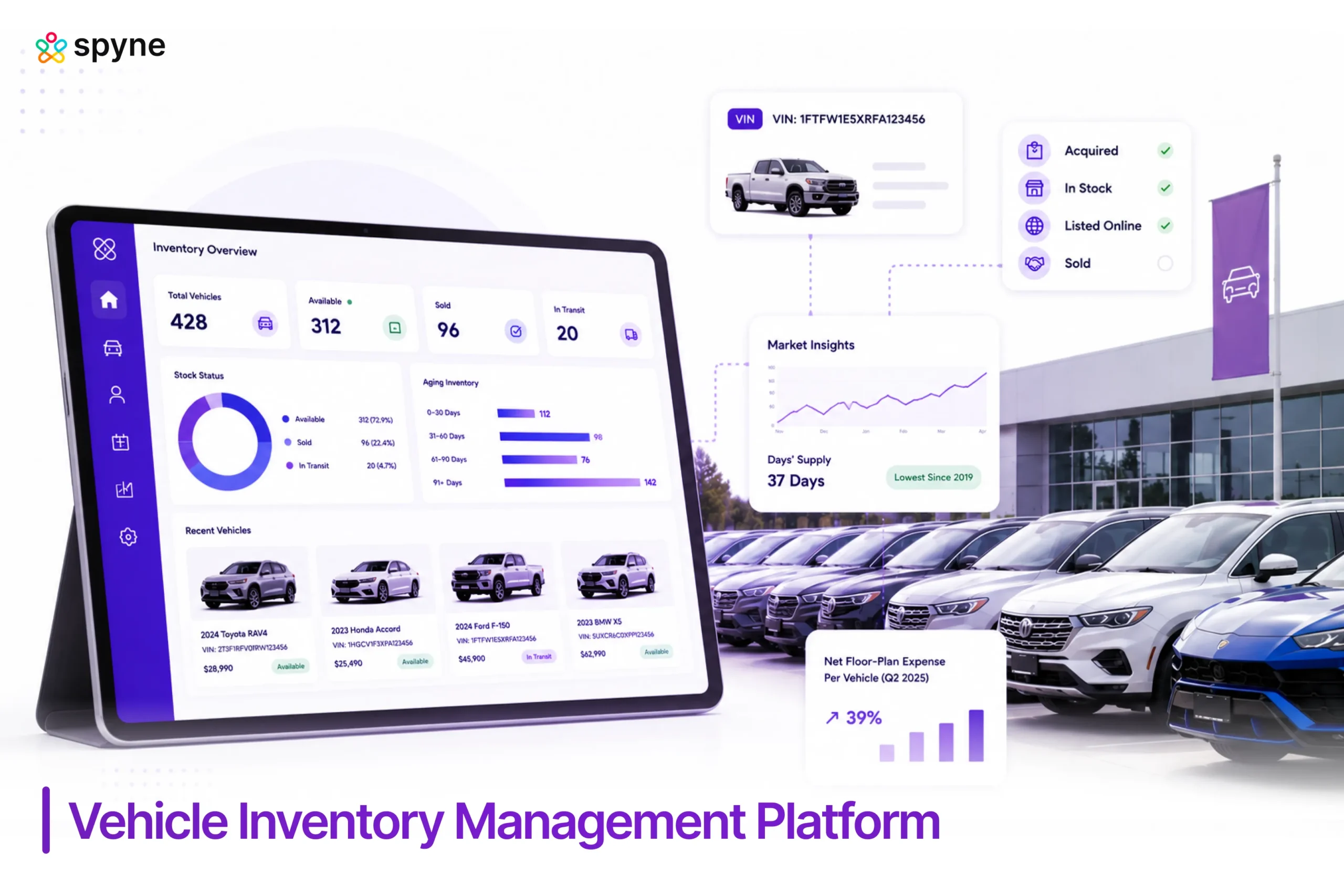

Executive SummaryA vehicle inventory management platform is dealership software that tracks every vehicle from acquisition to sale in one system, covering VIN data, stock status, pricing, and photos. Used-vehicle days’ supply fell to 37 days in March 2026, the tightest reading since tracking began in 2019 (Cox Automotive, 2026), and net floor-plan expense per vehicle rose roughly 39% in Q2 2025 as turns slowed (Cox Automotive, 2025). The right platform catches aging units early and protects gross before it disappears. |
A used car sitting on the lot for 90 days does not just lose value; it drains cash every day it stays there. Floor-plan expense per vehicle rose about 39% in Q2 2025 (Cox Automotive, 2025), and used-vehicle days’ supply hit its tightest point since 2019 in March 2026 (Cox Automotive, 2026). Dealers still tracking stock in spreadsheets are pricing blind. A vehicle inventory management platform closes that gap. Here is what one includes, how the leading options compare, and which strategies actually protect turn rate.
What Is a Vehicle Inventory Management Platform?
A vehicle inventory management platform is software that gives a dealership one real-time system of record for every vehicle in stock, from VIN decode and acquisition through pricing, photos, listing syndication, and sale. It replaces spreadsheets and disconnected tools with a single source of truth.
- Decodes a VIN automatically to pull trim, mileage, color, and factory options
- Tracks status as a vehicle moves from in-transit to available, reserved, or sold
- Layers in local market pricing so units get repriced before they age out
- Shows multi-location stock so dealer groups can transfer instead of re-acquire
- Sits alongside a dealership’s DMS (CDK Global, Reynolds & Reynolds, Tekion) rather than replacing it
This is the layer handling merchandising and stock intelligence that accounting-first DMS platforms were never built to optimize. For a single rooftop, that means one dashboard instead of three spreadsheets. For a multi-rooftop group, it means every manager sees the same live picture of what is on the lot, what it is worth, and how long it has sat there.
Why Spreadsheets and Legacy Tracking Fall Short
Manual tracking fails once a dealership runs more than a handful of rooftops or a few hundred units. Spreadsheets do not update in real time, so a vehicle sold at 9 a.m. can still show as available on three marketplaces by noon.
Net floor-plan expense per vehicle rose roughly 39%, about $139 per unit, in Q2 2025 as higher interest rates and slower turns pushed holding costs up (Cox Automotive, 2025). A dealer group running five rooftops on shared spreadsheets also cannot easily see that a slow-moving unit at one store is exactly what another store’s customer is waiting on. A vehicle inventory management platform replaces that guesswork with one live record every department can trust.
The gap widens with volume. A single-rooftop store might tolerate a day or two of lag between a sale and an updated spreadsheet. A five-rooftop group compounds that same lag five times over, and each hour of stale data is an hour a customer could be looking at a listing for a car that already sold.

Core Features Every Vehicle Inventory Management Platform Should Have
The strongest platforms share a consistent feature set. A platform missing more than one or two of these rows is a partial tool, not a full vehicle inventory management platform.
| Feature | What It Does | Why It Matters |
| VIN decoding and automated data entry | Pulls make, model, trim, and options directly from the VIN | Cuts manual entry errors and delays before a unit can be listed |
| Real-time stock status | Tracks available, reserved, in-transit, sold, and damaged units | Prevents units from showing as available after they are sold |
| Market-based pricing tools | Flags units priced above market before 30, 60, or 90 days | Keeps pricing aligned with actual local demand |
| Photo and document management | Stores inspection reports, titles, and registration with the vehicle record | Removes paperwork delays before a unit can go live |
| Multi-location visibility | Shows stock across every rooftop in a dealer group | Enables transfers instead of new acquisitions |
| Reporting and analytics | Surfaces aging inventory, turn rate, and profitability by model and trim | Turns monthly guesswork into a weekly routine |
| Listing syndication | Pushes pricing and photos to the website and marketplaces automatically | Keeps every channel accurate the moment status changes |
How to Run a Vehicle Inventory Management Platform Comparison
A fair vehicle inventory management platform comparison starts with the dealership’s own numbers, not a vendor’s feature list. Document rooftop count, average monthly units, current DMS, and where inventory gets stuck before scoring any vendor.
| Platform | Best For | DMS / Multi-Rooftop Fit | Pricing |
| Spyne Inventory Management | Dealerships needing merchandising, reconditioning tracking, and stock visibility in one system | Layers alongside an existing DMS; supports multi-location visibility | Customized |
| vAuto | Franchise groups prioritizing market-based pricing analytics | Integrates with the Cox Automotive ecosystem; multi-rooftop support | Connect with Sales Team |
| VinSolutions | Dealers wanting inventory tied directly to CRM data | Deep CRM integration within the Cox Automotive ecosystem | Connect with Sales Team |
| DealerSocket | Dealer groups wanting profit-first inventory scoring | Built for multi-location group management | Connect with Sales Team |
| CDK Global | Enterprise multi-rooftop groups needing accounting-tied inventory | Full DMS-embedded workflow at enterprise scale | Connect with Sales Team |
The right vehicle inventory management platform comparison weighs cost against actual fit for rooftop count and lot mix, not brand recognition alone. Vendors built around Cox Automotive data (vAuto, VinSolutions) tend to lead on market-pricing depth, while DealerSocket and CDK Global lean toward group-level scale and DMS-embedded workflows. None of that ranking matters if the platform never gets adopted store-wide.
Best Vehicle Inventory Management Platform for Franchise Dealers
The best automotive inventory management software for franchise dealers is the one that reconciles OEM allocation data, supports multi-rooftop transfers, and integrates cleanly with the group’s existing DMS. Franchise groups typically layer a dedicated inventory tool on top of an enterprise DMS rather than replacing it.
- Single-rooftop franchise stores should prioritize simplicity and fast onboarding
- Multi-rooftop groups should prioritize integration depth over any single pricing feature
- Confirm the platform gives every rooftop the same real-time inventory picture
- Verify multi-location transfer support before signing, since this determines store-wide adoption
Franchise dealers who skip this evaluation often end up running a second, unofficial system, usually a spreadsheet, alongside the platform they paid for. That defeats the purpose entirely and puts the dealership back to manual tracking within a few months of go-live.
Vehicle Inventory Management Strategies That Cut Days in Stock
The dealerships holding the tightest inventory follow a consistent set of vehicle inventory management strategies rather than reacting store by store:
- Set aging alerts at 30, 60, and 90 days so units get repriced or transferred before they become a write-down.
- Reprice against live market data weekly, since used-vehicle days’ supply can swing by double digits month over month (Cox Automotive, 2026).
- Track reconditioning against a fixed SLA so units are not losing frontline-ready days to an unmonitored shop queue.
- Transfer before you wholesale, since a sister-rooftop transfer often costs less than an outside acquisition.
- Tie acquisition to demand data, not gut instinct, using the platform’s own sales history.
These strategies work because units past their optimal sell window lose gross daily, and floor-plan costs compound the longer a unit sits (Cox Automotive, 2025).
Vehicle Inventory Management Platform Tips for Faster Turn Rates
A handful of vehicle inventory management platform tips consistently separate high-turn stores from the rest.
- Sync inventory data directly with the CRM so sales staff see live stock the moment a lead comes in
- Scan VINs at intake on a mobile device instead of typing them in at a desk
- Automate marketplace syndication so a sold status updates everywhere at once
- Set stale-unit alerts at fixed day thresholds instead of relying on manual review
- Review turn rate and aging reports weekly, since buyers now expect the same real-time accuracy online that AI-powered retail tools deliver in-store (Cox Automotive Car Buyer Journey Study, 2026)
None of these tips require new headcount. They require treating the platform as the daily source of truth instead of a system staff check only when a customer asks a direct question.
Common Mistakes Dealers Make When Choosing an Inventory Platform
Most inventory platform mistakes trace back to evaluating on price alone or skipping integration checks. Each one adds days-in-stock that a properly scoped vehicle inventory management platform comparison would have caught.
- Choosing on sticker price alone without weighing DMS and CRM integration
- Ignoring mobile capability, so staff default back to manual entry within weeks
- Underusing reporting once the platform is live, treating dashboards as optional
- Skipping rooftop-by-rooftop rollout planning for multi-location groups
NADA Show 2026 exhibitors noted dealers commonly lose 15 to 20 hours a week to manual pricing and inventory analysis (Dealerslink, 2026), much of it traceable to a platform implemented but never fully adopted. Every one of those mistakes is fixable before signing, not after, which is why the comparison step above matters more than any single feature.
Spyne Inventory Management: A Vehicle Inventory Management Platform for Dealership Operations
Spyne Inventory Management is an established vehicle inventory management platform built for dealerships that need real-time stock visibility, merchandising, and reconditioning tracking in one system. It gives used car managers and dealer principals one place to see what is aging, what needs reconditioning, and what is ready to list.
1. Centralized VIN-based inventory tracking
Spyne’s dealership inventory tracking software automatically pulls every vehicle record from VIN decode data, keeping specs consistent across every listing channel. A used car manager logging a trade-in gets accurate trim and mileage in seconds instead of a manual lookup.
2. Automated vehicle merchandising
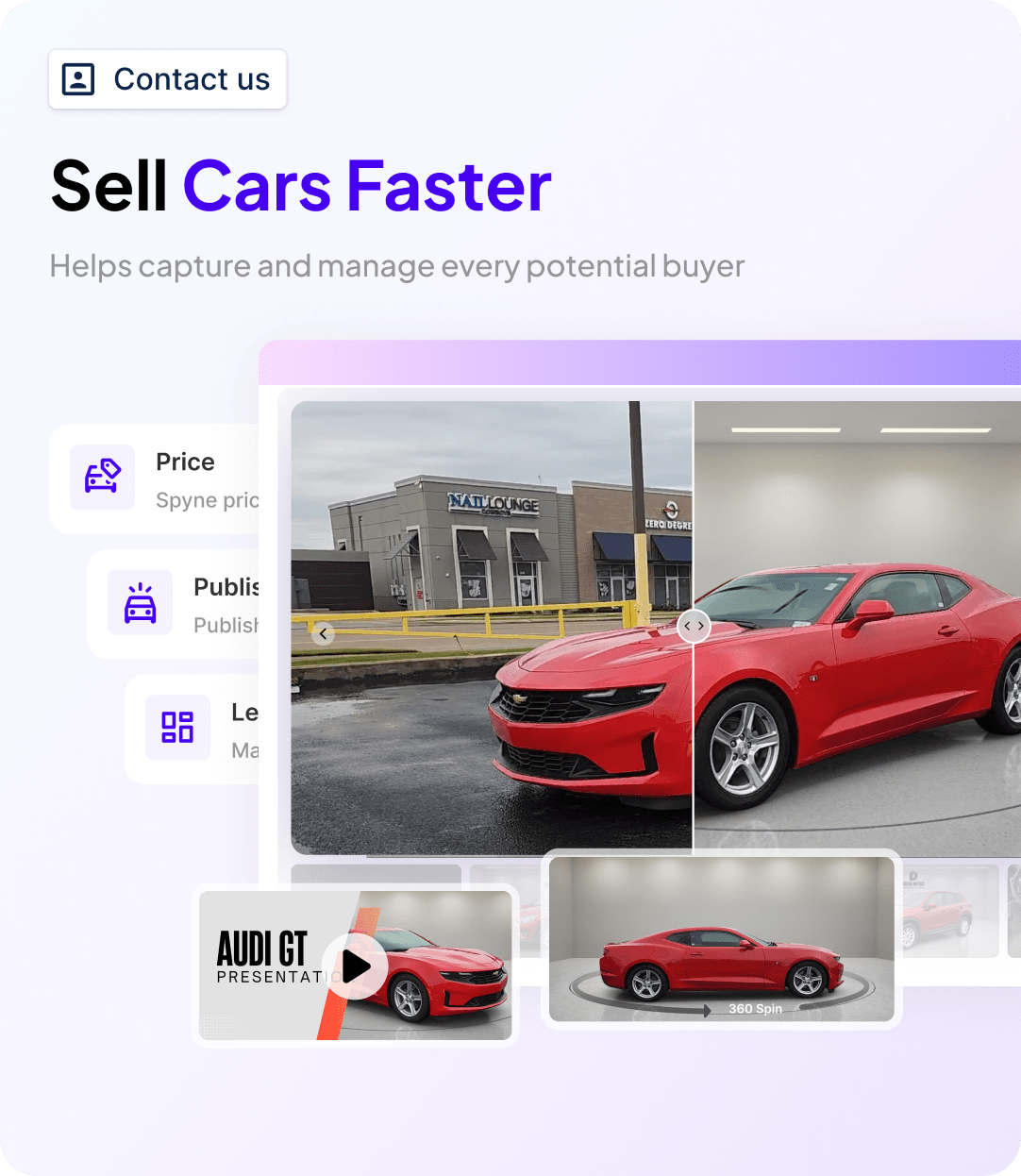
Photos and listing content get generated and published without a separate photography workflow. A reconditioned unit can go live on the website and marketplaces the same day it clears the shop.
3. Reconditioning workflow tracking
Recon status is visible in the same dashboard as pricing, so a used car manager can see exactly why a unit is not frontline-ready. This catches a unit stuck in the paint bay before it quietly adds a week to days-in-stock.
4. Multi-location inventory visibility
Dealer groups see stock across every rooftop in one dashboard, supporting transfers before a unit goes to auction. A slow-moving unit at one store can be matched to demand at a sister rooftop instead of being wholesaled at a loss.
5. Inventory health monitoring and aging alerts
Units approaching 30, 60, or 90 days on the lot get flagged automatically instead of surfacing in a month-end report. A manager can reprice or transfer the unit before it becomes a write-down.
6. Listing publishing and syndication
Our automotive listings management automatically updates pricing and photos to the website and third-party marketplaces without manual re-entry. A price drop entered in the morning shows correctly everywhere by the time a customer searches that afternoon.
7. Reporting and analytics
Turn rate, aging, and profitability data by model and trim are available on demand, not just at month-end close. A dealer principal can spot a slow-moving trim across the group before it drags down average days-in-stock.

Conclusion
Choosing a vehicle inventory management platform is a direct lever on gross and turn rate, not just a software decision. The dealerships absorbing the least holding cost replaced spreadsheets with real-time visibility, ran an honest platform comparison against their own rooftop numbers, and turned the vehicle inventory management platform tips and strategies above into a weekly routine. With used-vehicle days’ supply and floor-plan costs both moving fast in 2026, dealers who wait absorb the cost of every extra day a unit sits unlisted.
If your lot is still tracked in spreadsheets, every extra day in stock is money walking out the door. See what Spyne Inventory Management catches before it costs you, one rooftop or twenty. Book a demo today!