
Test drives are the single most powerful conversion event in automotive retail. Research shows that customers are significantly more likely to purchase a vehicle after a smooth test drive experience. Yet most dealerships still handle scheduling through phone calls, manual CRM entries, and email chains, a process riddled with double-bookings, missed calls, slow responses, and no-shows.
The result is predictable i.e only 16% of dealerships currently use AI to automate test drive scheduling, even though 66% of shoppers prefer to schedule immediately with an AI assistant rather than waiting for a human response. That gap between buyer expectations and dealership capability represents real lost revenue.
This guide covers the best tools in 2026 to automate test drive scheduling, along with common mistakes to avoid and key ROI metrics, so you can choose the right fit for your dealership’s size, tech stack, and workflow.
Why Manual Test Drive Scheduling Costs Dealerships Sales
Before evaluating tools, it’s worth understanding exactly where the manual process breaks down.
The first problem is response time. When a customer requests a test drive through your website, a marketplace listing, or a phone call, the clock starts immediately. If your team takes hours (or until the next business day) to respond, that buyer has likely contacted two or three competing dealerships in the meantime. When shoppers attempt to book a test drive over the phone, 81% face some kind of issue, and on average, they wait 13 minutes on hold. CDK Global That’s more than enough time to lose them.
The second problem is no-shows. Without automated confirmations and reminders, customers forget appointments, double-book their own time, or simply lose interest. Industry data suggests that missed test drive appointments contribute to a significant share of lost annual sales, and that automated reminders can prevent the majority of those no-shows.
The third problem is operational friction. Sales teams manually coordinating vehicle availability, salesperson calendars, and customer preferences creates scheduling conflicts, wastes advisor time, and leads to inconsistent customer experiences. When a test drive request comes in at 9 PM on a Saturday, there’s no one to handle it, and by Monday morning, the buyer has moved on.
Automated scheduling solves all three problems simultaneously: instant response, automatic confirmations and reminders, and 24/7 availability without additional headcount.
Types of Test Drive Scheduling Automation Tools
Not all automation tools work the same way. Understanding the categories helps you choose the right fit.
- Full-stack conversational AI platforms handle the entire customer interaction, from answering the initial inquiry (via phone, chat, or text) to qualifying the buyer, checking vehicle and calendar availability, booking the test drive, sending confirmations, and following up afterward. These are the most comprehensive option because scheduling is embedded within the broader lead engagement workflow, not treated as a separate step.
- Dedicated scheduling engines focus specifically on the booking mechanics, online self-service calendars, real-time availability, automated reminders, and CRM sync. They’re simpler and faster to deploy, but don’t handle the conversational layer (answering questions, qualifying leads, or managing follow-ups).
- CRM-integrated scheduling modules are built into your existing CRM or DMS. They add appointment booking and reminders on top of your lead management system, but typically lack the AI-driven conversation and qualification layer.
- Specialized test drive platforms focus exclusively on the test drive experience, including scheduling, ID verification, insurance checks, and pre-qualification. They serve a niche use case but usually need to be paired with a broader communication platform.
The best choice depends on whether you need just scheduling automation or full-funnel lead engagement with scheduling built in.
Best Tools to Automate Test Drive Scheduling in 2026
1. Spyne (Vini AI)
Category: Full-stack conversational AI platform
Best for: Dealerships that want test drive scheduling embedded within a complete AI-powered sales, service, and BDC communication system.
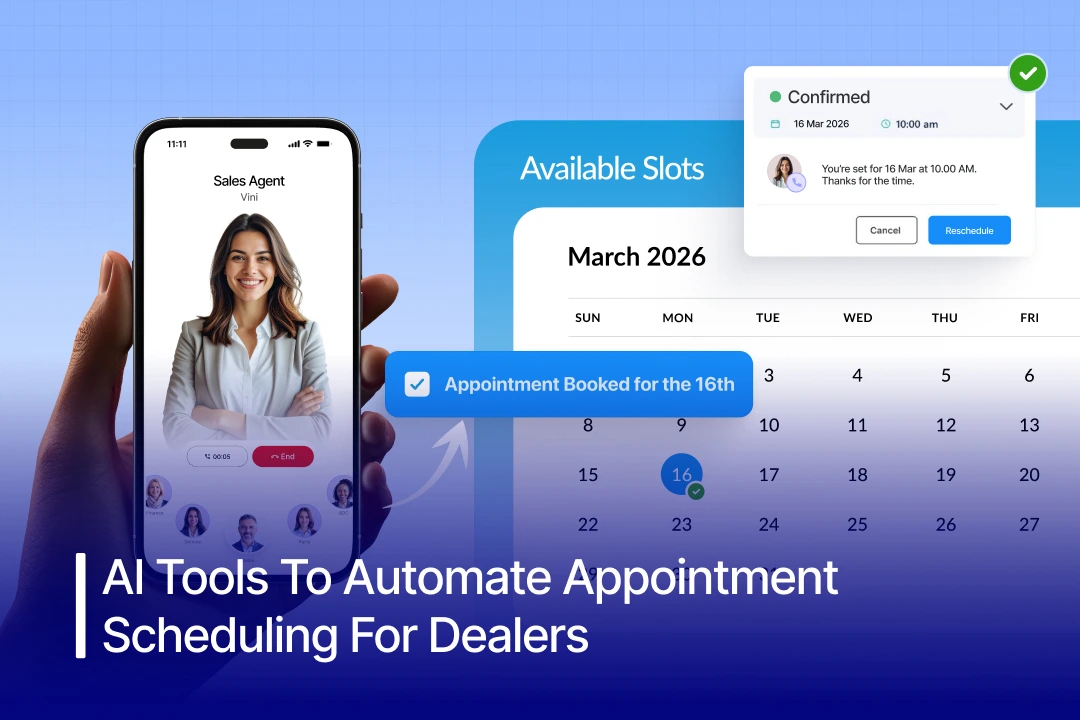
Spyne’s Vini AI doesn’t just book test drives, it handles the entire conversation that leads to the booking. When a customer calls, chats, or texts asking about a vehicle, Vini responds instantly with accurate inventory information (pulled from direct VDP and IMS integration), answers questions about pricing, trim, mileage, and Carfax history, qualifies the buyer’s intent and timeline, and then proactively nudges them toward scheduling a test drive.
What makes Vini particularly strong for test drive automation is that the scheduling step isn’t isolated from the sales conversation. Vini intelligently pushes interested buyers toward test drives, appointments, and financing options as part of a natural dialogue. It checks availability, books the appointment, sends confirmations via SMS or email, and logs the full interaction, including customer intent and vehicle interest, directly into the CRM. The sales team walks in to pre-qualified, booked appointments with complete context.
Vini operates across phone, chat, SMS, and email around the clock. It supports multilingual conversations and handles both sales and service scheduling from the same platform, so there’s no fragmentation between departments.
Key scheduling features: AI-driven test drive booking during live conversations, real-time calendar and inventory sync, automated confirmations and reminders, rescheduling and follow-up automation, CRM integration with full lead context, works across all inbound channels (phone, web chat, SMS, email).
Integrations: VinSolutions, DealerSocket, CDK, Salesforce, and other major CRM/DMS platforms. Direct inventory and VDP integration.
Best-fit dealership profile: Mid-size to large dealerships and dealer groups that want scheduling as part of an end-to-end lead engagement system rather than a standalone tool. Particularly strong for stores where missed inbound calls and after-hours coverage gaps are driving test drive booking losses.
2. Podium (AI Employee / Jerry)
Category: AI BDC platform with test drive scheduling.
Best for: Dealerships that want an AI-powered BDC to handle lead conversations and book test drives across text, web chat, and phone.
Podium’s AI Employee (branded as “Jerry” for automotive) acts as an always-on virtual BDC agent. It engages leads from any channel, answers inventory questions using CRM data, and schedules test drives and service appointments. Podium claims its AI BDC can help dealerships book 30% more test drives by responding instantly and keeping conversations moving even when human staff are unavailable.
Jerry is built on proprietary conversational AI trained on over a decade of automotive dealership conversations. It connects to the dealership’s CRM for inventory-informed responses and can classify inquiries to route them appropriately.
Key scheduling features: AI-driven test drive and appointment booking, CRM-connected inventory responses, automated follow-ups and reminders, multi-channel engagement (text, web chat, phone).
Integrations: Major CRM platforms. G2 rating of 4.6/5 with approximately 2,000 reviews.
Best-fit dealership profile: Dealerships already in the Podium ecosystem or those looking for a strong text/messaging-first AI BDC with proven appointment booking capabilities.
3. Numa
Category: Full-stack conversational AI platform (service-dominant)
Best for: Dealerships where service appointment scheduling is the primary use case, with sales/test drive scheduling as a secondary benefit.
Numa’s Smart Inbox unifies voice, text, and email into one platform. Its voice AI answers inbound calls, identifies customer intent, and books appointments directly into the dealership’s scheduler. While Numa’s strongest reputation is in service-lane automation, it also handles sales-related scheduling including test drives.
Numa reports converting 31% of cold messages into booked appointments and is used by over 1,200 dealerships.
Key scheduling features: Voice AI with end-to-end call resolution, real-time scheduler integration, automated confirmations and reminders, team collaboration via Smart Inbox.
Integrations: CDK, Reynolds, Tekion, Xtime, and major CRM platforms.
Best-fit dealership profile: Service-heavy stores looking for a communication platform that also covers sales scheduling. Not the first choice if your primary goal is maximizing test drive bookings specifically, more of a unified communication solution.
4. STELLA Automotive AI
Category: AI receptionist and call automation
Best for: Dealerships focused on answering every inbound call and converting phone inquiries into booked appointments (test drives and service).
STELLA specializes in AI-powered call answering and SMS engagement. It handles inbound call volume, schedules appointments, and routes complex conversations to the right team member. STELLA also runs outbound voice and SMS campaigns that book directly into schedulers.
STELLA reports that its Ford-store clients achieve a 56% conversion rate on booking opportunities.
Key scheduling features: AI voice receptionist for appointment booking, SMS-based scheduling campaigns, intelligent call routing, scheduler integration.
Integrations: Major automotive scheduling and CRM systems.
Best-fit dealership profile: Franchise stores with heavy inbound phone traffic that need a dedicated AI receptionist to ensure every call turns into an appointment opportunity.
5. TestDrive AI
Category: Specialized test drive qualification and scheduling platform.
Best for: Dealerships that want a purpose-built system focused exclusively on maximizing test drive conversions with pre-qualification.
TestDrive AI takes a unique approach, it doesn’t just schedule test drives, it qualifies buyers before they ever arrive at the dealership. Its AI engine scores leads based on purchase timeline, credit range, vehicle specificity, trade-in ownership, and depth of conversation. Qualified buyers arrive in the CRM with a complete profile: vehicle interest, budget, credit range, preferred time, and AI lead score.
The platform includes embedded ID verification, soft credit pulls, and insurance confirmation within the scheduling conversation, so buyers arrive pre-verified and pre-qualified.
Key scheduling features: AI-driven buyer qualification and scoring, embedded ID/credit/insurance verification, real-time calendar sync with DMS, automated confirmations and reminders, lead data auto-populated in CRM.
Integrations: Bi-directional DMS integration, Google Calendar, Outlook.
Best-fit dealership profile: Dealerships specifically focused on improving test drive quality (not just quantity), especially useful for stores that struggle with no-shows, unqualified walk-ins, or test drive fraud/theft concerns.
6. Matador AI
Category: Conversational AI for automotive (text/messaging-focused).
Best for: Dealerships that want automated test drive scheduling as part of a broader SMS and messaging engagement strategy.
Matador’s Sales Autopilot automates lead follow-ups, appointment booking, and conversational engagement across text, email, web chat, and social messaging. Its pre-built automation library includes workflows specifically for test drive scheduling, including follow-ups for unsold showroom visitors and lease-renewal campaigns.
Matador is strong in Canadian and U.S. markets with over 1,000 dealership clients and OEM partnerships.
Key scheduling features: Automated test drive booking via text conversations, pre-built scheduling workflows, CRM integration for lead routing, multi-channel engagement.
Integrations: DealerSocket, VinSolutions, CDK, Reynolds.
Best-fit dealership profile: Large dealer groups that run text-heavy sales processes and want test drive scheduling embedded within a sophisticated messaging automation platform.
7. AVA Drive (Autocorp)
Category: Specialized test drive scheduling with ID verification.
Best for: Dealerships prioritizing security, compliance, and fraud prevention in their test drive process.
AVA Drive combines online test drive scheduling with real-time identity verification. Customers book online and verify their ID in one step, ensuring only legitimate, verified leads take vehicles for test drives. Used by over 650 dealerships, it addresses a specific pain point: reducing test drive fraud and theft while streamlining the booking experience.
Key scheduling features: Online self-service booking, AI-powered ID scanning and verification, regulatory compliance built in, scheduling and verification in a single workflow.
Best-fit dealership profile: Dealerships in high-theft markets or stores with premium/luxury inventory where verifying customer legitimacy before handing over keys is a priority.
8. Calendly / Cal.com (Generic Scheduling Tools)
Category: General-purpose scheduling engines.
Best for: Dealerships on a tight budget that need basic online self-service booking without AI-driven conversations.
Tools like Calendly and Cal.com allow customers to view available time slots and book directly, no AI conversation, no lead qualification, no inventory-aware responses. They sync with Google Calendar, Outlook, and some CRM systems, and send automated confirmations and reminders.
These work if your only goal is giving customers a self-service link to book a time. But they don’t answer questions, qualify buyers, check vehicle availability, or handle phone/text inquiries. For dealerships that rely on inbound calls and multi-channel engagement, a generic scheduler leaves the most valuable part of the funnel unaddressed.
Best-fit dealership profile: Very small dealerships or independent lots that just need a simple booking page and don’t have the volume to justify a full AI platform.
Comparison: How These Tools Stack Up
| Capability | Spyne (Vini) | Podium | Numa | STELLA | TestDrive AI | Matador | AVA Drive | Calendly |
| AI Conversations (Phone) | Yes | Yes | Yes | Yes | Yes | Limited | No | No |
| AI Conversations (Chat/Text) | Yes | Yes | Yes | Yes | Yes | Yes | No | No |
| Lead Qualification | Yes | Yes | Limited | Limited | Deep | Yes | ID only | No |
| Inventory-Aware Responses | Yes | Yes | Limited | No | Yes | No | No | No |
| Test Drive-Specific Workflows | Yes | Yes | Yes | Yes | Purpose-built | Yes | Purpose-built | No |
| ID/Credit Verification | No | No | No | No | Yes | No | Yes | No |
| Automated Reminders | Yes | Yes | Yes | Yes | Yes | Yes | Yes | Yes |
| CRM/DMS Integration | Deep | Deep | Deep | Yes | Bi-directional | Deep | Limited | Basic |
| 24/7 Coverage | Yes | Yes | Yes | Yes | Yes | Yes | Self-service | Self-service |
| Service Scheduling Too | Yes | Yes | Yes | Yes | No | Yes | No | No |
| Multilingual | Yes | Limited | Limited | Limited | Limited | Yes | No | No |
How to Choose the Right Scheduling Software for Car Dealerships?
If you want test drive scheduling as part of a full AI sales and service platform: Spyne (Vini) or Podium are the strongest options. Both handle the complete journey from inquiry to booking to follow-up, with deep CRM integration. Spyne offers broader department coverage (sales, service, BDC, parts, finance) and inventory/VDP integration that feeds directly into conversations.
If your dealership’s primary bottleneck is missed phone calls: STELLA or Numa will address inbound call volume first, with scheduling as a natural output. STELLA is more focused on call-to-appointment conversion; Numa is stronger as a unified communication hub.
If you want to improve test drive quality and reduce no-shows/fraud: TestDrive AI and AVA Drive specialize in this. TestDrive AI adds deep buyer pre-qualification; AVA Drive adds identity verification. Both serve niche but high-value use cases.
If text messaging is your dealership’s dominant communication channel: Matador’s automation library and SMS-first approach make it the natural fit.
If budget is the primary constraint: Calendly or Cal.com provide basic self-service booking for minimal cost, but you’ll miss out on the conversational and qualification layer that drives the biggest revenue impact.
Test Drive Scheduling Tool Pricing & ROI Calculator: True Cost of Ownership
Most dealerships focus only on monthly subscription fees when evaluating tools. The true cost is significantly higher. A platform priced at $1,500/month ($18,000/year) typically costs $50,000-$70,000 annually when accounting for implementation ($2,000-$8,000), CRM integration, staff training, and ongoing optimization.
ROI Calculation for Dealerships*
The math is straightforward: if your dealership currently books 50 test drives monthly and a scheduling tool helps you reach 70-75 bookings (a 40-50% increase), you’re capturing 20-25 additional test drives monthly.
At a 25% test-drive-to-sale conversion rate and $2,500 average gross profit per vehicle, each additional test drive represents approximately $625 in expected profit. That’s $12,500-$15,625 in monthly additional gross profit, or $150,000-$187,500 annually.
Against a true annual cost of $60,000-$70,000, you achieve 2-3x ROI with a payback period of 3-5 months.
Key variables to calculate:
- Current monthly booking rate
- No-show percentage (automation reduces this by 50-70%)
- Implementation and training costs
- Expected booking lift (25-50% realistic range)
- Your test-drive-to-sale conversion rate
- Average gross profit per vehicle
Dealerships that underestimate implementation and training timelines see weaker first-year results. Plan for 4-8 weeks of proper setup and onboarding for optimal performance.
ROI calculations are estimates based on industry benchmarks; actual results vary based on dealership size, market conditions, existing processes, and tool implementation quality.
What to Look for in Any Test Drive Scheduling Tool?
Regardless of which tool you choose, these are the capabilities that separate effective scheduling automation from tools that just digitize a manual process.
Real-time inventory sync is critical. The tool should know which vehicles are actually available for test drives today, not just which time slots are open. Double-booking a car that’s already out or was just sold creates a terrible customer experience.
Automated confirmations and reminders via SMS and email are non-negotiable. Industry data consistently shows that timely reminders prevent the majority of no-shows. The best tools send a confirmation immediately after booking, a reminder 24 hours before, and a day-of reminder.
CRM integration should be bidirectional, the tool reads from your CRM to understand the customer and writes back to it with complete booking details, vehicle interest, and conversation context. One-way integration creates data gaps that your sales team will have to fill manually.
Multi-channel booking means customers can schedule through whichever channel they prefer, phone, web chat, text, email, or your website. If the tool only works through a web form, you’re missing the majority of customers who call or text.
Seamless human handoff ensures that when a customer’s request goes beyond what the AI can handle, a complex trade-in question, a specific financing scenario, the conversation transfers to a human with full context, so the customer never has to start over.
Common Mistakes Dealerships Make When Automating Test Drive Scheduling (And How to Avoid Them)
Mistake #1: Poor CRM Integration
The problem: Scheduling tools book appointments but don’t pass customer context, vehicle interest, or conversation history into your CRM. Your sales team gets only a name and time slot.
Solution: Ensure bidirectional CRM sync within 5 minutes of booking. Every appointment should include customer data, vehicle requested, pre-qualification notes, and the complete AI conversation transcript.
Mistake #2: Skipping Team Training
The problem: Sales teams bypass automation and revert to manual booking when they don’t understand the system or lack adoption buy-in.
Solution: Run mandatory 1-2 hour training before launch covering: how to access AI bookings in your CRM, what customer data to expect, how pre-qualification changes your sales approach, and follow-up automation workflow.
Mistake #3: Neglecting Automated Reminders
The problem: No-show rates remain at 15-20% because customers lack confirmation reminders despite automated booking.
Solution: Deploy multi-touch reminders: immediate SMS/email confirmation, 24-hour reminder, and 2-hour same-day reminder. Make rescheduling easy. This typically drops no-shows to 5-10%.
Mistake #4: Unrealistic Availability Windows
The problem: Systems offer 24/7 booking when your team is only available 9-5, creating customer friction instead of eliminating it.
Solution: Map realistic test drive capacity. With 4 salespeople and 90-minute availability per test drive, you can book 10-12 appointments daily. Set your booking window to match actual capacity.
Mistake #5: Cold Leads After Initial Booking
The problem: The AI books and goes silent. Customers with follow-up questions don’t receive timely responses and shop competitors.
Solution: Implement automated follow-up sequences: confirmation within 24 hours, escalation to human support if questions arise, and seamless rescheduling if needed. Conversational AI platforms handle this; basic schedulers don’t.

Final Take
Test drive scheduling automation isn’t optional in 2026, it’s the difference between dealerships that capture demand and those that lose it to faster competitors. Spyne’s Vini AI combines the two capabilities that matter most i.e real-time conversational engagement across all channels and seamless booking integration that preserves customer context through the entire sales process.
For mid-size to large dealerships serious about capturing inbound calls, after-hours leads, and multi-channel inquiries, Spyne delivers measurable ROI within months, typically 2-3x return in year one with payback periods of 3-5 months. The platform handles sales, service, parts, and finance scheduling from a single system, eliminating departmental fragmentation and ensuring consistent customer experience.
Ready to see how Spyne can transform your test drive bookings? Book a demo today and get a customized walkthrough of how Vini AI works with your dealership’s specific workflow.