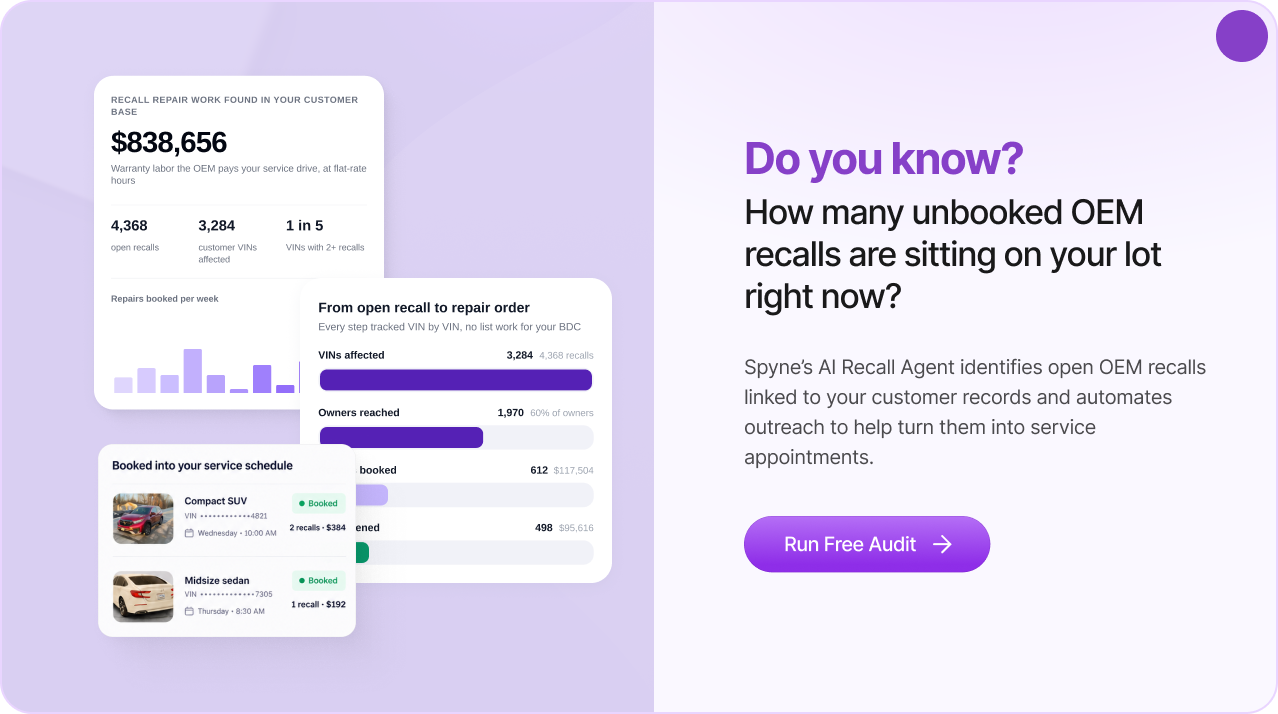

| Executive Summary: Dealership service retention is sliding. Cox Automotive found that only 54% of owners with vehicles under two years old returned to their selling dealer for service in 2025, down from 72% in 2023. Automated outreach, due-service reminders, recall campaigns, and no-show recovery, closes that gap when it runs on clean data and hands off to advisors correctly. Vini AI’s recall channel books recall appointments at a 33% rate on connected calls, turning a manual backlog into a predictable revenue stream. |
A dealership can lose a service customer long before that customer visits another repair facility. The loss often begins with a maintenance reminder that was never sent, an unanswered service call, a missed appointment that was not recovered, or declined work that was never revisited.
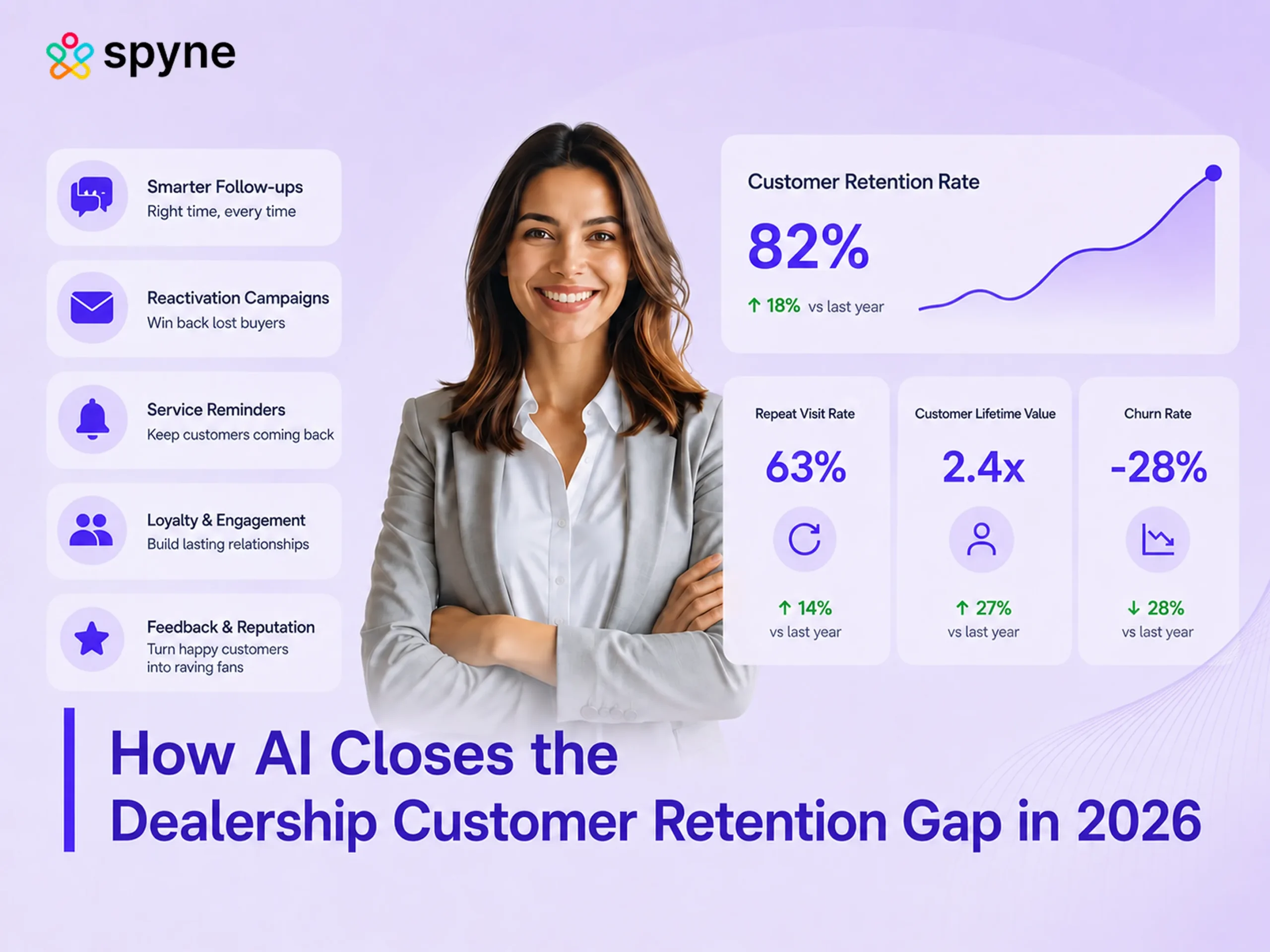
Cox Automotive reported that only 54% of owners with vehicles under two years old returned to their selling dealership for service in 2025, compared with 72% in 2023. Dealer share of service visits also declined, increasing pressure on fixed operations teams to protect customer relationships the dealership has already acquired.
AI-powered outreach helps address these gaps by identifying service opportunities, starting relevant conversations, supporting appointment actions, and recording customer outcomes. This article explains how AI improves dealership service retention, which outreach workflows create value, what data automation requires, and how dealerships should measure returned repair orders.
How Does AI Improve Dealership Service Retention?
AI improves dealership service retention by identifying customers who may be due for maintenance, recall work, follow-up, or re-engagement and initiating conversations based on verified dealership records.
Instead of relying entirely on advisors or BDC agents to review customer lists manually, AI can support workflows triggered by:
- Upcoming maintenance intervals
- Previous repair orders
- Open recalls
- Declined service recommendations
- Missed appointments
- Extended periods without a qualifying service visit
A practical retention workflow looks like this:
Service data identifies the opportunity → automated outreach starts a conversation → the customer books or returns → the DMS records the outcome → fixed ops measures the completed RO.
AI can send reminders, answer supported questions, confirm customer needs, assist with appointment actions, and route exceptions to dealership employees. Its primary value is consistency. Dealerships may already possess the customer data required for retention, but manually acting on every eligible record becomes difficult at scale.
AI does not create retention by itself. Successful retention still depends on accurate customer data, available appointment capacity, quality repairs, realistic commitments, and strong advisor communication. Dealerships assessing which processes are suitable for automation can use a dealership AI buyer’s guide to evaluate workflows, integrations, and operational requirements before deployment.
What Does Service Retention Mean for a Dealership?
Dealership service retention measures how effectively a store brings eligible customers back for future maintenance and repair work within a defined period.
A basic calculation is:
Returning eligible service customers ÷ eligible prior-period service customers × 100
However, a retention percentage is only useful when the dealership defines the underlying cohort consistently. Fixed operations leaders should specify:
- Which customers qualify for measurement
- The return period or service interval
- Which repair orders count
- Whether warranty, recall, and customer-pay work are included
- Whether first-service visits are measured separately
- Whether results are calculated by rooftop, brand, or dealer group
Service retention should not be confused with related dealership metrics.
| Metric | What it measures |
| Service retention | Whether eligible customers return for future service |
| Repeat repair orders | Whether customers generate additional service visits |
| Appointment show rate | Whether scheduled customers arrive |
| CSI score | Satisfaction with a specific service experience |
| Sales retention | Whether customers return to purchase another vehicle |
| Brand retention | Whether customers remain with the same manufacturer |
These metrics can influence one another, but they are not interchangeable. Automated reminders may improve appointment show rates, while recall outreach may increase completed repair orders. Neither guarantees higher CSI because satisfaction also depends on repair quality, pricing clarity, ready-when-promised performance, and advisor behavior.
Service retention also affects the broader ownership relationship. Customers who continue servicing at the dealership remain connected to its employees, vehicle records, and future sales opportunities. Fixed operations therefore contributes to both current service revenue and long-term customer lifetime value.
Why Are Dealerships Losing Service Customers?
Service customers do not always leave because of a single poor experience. Many gradually disengage because returning becomes inconvenient, communication is inconsistent, or another provider reaches them first.
1. Timely follow-up is inconsistent
Dealership databases contain customers approaching maintenance intervals, owners with open recalls, customers who declined work, and buyers who never completed a first service visit. Yet many of these records receive no meaningful follow-up because advisors and BDC teams cannot manually manage every opportunity.
AI can apply dealership-defined triggers to identify eligible records and initiate outreach before the customer becomes inactive.
2. Generic reminders fail to create urgency or relevance
A message stating that a vehicle “may be due for service” provides little reason to respond. Strong service outreach should reference verified details such as the vehicle, previous service activity, applicable maintenance context, dealership location, or reason for contact.
For example:
Hi Sarah, your 2023 Honda CR-V may be approaching its next maintenance interval based on your previous service history. Would you like help finding an appointment?
SMS is particularly useful for reminders because customers can respond immediately without starting another phone call. Dealerships evaluating this channel can review how automotive text messaging software supports two-way reminders, confirmations, and service conversations.
3. Missed service calls create lost appointments
Customers commonly call the service department to book appointments, check repair status, ask about recalls, reschedule visits, or request an advisor. When those calls go unanswered or remain on hold, customers may contact another provider.
An AI receptionist for dealerships can support routine inbound conversations, capture after-hours requests, answer approved questions, and route customers when an advisor needs to intervene. The goal is not to block access to employees. It is to prevent ordinary service requests from disappearing when the department is busy.
4. Limited after-hours access increases customer friction
Service needs do not follow dealership operating hours. Customers may attempt to schedule maintenance before work, ask a question during the evening, or respond to a reminder over the weekend.
An automotive virtual assistant can help maintain coverage across voice, chat, or messaging channels while escalating complaints, technical questions, estimates, and exceptions to dealership staff.
5. Declined work is rarely revisited consistently
Customers decline recommended service for several reasons, including cost, timing, uncertainty, or the need to discuss the repair with someone else. A declined recommendation does not necessarily mean the customer will never complete the work.
Automated outreach can create a defined follow-up process based on repair type, elapsed time, and dealership rules. However, AI should not exaggerate urgency, diagnose vehicle problems, or present unverified safety claims. Technical explanations, disputes, and exact repair estimates should move to a service advisor.
6. First-service relationships are not established early enough
The first service visit is a critical ownership milestone because it begins the relationship between the buyer and the dealership’s fixed operations team. When dealerships fail to engage customers before the first maintenance interval, independent repair shops and national service chains gain an opportunity to establish that relationship instead.
AI can support first-service outreach by identifying recently delivered vehicles, timing reminders around approved intervals, and offering an easy route to the service department.
7. Customer records are fragmented across dealership systems
Retention data may sit across the DMS, CRM, service scheduler, OEM systems, and communication platforms. When these systems do not share reliable information, dealerships risk contacting customers who already completed the work, no longer own the vehicle, or have an existing appointment.
Effective automation requires integration, suppression rules, and clear write-back processes. Dealerships planning these connections can use an AI implementation roadmap for dealerships to define data requirements, employee ownership, pilot workflows, and performance benchmarks before expanding automation.
Which Automated Outreach Workflows Improve Service Retention?
AI-powered outreach performs best when each campaign has a specific trigger, audience, message, and measurable outcome. A due-service reminder should not follow the same logic as recall outreach, no-show recovery, or post-repair follow-up.
| Outreach workflow | Recommended trigger | Desired outcome |
| First-service outreach | Vehicle delivery or approaching first maintenance interval | Establish the service relationship |
| Due-service reminders | Time, mileage, or service-history trigger | Generate routine maintenance visits |
| Recall outreach | Verified open recall matched to the VIN | Schedule eligible recall work |
| Appointment confirmation | Upcoming booked service visit | Confirm, cancel, or reschedule |
| No-show recovery | Missed service appointment | Rebook the customer |
| Post-RO follow-up | Recently closed repair order | Identify unresolved concerns |
| Declined-service follow-up | Previously recommended work remains incomplete | Recover deferred work |
| Lapsed-customer reactivation | No qualifying RO within a defined period | Restart the service relationship |
First-Service Outreach
The first service visit gives a dealership its earliest opportunity to build a fixed operations relationship with a recent buyer. Outreach can begin shortly after delivery and continue as the vehicle approaches an approved maintenance interval.
The message should introduce the service department, explain available support, and provide a simple booking path. Dealerships should avoid estimating mileage or presenting maintenance as overdue unless the underlying records support that statement.
Due-Service Reminders
Due-service reminders use time, mileage estimates, service history, or OEM-approved intervals to identify customers who may need maintenance. The strongest reminders reference verified vehicle information and ask one clear question.
For example:
Hi Sarah, this is ABC Motors. Based on your previous visit, your 2023 Honda CR-V may be approaching its next maintenance interval. Would you like help finding an appointment?
A reminder sequence may begin with an early notice, continue with a booking prompt, and stop when the customer schedules, completes service, opts out, or becomes ineligible.
Recall Outreach
Recall campaigns match open recall information with customer and VIN records before initiating contact. AI can explain the approved reason for outreach, answer supported questions, and help customers reach the scheduler or an advisor.
The system should not invent recall details, overstate urgency, or make unsupported claims about whether a vehicle is safe to drive. Questions involving safety, parts availability, or recall eligibility should reach dealership staff.
Appointment Confirmation and No-Show Recovery
Automated reminders can reduce avoidable no-shows by making confirmation, cancellation, and rescheduling easier. A practical sequence includes an immediate booking confirmation, a reminder 48 to 72 hours before the visit, and a final message for customers who have not confirmed.
When a customer misses an appointment, AI can ask whether they want to reschedule and update the service record accordingly. This section remains focused on retention. The complete mechanics of creating and managing appointments belong within a dedicated service scheduling resource.
Post-RO Follow-Up
Post-repair outreach helps dealerships identify unresolved concerns before the customer silently defects. A brief check-in can confirm whether the visit met expectations and surface customers who require manager or advisor attention.
AI may initiate the check-in and analyze the response, but complaints should not remain inside an automated sequence. Frustration, repeated repair concerns, billing disputes, and broken commitments require prompt human recovery.
Declined-Service Follow-Up
Customers may decline recommended work because of cost, timing, uncertainty, or competing priorities. Automated outreach gives the dealership a structured way to revisit the recommendation without depending on an advisor’s memory.
The campaign should use the actual declined recommendation, respect dealership-defined waiting periods, and stop when the work is completed or the customer declines further contact. AI should not diagnose the vehicle or present an exact repair estimate without approved data.
Lapsed-Customer Reactivation
A lapsed customer is not simply someone who has not visited recently. The dealership must define the expected return window according to service history, ownership status, vehicle age, and campaign purpose.
AI can work through eligible records, determine whether the customer still owns the vehicle, identify current service interest, and offer a path back to the dealership. Customers with active complaints, invalid ownership records, existing appointments, or opt-out status should be excluded.
How Does Automated Service Outreach Work?
Automated service outreach connects dealership data, communication channels, scheduling systems, and employee handoffs within one measurable process.
A complete workflow generally follows ten steps:
- Read eligible customer and vehicle records.
- Identify the applicable service trigger.
- Remove suppressed, duplicated, or ineligible records.
- Select the approved channel and campaign sequence.
- Reference only verified vehicle and service information.
- Ask about the customer’s current need.
- Answer questions within approved boundaries.
- Offer appointment or advisor assistance.
- Record the disposition and required next action.
- Measure whether the customer returns and completes an RO.
This creates a closed-loop process:
DMS or CRM data → outreach trigger → customer conversation → booking or handoff → recorded disposition → completed RO attribution
Voice outreach can support customers who prefer a direct conversation or have not responded digitally. Dealerships considering that channel should review how AI outbound calling for dealerships handles campaign eligibility, calling controls, conversations, and staff transfers.
What Data Does AI Need for Service Retention Outreach?
AI outreach is only as reliable as the dealership information supporting it. Sending a personalized message does not help when the vehicle, service requirement, appointment status, or ownership record is wrong.
A retention workflow may require:
- Customer name and valid contact information
- Channel permission and suppression status
- VIN, make, model, and model year
- Last service date
- Completed repair orders
- Declined recommendations
- Mileage or approved interval estimate
- Verified open recalls
- Existing appointments
- Preferred dealership location
- Assigned advisor
- Available appointment slots
Dealerships should establish a clear source of truth for every field. The service scheduler should control appointment availability, while the DMS should confirm completed repair orders. CRM notes and AI transcripts can support context, but they should not override verified service records.
Stopping rules are equally important. Outreach should pause when the customer books, completes the work, sells the vehicle, opts out, disputes the record, or enters another active workflow.
When Should AI Transfer a Customer to a Service Advisor?
AI should transfer the conversation whenever the customer’s request requires technical judgment, empathy, authorization, or information the system cannot verify.
Advisor involvement is appropriate when the customer:
- Disputes previous work or charges
- Reports a breakdown or possible safety issue
- Raises a complaint
- Requests a vehicle diagnosis
- Wants an exact repair estimate
- Questions warranty coverage
- Needs parts availability confirmed
- Requests a transportation or loaner exception
- Asks for a specific advisor
- Does not match the available customer or vehicle record
The transfer should include the customer’s verified details, reason for contact, conversation summary, transcript, and required next action. This prevents customers from repeating the entire conversation after reaching an employee.
The most useful operating principle is simple:
Automate routine communication. Escalate emotion, complexity, and exceptions to people.
How Should Dealerships Measure Service Retention Outreach?
Dealerships should judge automated outreach by returning customers and completed repair orders, not message volume.
NADA reported that franchised dealerships wrote more than 276 million repair orders and generated over $164 billion in service and parts sales during 2025. That scale makes service retention financially significant, but it also shows why measurement must connect campaign activity with actual dealership outcomes.
| Metric | What it shows |
| Eligible customer count | True campaignable audience |
| Contact or delivery rate | Accuracy of customer information |
| Conversation rate | Successful two-way engagement |
| Appointment-set rate | Conversations producing bookings |
| Appointment show rate | Booked customers who arrive |
| Rebook rate | Missed appointments successfully recovered |
| Recovered RO count | Completed work attributable to outreach |
| Repeat-customer rate | Longer-term service retention |
| Declined-work recovery rate | Deferred recommendations later completed |
| Opt-out rate | Possible targeting or frequency problems |
| Advisor escalation rate | Conversations requiring human support |
| CRM/DMS disposition coverage | Whether outcomes were recorded |
Each workflow should be reported separately. Recall outreach, due-service reminders, no-show recovery, and lapsed-customer reactivation have different audiences and completion events. Combining them into one average can hide weak targeting or poor execution.
Dealerships should also define attribution before launch. A booked appointment is not a completed RO. The final outcome should be verified through the dealership’s scheduler, DMS, or financial system using a stable customer, appointment, or VIN identifier.
Cox Automotive’s 2026 Fixed Ops and Ownership Research also found that 74% of buyers who returned to the selling dealership for service were likely to buy their next vehicle there, compared with 44% of buyers who did not return. This indicates that service retention can influence the dealership’s future sales relationship, although it does not prove that outreach alone caused repurchase intent.
What Are the Risks of Automating Service Outreach?
Most automated outreach failures begin with operations rather than conversation quality.
Common risks include:
- Incorrect or duplicated customer records
- Contacting customers after the work is complete
- Using unverified recall or maintenance information
- Sending too many reminders
- Ignoring communication preferences
- Weak opt-out processing
- Failing to update the DMS or CRM
- Continuing automation after a complaint
- Losing context during an advisor handoff
- Measuring attempts instead of completed ROs
Dealerships also need channel-specific compliance controls. The FCC has confirmed that AI-generated voices fall within the TCPA’s restrictions on artificial or prerecorded voice calls. Outbound campaigns should therefore use counsel-reviewed rules covering consent, calling purpose, permitted hours, Do Not Call suppression, opt-outs, and recordkeeping.
AI outreach is not automatically compliant because the customer previously purchased or serviced a vehicle. Eligibility must be established for the campaign and communication method being used.
How Vini AI Supports Dealership Service Retention
Vini AI helps dealerships maintain consistent service communication across voice and text. It supports fixed operations teams by initiating eligible outreach, handling routine customer requests, assisting with appointment actions, and routing complex conversations to the appropriate employee.
Key service retention capabilities include:
- Due-service reminder campaigns: Vini can contact eligible customers based on dealership-defined maintenance triggers and verified service records. It helps customers understand the reason for outreach and move toward an appointment or advisor conversation.
- Recall outreach: Vini supports outbound recall campaigns using approved customer and vehicle information. It can initiate conversations, capture customer interest, assist with scheduling, and escalate questions involving safety, parts, or eligibility.
- Inbound service call handling: Vini can respond to routine service inquiries when advisors are busy or the department is closed. This helps dealerships capture appointment requests and customer questions that might otherwise go unanswered.
- Appointment booking and rescheduling: Customers can receive support with booking, confirming, or changing service appointments through connected dealership workflows. Complex scheduling requests can be transferred to the fixed operations team.
- Customer qualification and advisor routing: Vini identifies why the customer is contacting the dealership and routes complaints, technical questions, estimate requests, and other exceptions to the appropriate advisor or department.
- CRM logging and campaign dispositions: Customer responses, appointment outcomes, follow-up requirements, and opt-out requests can be recorded for dealership teams. This gives fixed operations leaders greater visibility into which outreach campaigns produce returning customers.
- Communication and suppression controls: Vini supports Do Not Call, opt-out, and campaign suppression rules so dealerships can stop irrelevant outreach and avoid repeatedly contacting customers who are already scheduled or ineligible.
In a Spyne-reported one-week Paragon Honda recall campaign, Vini placed 80 calls, achieved a 53% connection rate, and booked 13 recall appointments. This represents one campaign sample rather than a guaranteed performance benchmark.
Vini supports the communication layer of service retention, but it does not replace strong lane execution. Accurate customer data, available appointment capacity, advisor follow-through, and quality repairs ultimately determine whether customers continue returning.
How Should a Dealership Launch Automated Retention Outreach?
A dealership should begin with one measurable workflow rather than automating the full ownership cycle immediately.
- Define the cohort: Establish who qualifies and what return window applies.
- Select one campaign: Start with due service, recalls, or no-show recovery.
- Audit the data: Check ownership, contact information, service history, consent, and suppression status.
- Set conversation boundaries: Define what AI can answer and when employees take over.
- Confirm integration depth: Test scheduler availability, booking write-back, CRM logging, and DMS outcome matching.
- Assign ownership: Give advisors or managers responsibility for escalations.
- Pilot a controlled segment: Avoid launching across the entire database initially.
- Review conversations: Identify inaccurate data, weak messaging, and missed handoffs.
- Compare outcomes: Measure bookings, shows, completed ROs, opt-outs, and repeat visits against the baseline.
- Expand carefully: Add another workflow only after the first campaign operates reliably.
A 60-to-90-day pilot should determine whether outreach creates incremental completed ROs after accounting for existing demand, campaign costs, and staff involvement.

Conclusion
AI improves dealership service retention when it turns reliable service data into timely customer conversations. Effective outreach identifies eligible customers, references verified vehicle information, respects communication preferences, and creates a clear path to an appointment or advisor.
Dealerships should begin with one measurable workflow, such as due-service reminders, recall outreach, or no-show recovery. They can then compare booked appointments, shows, completed repair orders, and repeat visits against a defined baseline. When automation, integrations, and human handoffs work together, fixed operations teams can recover more service opportunities without adding another manual process.
Book a demo with Spyne to see how Vini AI supports automated service outreach and customer retention.