
Executive SummaryAn automotive CRM with AI adds automated lead prioritization, omnichannel follow-up across text, email, and chat, and predictive reporting to standard dealership CRM functions. Cox Automotive (2025) found 60% of dealers are already testing AI tools across departments, and Salesforce (2026) reports sales reps lose 60% of their time to non-selling admin work that AI can absorb. Platforms like Spyne Automotive CRM combine this AI layer with omnichannel lead capture so dealerships run one system instead of stitching several together. |
A hot lead sits untouched for six hours because the BDC rep is buried in call logs and spreadsheet follow-ups. By the time someone reaches out, the buyer has already test-driven a car two lots over. This is the gap an automotive CRM with AI is built to close. Cox Automotive (2025) found 81% of dealers now believe AI adoption is critical to staying competitive, yet most CRMs still rely on a human to catch every lead in time. This guide covers what AI adds to a dealer CRM, which features matter, and the strategies that make adoption stick.
What Is Automotive CRM With AI?
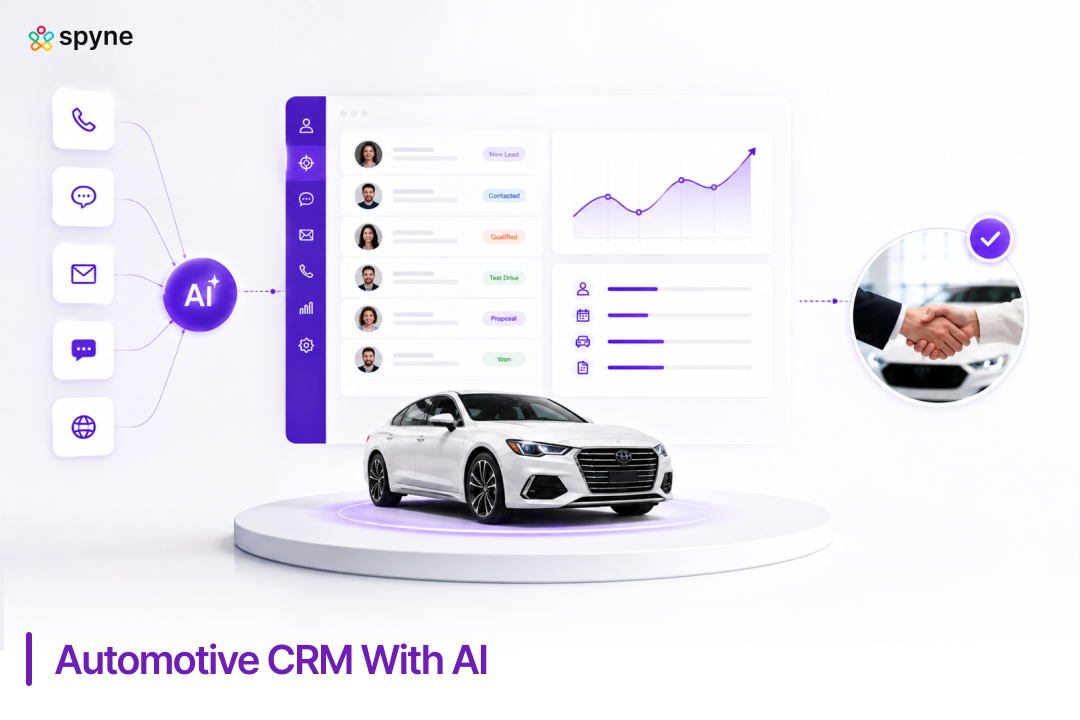
Automotive CRM with AI is dealership CRM software that uses automation and predictive logic to prioritize leads, trigger follow-ups, and surface insights without a rep managing every step manually. A standard dealership CRM stores contact records, tracks pipeline stages, and logs communication history. Layering AI on top means the system decides which leads need attention first, sends a first response automatically, and flags deals at risk of going cold. For a General Manager, the practical difference is fewer leads sitting in a queue and more consistent follow-up across every rep, regardless of how busy the desk is.
Why Dealerships Are Moving to AI-Powered CRM Now
Dealerships are adopting AI-powered CRM because manual follow-up cannot keep pace with lead volume across web, phone, chat, and walk-in channels. Cox Automotive (2025) surveyed 537 franchise leaders and found 60% are testing AI tools across departments, though only about 15% have fully embedded AI into daily workflows. Salesforce (2026) reports 60% of a rep’s time goes toward non-selling tasks like data entry, work automated CRM logic can absorb. Gartner’s 2024 survey found reps using AI tools are 3.7 times more likely to hit quota, a gap that matters to any Sales Manager.
AI Features in Dealer CRM Platforms
The AI features in dealer CRM platforms that matter most center on speed, accuracy, and follow-through, not novelty. Below are the capabilities worth evaluating in any automotive CRM with AI.
1. AI Lead Scoring
Lead scoring ranks incoming leads by likelihood to buy, using signals like response speed, page views, and past purchase data. This helps a BDC Manager route the hottest leads to the strongest closers first instead of working the list in order.
2. Automated First Response
Conversational AI sends an instant text, email, or chat reply the moment a lead comes in, even at 9 p.m. on a Sunday. Cox Automotive (2025) found 52% of dealers already use 24/7 text, chat, or email engagement as their top AI marketing use case.
3. Predictive Follow-Up Timing
Predictive automated follow-up timing tells a rep when a lead is most likely to respond, rather than defaulting to a fixed three-day cadence. This cuts down on calls that go straight to voicemail.
4. Conversation Summarization
Conversation summarization pulls key points from a long call or chat into a short note, so the next rep on the deal does not have to re-read the history before calling back.
5. Sentiment and Intent Detection
Sentiment and intent detection flags when a customer’s tone shifts, such as frustration about financing delays, so a manager can step in before the deal is lost.
6. Missed-Lead Recovery
Missed-lead recovery scans the database for cold leads and resurfaces ones showing renewed buying signals, like revisiting the website or opening old emails.
How the Best AI Automotive CRM Helps Dealers Sell More
The best AI automotive CRM helps dealers sell more by closing the gap between when a lead arrives and when a human responds. A lead that gets a response within five minutes converts at a meaningfully higher rate than one contacted hours later, which is why automated first response and lead scoring have the most direct effect on closing ratios.
Beyond first contact, AI-driven reporting shows a Sales Manager exactly where deals stall, whether that is financing approval, trade appraisal, or a slow callback, so the team can fix the actual bottleneck instead of guessing. For Fixed Ops, similar logic applies to service-to-sales handoffs, where AI can flag customers whose vehicle age and mileage suggest they are close to a trade-in decision. Spyne Automotive CRM applies this same logic inside the CRM itself, since automated first response and lead prioritization run in the platform reps already use for pipeline tracking, not a bolt-on tool.

Best Automotive CRM Platforms With Built-In AI Features
Best automotive CRM platforms with built-in AI features generally fall into three categories: automotive-specific CRMs built for dealership workflows, enterprise CRMs adapted for auto retail, and communication-first platforms centered on texting and chat. Automotive-specific platforms tend to have deeper DMS and inventory integration, since they are built around vehicle data from the start.
Enterprise CRMs bring stronger reporting but need more setup for workflows like trade appraisals or F&I handoffs. Communication-first platforms lead with response speed but often need a separate system for full pipeline tracking. Spyne Automotive CRM sits in the automotive-specific category, built around omnichannel lead capture and AI-assisted follow-up, not general-purpose automation retrofitted for dealers.
Best AI Automotive CRM Comparison: What to Evaluate Before You Buy
A best AI automotive CRM comparison should start with integration depth, not feature lists, since an AI feature is only as useful as the data it can see. Evaluate platforms on:
- DMS and inventory integration: Can the CRM pull live inventory and DMS data, or does it work off static imports that go stale within days?
- Omnichannel response coverage: Does automated first response cover text, email, and chat from one system, or does each channel need a separate tool?
- Data accuracy safeguards: Cox Automotive (2025) found 74% of dealers worry about AI accuracy and errors, so ask vendors how scoring models are trained and corrected.
- Reporting depth: Can the GM see conversion by source, rep, and lead type, or only high-level totals?
- Training and support: Cox Automotive (2025) also found 66% of dealers want more AI training, so ask what onboarding actually includes.
See the table below for how Spyne Automotive CRM stacks up against other automotive-specific platforms on this basis.
Automotive CRM AI Strategies for Dealership Teams
Effective automotive CRM AI strategies start small and expand once the team trusts the system:
- Start with one workflow. Automate first response for web leads only before expanding to phone and chat.
- Set a review cadence. Have a manager spot-check AI-scored leads weekly to catch scoring errors early.
- Train reps to override, not avoid, the system. Reps should feel comfortable correcting an AI suggestion, not working around it.
- Tie adoption to a metric. Track response time and lead-to-appointment conversion before and after rollout so the team sees proof, not just process change.
Automotive CRM AI Tips and Mistakes to Avoid
The most useful automotive CRM AI tips focus on adoption discipline, not feature count.
Tips:
- Audit your current lead response time before rollout for a real baseline.
- Assign one person to own AI configuration instead of leaving it to whoever has time.
- Review flagged leads weekly for the first quarter to catch bad scoring patterns.
Common mistakes:
- Turning on every AI feature at once, which overwhelms reps and hides which one is failing.
- Letting automated messages go out with no human review in the first few weeks.
- Ignoring rep feedback when AI scoring does not match what the floor is seeing.
AI Automotive CRM Platforms at a Glance
| Platform | Best For | AI Capabilities |
| Spyne Automotive CRM | AI-assisted lead prioritization with omnichannel follow-up | Lead prioritization, automated follow-up, missed-lead recovery, conversion reporting |
| VinSolutions CRM | Franchise dealerships needing OEM integration | Predictive lead scoring, AI-driven engagement |
| DealerSocket CRM | Multi-location dealership groups | Lead scoring, automated follow-up workflows |
| Elead CRM | Enterprise-scale dealership groups | AI-assisted workflows, lifecycle management |
| AutoRaptor | Independent and multi-location dealerships | AI-assisted lead management, automated messaging |
Spyne Automotive CRM: Automotive CRM With AI Built for Dealerships
Spyne Automotive CRM is an AI-powered automotive CRM built for dealerships that centralizes lead management, sales pipelines, customer communication, and reporting so teams are not chasing leads across disconnected tools. It fits into daily operations at the point a lead first enters the system, whether from the website, a phone call, or a walk-in, and stays with that customer through follow-up, appointment, and sale. Below are the core capabilities that make it an automotive CRM with AI that dealerships can run day-to-day.
1. AI-Assisted Lead Prioritization
Spyne Automotive CRM ranks incoming leads by engagement signals so reps know which ones to call first. A BDC team handling 80 leads a day can work by likelihood to convert instead of timestamp, cutting down on hot leads left untouched.
2. Automated Follow-Up Sequencing
The platform triggers follow-up texts and emails on a schedule tied to lead behavior, so a lead gone quiet for 48 hours gets a re-engagement message automatically. This keeps follow-up consistent even when the desk is short-staffed.
3. Centralized Communication Timeline
Every call, text, email, and chat lands in one timeline attached to the customer’s record. When a different rep picks up a deal mid-cycle, they see the full history in seconds instead of asking the customer to repeat themselves.
4. Pipeline and Deal-Stage Tracking
Deals move through clear stages from first contact to sold, with visibility into where each one is stuck. A Sales Manager can see if deals are piling up at credit approval and address it before month-end.
5. Missed-Lead Recovery Alerts
Our CRM system flags leads that went cold but show renewed activity, like revisiting a vehicle listing weeks later. This lets a rep re-engage a warm lead instead of leaving it in a dead file.
6. Performance and Conversion Reporting
Built-in reporting breaks down conversion by lead source, rep, and vehicle type, giving a GM the detail to see whether marketing spend is producing appointments and sales, not just clicks.
7. Mobile Access for On-the-Lot Follow-Up
Reps can view lead details and send follow-ups from a phone while walking the lot, so a customer who just left after a test drive gets a same-day message instead of waiting until the rep is back at a desk.

Conclusion
An automotive CRM with AI is not about flashy features. It is about closing the response gap that costs dealerships real deals every week. Cox Automotive (2025) found 81% of dealers already see AI adoption as critical to staying competitive, yet most are still in early testing. The dealerships that win will pick an automotive CRM with AI based on integration depth, omnichannel coverage, and reporting clarity, roll it out with clear ownership, and hold the team accountable to metrics that move gross.