
| Executive Summary: Vini AI by Spyne answers every inbound service call in under 5 seconds and checks live OEM recall and parts data before a customer ever hangs up, recovering $310,000 in missed service revenue at Paragon Honda in one week. Numa recovers calls only after they’ve already been missed, via a follow-up text. For dealerships that want prevention instead of recovery, and one AI system across sales, service, parts, and F&I, Vini AI is the stronger platform. |
Service lane calls follow a pattern most dealerships already know: volume peaks between 8 and 11:30 a.m., exactly when advisors are also handling walk-in customers at the counter. Car Wars found dealerships miss roughly 19 million service calls a year industry-wide, with more than half going to voicemail. Some of those calls are routine, checking on a repair, confirming an appointment. Others are recall inquiries or parts questions that need a real answer, not a callback promise. AI call handling exists to close that gap, and two platforms built for dealership service departments have taken different approaches to solving it. This piece compares Vini AI and Numa on recall handling, DMS integration, rollout speed, and cost.
Is Numa or Vini AI Better for Service Lane Calls?
Vini AI is the stronger platform for service lane calls, because it prevents the miss instead of recovering from it.
- Car Wars tracked 53 million inbound service calls in 2025; about 19 million went unanswered
- Numa’s Missed Call Recovery only activates after a customer has already hung up frustrated
- Vini AI answers in under 5 seconds, so there’s rarely a missed call to recover from
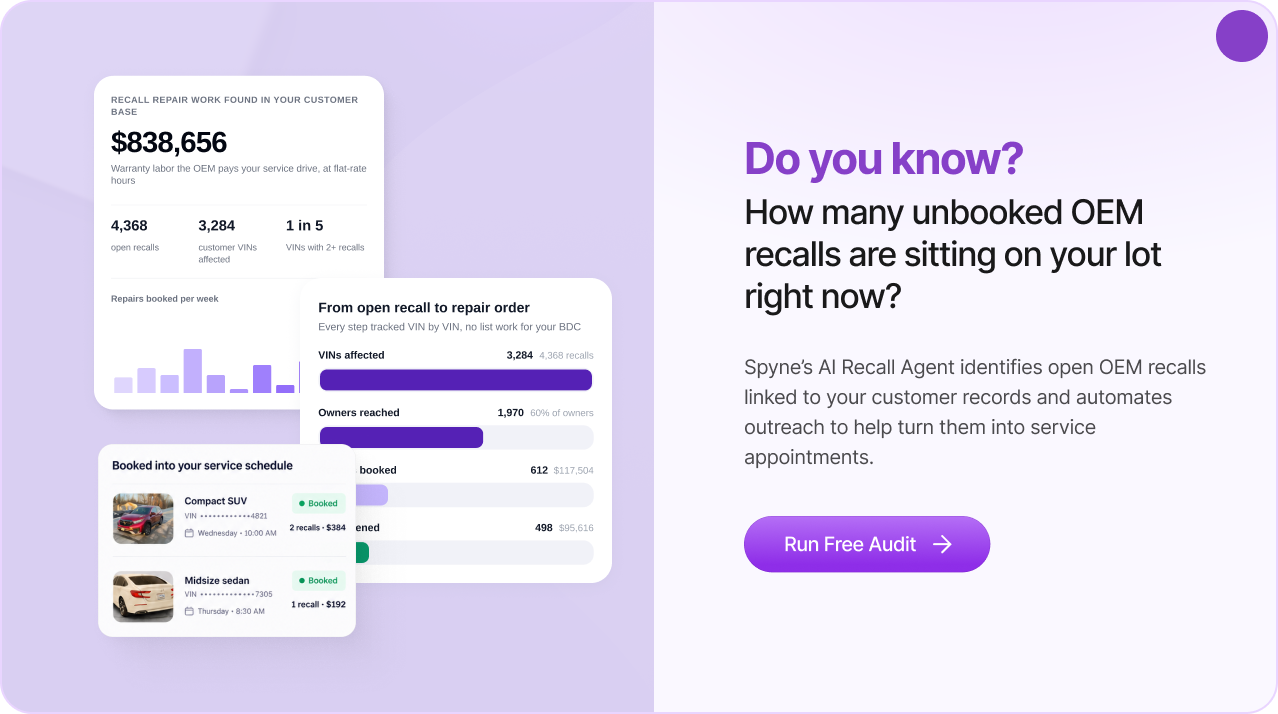
- Vini AI checks live recall and parts data mid-call; Numa routes that conversation elsewhere
- Numa’s real strength is narrower: single-department coverage, nothing else
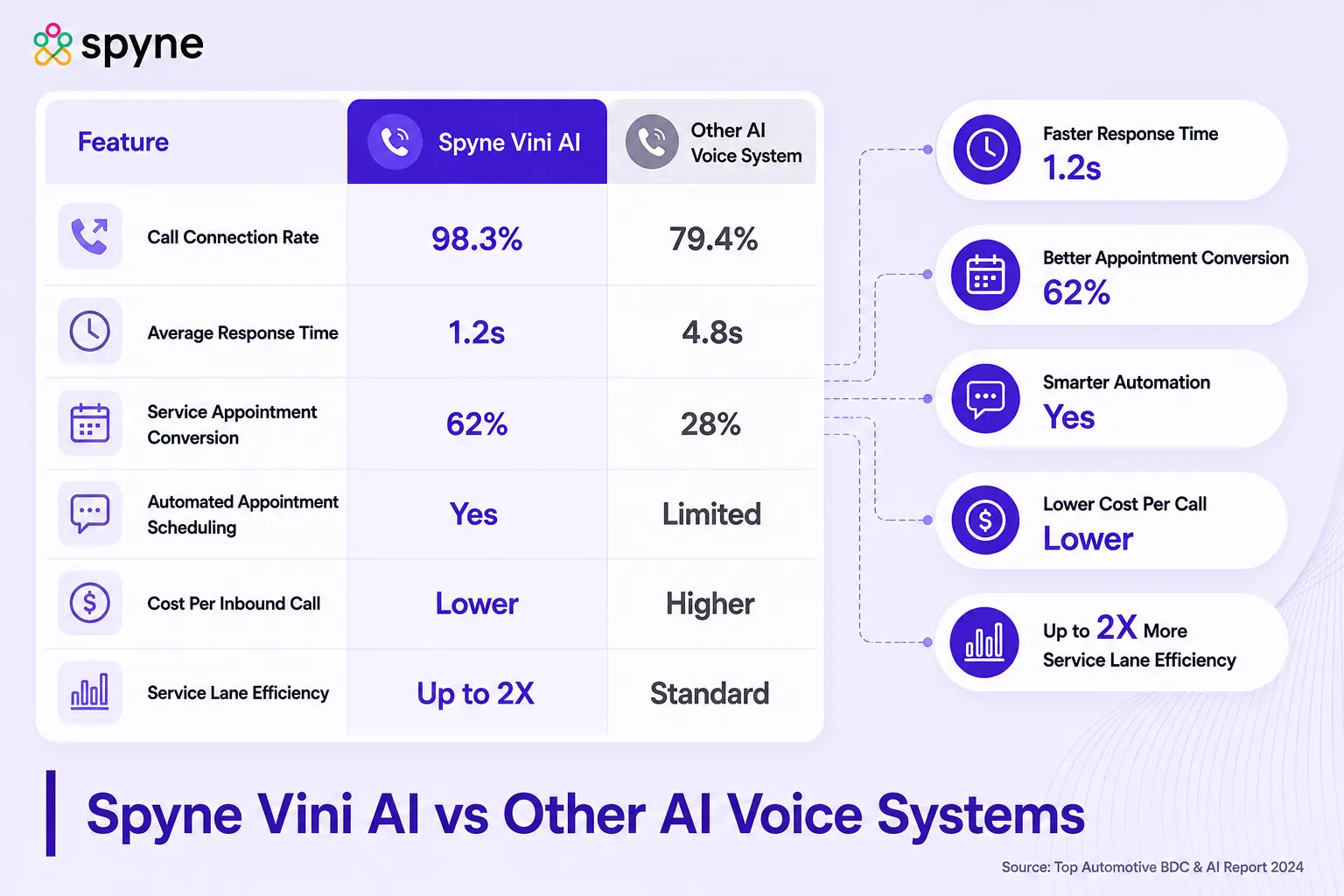
| Metric | Vini AI (Spyne) | Numa |
| Missed calls | Prevented, sub-5-second live answer | Recovered after the fact via text, ~66% of misses |
| Recall handling | Live OEM data checked mid-call | Recall-aware messaging only, no live lookup |
| DMS integration | 50+ named systems (CDK, Reynolds, VinSolutions, DealerSocket, Tekion, Xtime, Dealertrack) | Self-reported ~90% coverage, unspecified beyond CDK/Reynolds |
| Advisor escalation | Full transcript passed pre-handoff | Advisor reassignment within Smart Inbox, no transcript detail published |
| Department scope | Sales + service + parts + F&I, one dashboard | Service and parts only, ceiling on value as a dealership scales |
| Human QA | Every call reviewed daily | Not publicly specified |
| Compliance | SOC2, TCPA, GDPR, DNC documented | Not publicly specified |
| Setup | 10–14 days including supervised live testing | Under 15 minutes, software activation only |
What Does Vini AI Do on the Service Lane?
Vini AI answers every service call in under 5 seconds and checks live recall and parts data before booking.
- Pulls live OEM recall data mid-call, confirms coverage before booking.
- Passes full call transcript to the advisor pre-handoff, no restart on escalated calls.
- Runs a 3-touch declined-service follow-up: 48 hours, 7 days, 30 days, naming the specific item.
- Delivers a +35% RO rate lift when scheduling and follow-up run together.
- Every AI call reviewed by a human daily.
- Operates under SOC2, TCPA, GDPR, and DNC compliance frameworks.
What Does Numa Do on the Service Lane?
Numa is a service-and-parts-only AI platform running on 1,300+ dealership rooftops, with no cross-department coverage.
- Missed Call Recovery auto-texts customers after a missed call, recovering ~66% of those contacts after the fact
- Smart Inbox unifies calls, texts, and service-lane messages in one workspace
- Advisor can loop in a technician or parts department mid-conversation
- Scheduling checks availability against the DMS, tuned on repair-order language
- ~90% DMS coverage industry-wide, strongest on CDK and Reynolds & Reynolds
- Runs on existing phone lines, setup under 15 minutes for activation only
- Numa positions itself as dealership/service-center specific, with no stated path into sales or F&I coverage
Six Metrics That Actually Decide This Comparison, Not a Feature List
Six factors decide this evaluation, not a generic feature list:
- Prevention vs. recovery: does the platform stop a missed call, or clean up after one
- Recall-spike handling without a human step
- DMS/CRM integration depth
- What happens the instant a call needs a person
- One department covered, or four
- Documented compliance and QA, not just self-reported feature claims
How Do They Handle the Same Call Differently?
A customer calls: their car is in today for an oil change, and they mention considering a trade-in.
With Numa: confirms repair status, routes the trade-in mention to sales. Service resolves fast; the sales opportunity depends on a clean handoff actually happening.
With Vini AI: confirms repair status, surfaces matching inventory, offers a test drive, all in the same call. The RO and the sales lead both get worked without a transfer or a dropped thread.
Which Platform Fits Your Dealership: Single Store, Group, or Enterprise?
| Situation | Recommendation |
| Single rooftop, zero cross-department need | Vini AI still prevents more misses; Numa is workable only if sales stays fully separate |
| 2–20 store group, mixed service/sales calls | Vini AI, cross-department capture has real value at this volume |
| 20+ store enterprise group | Vini AI, one dashboard beats a vendor per department per rooftop |
| Independent service center, single department | Neither platform is built for this scope; Numa’s narrower focus is the closer fit if forced to choose |
Rollout Timeline: 10-14 Days vs Under 15 Minutes, What That Actually Means?
- Vini AI: 10–14 days from contract to full autonomous handling. Days 1–7: DMS integration, routing, escalation rules. Days 7–14: supervised live period with human monitoring before full handoff.
- Numa: Under 15 minutes for software activation on existing phone lines. This covers activation only, not script tuning, workflow configuration, or a published testing period.
Choose Vini AI if you want calls answered before they’re missed rather than recovered afterward, you need sales and service handled by one system, or documented compliance matters to your evaluation.
Choose Numa only if your dealership has zero cross-department need at all, service is fully walled off from sales and BDC, and same-day software activation matters more than a documented, QA-supervised rollout.
The Objections Fixed Ops Directors Raise Before Buying Either Platform
- “We already have a BDC.” Vini AI covers overflow, after-hours, and peak-hour calls the BDC can’t reach. Coverage, not replacement.
- “We’re not missing that many calls.” CDK Global shows dealerships miss 19% of incoming calls on average, 38 calls on a 200-call day.
- “Advisors prefer handling calls themselves.” Most stores start with after-hours/peak overflow only. Full coverage is a later choice, not a forced change.
- “Not confident in AI call quality.” Vini AI trains on real dealership conversations and adds daily human QA on every call, with documented compliance under SOC2, TCPA, GDPR, and DNC.
What a Missed Service Call Actually Costs (by Dealership Size)?
NADA’s 2025 data: average repair order value is $470.
| Dealership Size | Missed Calls/Month | Annual Exposure |
| Single rooftop | 50 | $84,600 |
| Mid-size (2–20 stores) | 158 (industry avg.) | $267,336 |
| Large group (20+ stores) | 216+ per rooftop | $362,880+ per store |
Assumes a 30% book rate, consistent with Foureyes’ 74% phone-to-appointment conversion for connected calls.
Closing Thoughts
The service lane fails when phone volume and walk-in traffic peak in the same window, not because advisors don’t care. The real choice isn’t between two equally good options, it’s between preventing a missed call and cleaning up after one. Missing even 50 service calls a month costs over $84,000 a year. Book a demo with Spyne to see Vini AI handle a live recall call, start to finish, on your DMS.