
| Executive Summary
The average dealership misses 23% of inbound calls, losing an estimated $1.17 million in annual service revenue per store. Vini AI, Spyne’s purpose-built dealership AI, answers every call in under five seconds, handles 70% of routine sales and service interactions without human involvement, and integrates natively with CDK, Reynolds & Reynolds, VinSolutions, Xtime, and Tekion. Paragon Honda recovered $310,000 in a single week after deployment. The tools ranked below are evaluated on one criterion: automotive fit. |
Most dealerships are not failing at customer service because of attitude problems or inadequate staff. They are failing because their phone infrastructure was designed for a different era. Car Wars tracked roughly 53 million inbound service calls across its dealer network in 2025, of which approximately 19 million represented missed opportunities, 53% landing in voicemail and 29% abandoned by callers who waited on hold too long. Only 44% of those missed calls were ever recovered, even when buying signals were present in the original interaction. Vini AI responds in under five seconds, handles 70% of routine interactions without human involvement, and connects natively to the systems your team already uses. This post ranks the leading AI receptionist platforms by automotive fit and gives you the evaluation framework to choose the right one.
What does an AI receptionist actually do in a dealership?
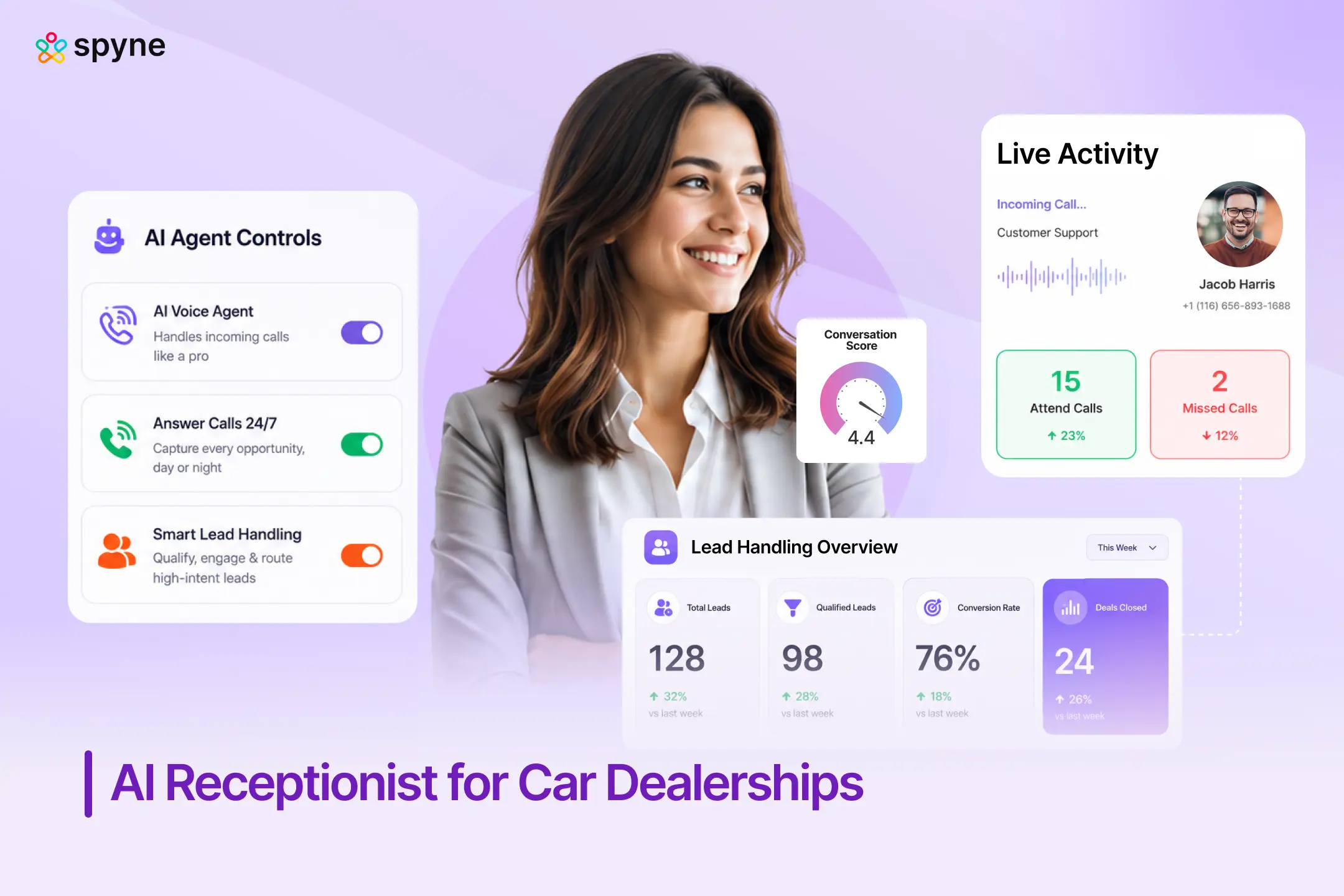
An AI receptionist for car dealerships is a conversational, voice-enabled system that answers inbound and outbound calls, interprets customer intent using natural language processing, and books appointments or logs interactions directly into the dealership’s CRM or DMS, no human involvement required.
The distinction from an IVR matters operationally. A “Press 1 for sales” menu routes calls without resolving them, and every unresolved call is a potential repair order or sale deferred, not handled. Modern dealership AI receptionist software answers the intent behind the call. “My brakes are grinding” routes to service scheduling with a confirmed appointment slot. “I saw the Accord on your lot” routes to a qualified sales handoff with vehicle details pre-loaded. The call gets resolved in a single exchange.
What a purpose-built dealership AI receptionist does:
- Answers inbound calls 24/7, including the 9 PM sunday calls that previously went to voicemail until Monday morning
- Pulls live inventory, pricing, and appointment availability directly from the DMS, not from a static script
- Qualifies buyer or service intent and routes complex conversations to the appropriate human with full call context
- Books confirmed appointments without a callback or manual follow-up step
- Logs every interaction into the CRM automatically, including contact details, vehicle interest, and intent signals.
How much revenue are dealerships losing to missed calls?
At a $450–$470 average repair order, NADA’s 2024 data puts the average service and parts sales per customer RO at $466, climbing to $470 in the first half of 2025, the arithmetic on missed calls is direct. Car Wars tracked 53 million inbound service calls in 2025, of which 19 million were missed opportunities. Of those, 53% reached voicemail and 29% abandoned after being put on hold. At a conservative 30% book rate on recovered calls, 158 missed calls per month represents roughly $21,000 in lost monthly gross, more than $250,000 annually per store.
The timing compounds the problem. Service call volume peaks between 10 AM and noon, the same window when customers most frequently request appointments, while advisors are simultaneously managing walk-in traffic at the service lane. Every minute an advisor spends on a routine scheduling call is a minute they are not at the write-up desk with a customer who drove in.
| Missed calls/month | Avg. RO value | Book rate (30%) | Monthly lost revenue | Annual lost revenue |
| 50 | $450 | 30% | $6,750 | $81,000 |
| 100 | $450 | 30% | $13,500 | $162,000 |
| 158 (industry avg.) | $450 | 30% | $21,330 | $255,960 |
| 216 (high-miss stores) | $450 | 30% | $29,160 | $349,920 |
Conservative estimate using 30% book rate. Full conversion scenarios at the industry 74% phone-to-appointment rate produce multiples of these figures.
What separates automotive-native AI from general-purpose tools?
Not all products marketed as “AI receptionist” are built for dealership workflows. Most were built for call centers, healthcare, or general small business and later retrofitted for automotive. The gap between them and a purpose-built system shows up at four specific points.
#1- DMS integration depth. A general-purpose tool can check a static calendar. An automotive-native platform writes back into the DMS scheduler in real time, confirming the appointment slot, updating the repair order, and syncing with Xtime, CDK Service, or Reynolds Service without a manual step. Read-only integration and bi-directional write integration are not the same product.
#2- VIN-aware conversation handling. A customer calling about a recall on their 2021 RAV4 expects the system to know what that recall is, whether parts are in stock, and how long the repair takes. A platform trained on dealership conversation patterns and connected to live OEM recall data can answer that. Generic AI cannot.
#3- Service lane workflow training. Routing a brake noise complaint to the right technician tier, distinguishing whether a complaint warrants a warranty claim, and differentiating a waiter appointment from a drop-off, these require automotive-specific training data, not general customer service logic built for other industries.
#4- Human QA on every call. Most platforms use flagged-call review, meaning a percentage of low-quality interactions are never audited. Vini AI runs daily human quality assurance on every call across its dealer network. The AI handles the call; a human confirms the quality. This is the operating difference that produces the outcome data Spyne can name.
Vini AI integrates natively with CDK, Reynolds & Reynolds, Xtime, VinSolutions, DealerSocket, Tekion, and Dealertrack, more than 50 CRM and DMS integrations, with direct VDP integration for inventory-aware conversations. The under-five-second response time and 89% first-call resolution rate are functions of that integration depth, not just the underlying AI model.
Top AI Receptionist Software for Car Dealerships (2026)
This table ranks tools by automotive fit, defined as the combination of DMS integration depth, dealership-specific conversation training, and documented operational outcomes in automotive environments.
The Automotive-Native column uses three ratings:
- Purpose-built (designed from the ground up for dealerships)
- Adapted (capable platform with automotive connectors added to general infrastructure)
- Generic (cross-industry tool requiring significant configuration for dealership use)
| Tool | Best For | Automotive-Native | Key DMS Integrations | Starting Price |
| Vini AI (Spyne) | Full-coverage AI BDC across sales, service, parts, and F&I, voice, SMS, and chat unified | Purpose-built | CDK, Reynolds, Xtime, VinSolutions, DealerSocket, Tekion, Dealertrack (50+) | Custom |
| Numa | Enterprise dealer groups needing unified communication across all rooftops | Purpose-built | CDK, Reynolds, major DMS | Custom |
| Toma AI | Service scheduling and inbound voice with reinforcement learning at the store level | Purpose-built | CDK, Xtime, Tekion | Custom |
| Pam AI | Outbound service follow-up and missed-call re-engagement automation | Automotive-focused | CDK, Reynolds, DealerSocket | Custom |
| STELLA | High-volume inbound service scheduling, especially on Tekion and CDK stacks | Automotive-focused | Tekion, CDK | Custom |
| Conversica | Enterprise multi-rooftop lead nurture and follow-up, stronger on leads than phones | Adapted | CDK, VinSolutions, Salesforce | Custom / enterprise |
| Podium (Jerry) | Messaging-first stores already standardised on the Podium platform | Adapted | Major DMS via Podium | From ~$399/month |
| Smith.ai | Smaller stores needing after-hours overflow with light call volume | Generic | No native DMS integration | From ~$300/month |
How to read this table: Purpose-built means the platform was designed from the ground up for dealership workflows. Adapted means a capable platform that built automotive connectors onto general infrastructure. Generic means it requires significant configuration and will not natively understand your DMS, service lane workflow, or VIN-level inventory data.
Which calls should go to AI, and which still need a human?
The question dealers most commonly avoid when evaluating AI receptionist software is the one that determines whether deployment succeeds: which call types should route to AI, and which require a human? The answer is operational, not philosophical.
Most dealer objections to AI phone handling stem from imagining the wrong call going to the wrong system. The frame that resolves this is simple: calls that require resolution get handled by AI. Calls that require judgment go to a human.
| Call Type | Route to AI | Route to Human |
| Service appointment booking | Yes | |
| Oil change, tire rotation, recall scheduling | Yes | |
| Parts availability inquiry | Yes | |
| Vehicle availability and pricing questions | Yes | |
| After-hours inquiry of any kind | Yes | |
| Inbound overflow during peak hours (8–11:30 AM) | Yes | |
| Returning customer status update (“where’s my car?”) | Yes | |
| Test drive scheduling | Yes | |
| Warranty dispute or repair cost disagreement | Yes | |
| Billing complaint or overcharge concern | Yes | |
| Trade-in negotiation | Yes | |
| Emotionally escalated caller | Yes | |
| Finance or F&I structure discussion | Yes | |
| Complex multi-vehicle fleet inquiry | Yes |
The stores seeing the best outcomes from AI receptionist deployment are the ones that map this explicitly before go-live. Fixed Ops appointment booking at 9 PM does not require human judgment. A customer disputing a repair cost does. Defining the boundary in advance means the AI handles its call types cleanly and every escalation reaches a human with full context already loaded.
Vini AI’s escalation architecture transfers any interaction that exceeds its confidence threshold to the appropriate human advisor in real time, with a full transcript of the conversation visible on their screen before they say a word. The advisor does not start from scratch. The caller does not repeat themselves.
What questions should you ask an AI receptionist vendor before signing?
Most vendor demos are scripted. A fixed-path demo that handles rehearsed prompts tells you nothing about how the system performs when a caller says “my lease is up in three months, I want to trade it in, and I also need an oil change before I do, can I come Tuesday?” That is a real dealership call. Ask these five questions before any contract:
- Is your DMS integration read-only or bi-directional? Read-only means the AI can check availability but cannot confirm a booking live. The appointment still requires a human callback. Bi-directional means the AI writes the appointment directly into the DMS scheduler during the call. Ask for a live demonstration on your actual DMS, not a sandbox environment.
- Can you show documented results from a dealership on my exact DMS stack? CDK and Reynolds integrations at the same vendor vary significantly in depth. One may be fully certified, the other a lighter API layer. Ask for a reference customer running your specific DMS combination, not a general reference list.
- What triggers a live transfer, and what does the handoff look like? The answer should be specific: which call types trigger escalation, what context is passed to the advisor, and what happens if no advisor is available. Vague answers here indicate the handoff has not been designed for production volume. A handoff that restarts the conversation from scratch means the caller repeats everything they just told the AI.
- What does onboarding look like, with milestones? Dealers are advised not to sign annual contracts without first running a 30–60 day pilot to validate how the AI performs in their specific store. A vendor that pushes back on a supervised pilot period before full deployment is a vendor that does not want you to see the gap between demo conditions and production performance.
- Who reviews call quality, and how often? Most platforms use flagged-call review, meaning a percentage of poor interactions never get audited. Vini AI runs daily human QA on every call across its network. Ask any vendor whether they review all calls or only escalations. The answer tells you how much accountability they have built into their own system.
Why do AI receptionist deployments fail at dealerships?
The technology is rarely the problem. The deployment is. As quoted in a report: dealers who assume AI will plug in and solve everything tend to see poor results; the approach that works treats AI like a new hire who needs proper onboarding and training specific to each store’s culture and processes. Three failure patterns appear consistently across poor deployments.
- Unclear escalation ownership before go-live. If no one defines which call types go to which human before deployment, the AI either over-escalates, creating more work than it saves, or under-escalates, frustrating callers who needed a human and did not get one. Escalation rules need to be written and approved by the Fixed Ops Director and BDC Manager before the first live call, not revised after the first complaint.
- BDC team resistance from a lack of transparency. Dealers getting the strongest results share performance data openly with their team, weekly reviews where staff sees appointment lift, recovered calls, and response times. Hidden dashboards build suspicion. A BDC team that views the AI as surveillance will route around it. A team that sees it recovering calls they genuinely could not have answered will use it.
- Integration tested in demo conditions only. The demo DMS environment and the production DMS environment behave differently under real call volume. Insist on a supervised live deployment window, not a handoff immediately after configuration. Vini AI’s standard implementation includes a supervised live period for exactly this reason: the AI handles real calls with human monitoring before full autonomous deployment begins.

Conclusion
The phone gap at most dealerships is not a people problem. It is an infrastructure problem that compounds into a revenue problem every day it goes unaddressed. Car Wars’ 2025 tracking data puts the average dealership’s inbound service call connect rate at 65%, meaning one in three callers with genuine buying intent never reaches a live person. That gap does not close by hiring another advisor. It closes by deploying an AI layer built specifically for how dealerships operate, one that answers every call, routes every escalation cleanly, and books every appointment the team could not get to.
If your store is missing 158 service calls per month at a $450 average RO, the annual math takes thirty seconds. Book a demo with Spyne to see Vini AI handle a real dealership call, from greeting to booked appointment, in under 60 seconds.