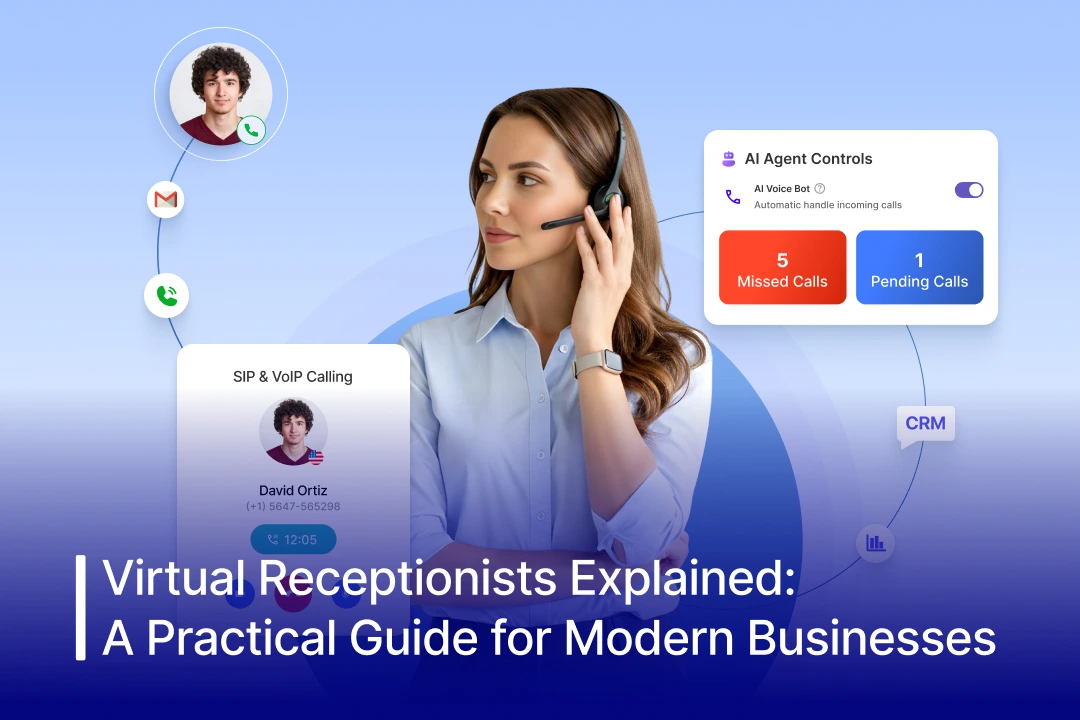

When you have a growing business, you have likely wondered whether you need someone to answer your phone all day long. This is what virtual receptionists are: the first point of contact for your business, without having to show up in person at your office. When a person calls your business, the call is answered remotely by a human receptionist working out of the office, an automated system, or both.
A virtual phone receptionist aims to understand the reason why the customers are calling and make the dialogue proceed rather than stopping at voicemail. In this blog, we take a deep dive into the concept of a virtual receptionist, its advantages and disadvantages, prices, and draw a detailed comparison to other call-handling services for modern businesses in the digital-first buyer age.
What is a Virtual Receptionist?
A virtual receptionist is a remote front-desk solution that answers incoming calls for your business. Instead of sitting at a physical reception desk, a virtual phone receptionist works off-site while still serving as your first point of contact. Depending on the provider, this may involve a live agent, an automated system, or a hybrid model.
However, over the years, the definition of a virtual receptionist has expanded. What started as basic call answering and routing to maintain a consistent professional caller experience without expanding in-house staff has now evolved into intelligent, AI-powered virtual receptionists that adapt and evolve to grow with their business needs. Modern businesses are no longer choosing virtual assistants that are simple auto attendants relying on keypad menus, but rather how advanced the receptionist should be in terms of understanding caller intent, handling complex conversations, and taking course-of-action in real time.
How Does a Virtual Receptionist Work?
Most virtual receptionist services follow a similar workflow, with a few differences in execution based on the provider. Such virtual agents use a scripted greeting when answering calls, and as the caller explains why they are calling, the receptionist determines the next step based on the instructions provided.
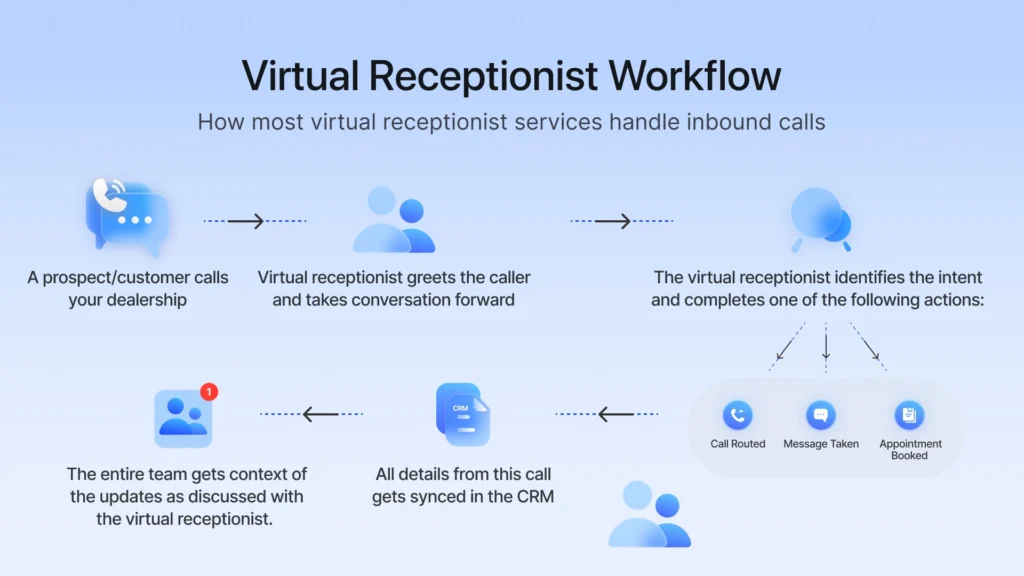
1. Call Greeting
The majority of virtual reception providers allow businesses to define custom greetings that reflect their brand voice. Instead of a generic opening, callers hear your business name and a scripted introduction tailored to your operations. This reinforces brand consistency and ensures every caller receives the same professional welcome. Well-structured greetings also play a critical role in overall receptionist answering phone calls, as the first few seconds of a conversation often determine whether the caller stays engaged or drops off.
2. Call Routing to the Right Department
Call routing is one of the typical use cases of a virtual receptionist. The receptionist recognizes the reason why the caller is calling and sends the call to the relevant department instead of the front desk receptionist or bouncing between extensions. This ensures your callers reach the right person faster, while internal teams avoid unnecessary interruptions.
3. Call Screening and Prioritization
Beyond basic routing, some services offer call screening. This means the remote agent can identify high-priority calls and escalate them appropriately while filtering out spam or non-relevant inquiries. For businesses dealing with high inbound volume, this reduces interruptions and protects team productivity.
4. 24/7 Call Handling
Virtual reception is often used as overflow support when internal teams are busy or during peak periods. Calls that would otherwise go unanswered can be redirected automatically. Similarly, after-hours call answering ensures that late inquiries are captured instead of being lost. Many dealerships now rely on an automotive answering service to ensure no inbound opportunity is missed after hours.
5. Scheduling Appointments or Callbacks
Most virtual receptionist services are configured to receive appointment or call-back requests. The receptionist can schedule time into the predefined availability or forward an approved callback request rather than requesting your callers to call back later.
6. Answering Common Questions
Virtual receptionists are frequently trained to answer frequently asked questions with approved answers. This can be as simple as business details like hours, whereabouts, or directions, or details about the services. Virtual reception eliminates the number of calls that need the attention of the staff by addressing these minor inquiries.
7. Capturing and Sharing Call Details
Following every interaction, important information on the call is recorded and forwarded to the relevant team member. This is usually in the form of email notifications, CRM updates, or internal notes, which provide the teams with an idea of who called, the purpose of their call, and what action they took, or not. The transparency aids in continuity even in conversations that cut across several touchpoints.
8. Call Logging and Basic Reporting
Many providers offer simple call reporting tools that summarize call volume, duration, and message logs. This helps businesses understand inbound patterns and monitor performance without installing a full call center system.
9. Supporting Bilingual Callers
For businesses operating in diverse communities, language may become a tangible obstacle to conversion and customer experience. Some services also provide bilingual agents who can take calls in multiple languages and cater to such an audience. However, bilingual virtual receptionist services are not included by default but are available as an add-on. Companies working in multilingual markets need to consider remote agents with such features to provide bilingual coverage and ensure consistent communication across all callers.
10. Lead Capture for New Inquiries
In addition to message-taking, some virtual receptionist services are structured to capture new lead details such as name, contact information, and basic qualification questions. This ensures potential opportunities are recorded even when no internal team member is immediately available.

For many businesses, faster qualification and routing significantly helps AI receptionist improve lead response time, especially during peak hours, which makes virtual reception appealing. Calls are answered consistently, conversations feel guided, and teams gain more breathing room. However, as operations become more complex and conversations demand faster outcomes, it’s worth examining not just the benefits of virtual reception but also the constraints that come with it.
Top 8 Benefits of Using a Virtual Receptionist
Virtual receptionists are hired to address the daily call-handling challenges of large-scale businesses. The advantages that make them a viable option in handling inbound conversations are as follows:
1. Having a professional first point of contact
Among the most effective advantages of having a remote call handling agent is how phone calls are handled from the moment they are initiated. Your callers don’t get redirected to a long wait queue or voicemail, instead they’re greeted by a virtual receptionist hired from the agency who represents your business round-the-clock. Not only does this establish a strong first impression, but it also sets the tone for the rest of the conversation.
2. 24/7 availability beyond business hours
Virtual receptionist services enable businesses to remain available even when internal teams are not available. Calls can be answered out of the usual working hours, something that is particularly helpful for companies with customers across varying schedules or time zones. This long coverage works towards making conversations move ahead despite off-hours.
3. Reduced pressure on internal teams
As call volumes increase, answering phone calls can quickly become a distraction for staff. A virtual agent will ease that burden by taking the place of a receptionist on the phone, freeing internal teams to concentrate on their core tasks. It is among the most sought-after benefits of having a virtual receptionist for scaling companies with a limited workforce.
4. Lower staffing and overhead costs
There are long-term expenses attached to hiring and maintaining a full-time front desk employee. A remote receptionist provides an alternative that covers calls without hiring more on-site personnel. To most companies, a major benefit of such services is their flexibility, especially when call volumes fluctuate or businesses scale rapidly.
5. Better organization of inbound calls
Calls become easier to handle when a trained remote agent filters, routes, and documents the calls. Call information is recorded, the purpose is explained, and follow-up becomes more organized. Such an order minimizes internal confusion and assists in making sure no significant conversations get lost in the cracks.
6. Easier scalability during peak periods
Virtual reception can also be handy when it comes to spikes in call volume. Instead of scrambling to add temporary staff, businesses can rely on virtual receptionist services to manage higher call traffic. This makes it easier to scale call handling without making immediate changes to internal staffing.
7. Consistency across every caller interaction
Consistency is, perhaps, one of the most underrated advantages of having a virtual front-desk agent. All callers are treated equally, subjected to the same procedure, and provided with precise follow-ups. This consistency is more critical as businesses expand to ensure there is consistency in the customer experience.
8. Disaster recovery and business resilience
An often-overlooked advantage is operational continuity during disruptions. Whether due to office closures, weather events, or internal staffing shortages, remote call answering ensures communication remains uninterrupted. This layer of resilience protects customer trust when it matters most.
How Much Does a Virtual Receptionist Cost?
A basic plan can begin at $25-50/month with limited minutes, and more intensive volume or 24/7 virtual phone receptionists may be in the 500-1000 and up monthly range. Due to the usage-based billing across providers, costs rise with increasing call volume.
A majority of the virtual receptionist pricing is charged on the basis of a per-minute, per-call, or a monthly subscription structure. Virtual receptionists can be affordable to businesses with consistent call volume. But with size or call volume, per-minute/per-call pricing can feel limiting. For scaling businesses, long-term scalability is as critical as simple call coverage.
How to Choose the Right Virtual Receptionist for Your Business?
Choosing the best virtual receptionist isn’t just about comparing pricing plans, but requires evaluating how well the service fits your business model, call volume, and long-term growth goals. Here are the key steps to guide your decision:
1. Identify Your Operational Needs
Start by mapping your daily goals you need to achieve with a virtual receptionist. Then further narrow down whether these are something that can be met by a live human answering service, an AI-powered system, or a hybrid model? Consider whether you need simple message-taking and call routing, or more advanced capabilities like appointment scheduling, CRM integration, bilingual support, and outbound follow-ups. The more complex your operations, the more advanced your solution should be.
2. Evaluate Core Capabilities
Look beyond simple message-taking. Assess whether the service integrates seamlessly with your CRM or calendar systems, delivers messages in real time, and allows you to customize call scripts aligned with your brand voice.
3. Check Reliability and Interaction Quality
There is no compromise with professionalism. Read customer reviews, third-party reviews, and case studies. Request references where necessary. Note the level of consistency with which your callers experience insightful and brand-specific communication. A virtual receptionist represents your business, so quality matters as much as coverage.
4. Evaluate Technology and Training Standards
Quality providers combine reliable infrastructure with well-trained agents. Start by evaluating if the platform uses modern call routing systems, uptime guarantees, secure data handling, and clear Service Level Agreements (SLAs). When it comes to live agents, make sure that they are well-trained to represent your brand voice and uphold industry terms.
5. Evaluate Scalability and Pricing Structure
Finally, assess how pricing scales with growth. Many virtual receptionist services charge per minute or per call, which can increase costs as call volume rises. Make sure the model aligns with your long-term trajectory.
6. Use Demos and Free Trials Before Committing
The best way to decide is to first test the service yourself. Request a demo or free trial, call in as a customer, and evaluate voice quality, responsiveness, call flow, and how it handles real-world scenarios.
Virtual Receptionist vs Other Call-Handling Options
As businesses evaluate how to manage inbound calls, virtual receptionists are often compared to different call-handling approaches. Each option serves a different purpose, and understanding these differences helps clarify where virtual receptionist services fit and where they may fall short as needs evolve.
Virtual Receptionist vs Front Desk Receptionist
A front desk receptionist provides familiarity and live context. Being present at the office enables such agents to learn about the daily operations, the frequent callers, and to operate sensibly. The availability, staffing cost, and working time of this model are, however, limited. After-hours work or seasonal work might need hiring additional staff or providing overtime perks.
A virtual receptionist replaces or supplements the receptionist on the phone by handling calls remotely. This offers a wider coverage and flexibility without having on-site staff, irrespective of having a lower real-time business context. Virtual reception provides the best middle-ground between unmanageable calls and having an on-site front desk for many expanding businesses.
Virtual Receptionist vs Call Centers
Call centers are built for volume. They are created to support very high volumes of inbound call traffic, typically with standardized scripts and processes. Although it makes them scalable, it can also render interactions impersonal, in particular when the agents do not know your business or customers.
Virtual receptionist services typically offer a more tailored experience. Your business name is used to answer calls, and conversations are carried out based on specific instructions applicable to your operation. This personalization is, however, done at the expense of scale. With rising call volumes, businesses comparing call center outsourcing vs. AI receptionist pricing may find the former constraining the latter.
Virtual Receptionist vs Auto Attendants
Auto attendants rely on menus, prompts, and keypad selections to guide callers. They’re inexpensive and easy to deploy, but they often introduce friction. Callers may get stuck navigating options or abandon calls altogether when their needs don’t fit neatly into a menu.
A virtual phone receptionist provides a more human experience. Instead of pressing buttons, callers explain why they’re calling and are guided accordingly. While this improves experience, virtual reception still relies on predefined scripts and rules, which can limit flexibility in more complex conversations.
Virtual Receptionist vs Live Agents
Live agents offer emotional intelligence, empathy, and the ability to navigate unstructured conversations. In high-intent industries, that human element can be valuable. However, live staffing comes with practical limitations. Coverage outside business hours requires shift scheduling, overtime, or additional hires. For high-volume periods, comparing an AI receptionist vs human receptionist, the former can lead to increased wait times unless more human agents are added, increasing fixed costs.
According to workforce efficiency research published by Deloitte and McKinsey, labor-driven service models scale linearly with demand. In simple terms, as call volume increases, staffing costs increase proportionally. In AI vs remote vs in-person receptionist, this is what makes purely live-agent models expensive to maintain at scale, especially for businesses with fluctuating call traffic.
Virtual receptionists reduce this dependency on in-house labor. They provide broader coverage, standardized call handling, and operational continuity without expanding headcount. For growing businesses, this makes them easier to scale, particularly when demand is unpredictable.
Virtual Receptionist vs In-House Receptionist
Traditional answering services and scripted agents are built around predefined workflows. They follow structured prompts to greet callers, gather basic information, and route calls accordingly. However, such agents have limitations across complex conversations: multi-step requests or callers who shift topics mid-conversation often fall outside fixed scripts. In such scenarios, agents may escalate or defer the issue rather than resolve it directly.
Modern AI-powered virtual receptionists are designed with more intent awareness. Instead of relying solely on scripts, they use conversational intelligence to detect intent in real time and adjust responses dynamically. This allows them to handle more nuanced interactions, whether that involves booking appointments, qualifying leads, or responding to layered inquiries without requiring manual intervention. Many businesses also compare the AI receptionist cost vs in-house receptionist cost to determine long-term stability.
7 Best Virtual Receptionist Providers For Automotive Dealers
In a car dealership, all calls are sales potentials: sales leads, service request or parts questions. While many dealerships still operate on call center software for the automotive industry, other fast-scaling dealerships layer in virtual receptionist services to ensure that those calls are answered professionally and consistently, 24/7, without expanding in-house staff.
Here’s a curated list of top virtual receptionist providers specially curated for car dealership operators:
1. Spyne
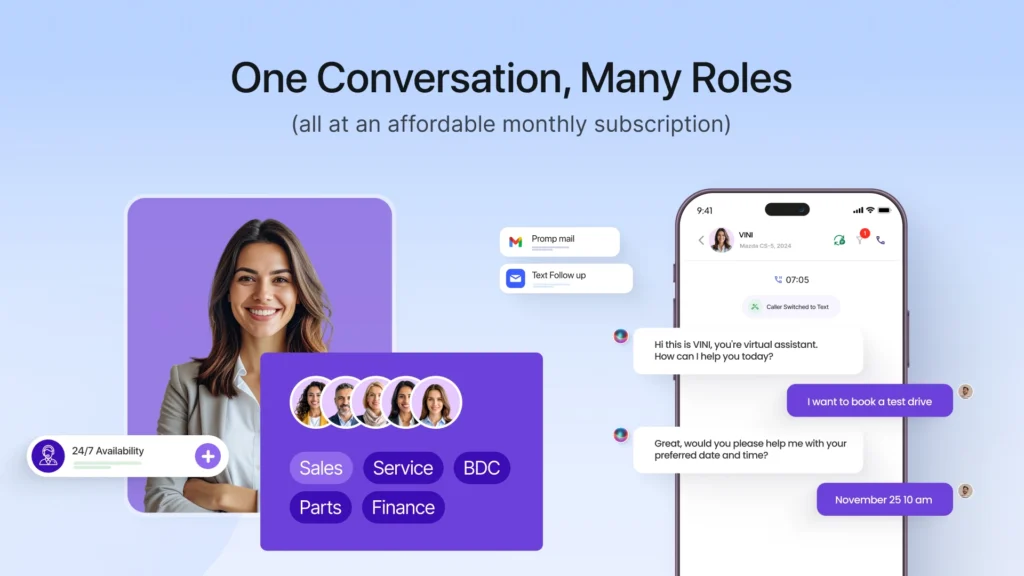
Spyne offers an AI receptionist for car dealerships designed specifically for the modern automotive retail. Unlike general answering services, it is built to understand caller intent, automotive workflows, and handles conversations dynamically, switching between different segments as needed.
Key Features:
- Dynamic role switching between sales, service, parts, F&I, and BDC
- CRM integration for automatic lead capture and appointment logging
- 24/7 coverage with outbound follow-ups and dormant lead re-engagement across calls, chat, email, texts, and social media
- Call recording, analytics, and performance insights
- Outbound calling and automated follow-up messages
- Multi-lingual services based on the dealership’s target audience
Spyne’s AI call bot for car dealerships goes beyond traditional virtual receptionists by turning every call into a qualified conversation and measurable pipeline activity. This makes it ideal for dealerships that want responsiveness, revenue impact, and automation at scale.
2. Smith.ai
Smith.ai blends AI tools with live receptionists for flexible coverage. Its model is strong for operations that still want a human voice supported by intelligent screening and CRM workflows.
Key Features:
- 24/7 answering with AI-assisted screening
- Lead qualification, routing, and appointment scheduling
- English/Spanish bilingual receptionists
- CRM and calendar integrations
Pricing plans start upto $255/month.
3. Ruby Receptionists
Ruby is one of the most recognized virtual receptionist companies, known for its professional, personable live receptionists.
Key Features:
- 24/7 live answering
- Custom call handling and scripting
- Appointment booking and messaging notifications
- Text and email delivery of call details
- CRM and calendar support
The pricing plan starts at $230/month.
4. PATLive
PATLive is known for handling high call volumes with flexible call scripting and live call transfers.
Key Features:
- 24/7 answering services
- Custom scripting and message taking
- Live transfers and queue management
The pricing plan starts at $60/month, with a 14-day free trial.
5. Specialty Answering Service (SAS)
SAS is valued for affordability and basic multi-channel answering services.
Key Features:
- Voice answering and live support
- Call routing and overflow handling
- Simple reporting
- Multi-channel engagement
The pricing starts at $38/month.
6. AnswerConnect
AnswerConnect stands out for its approach to combining dealerships focused on lead qualification.
Key Features:
- 24/7 availability with customizable call workflows
- CRM connectivity and dedicated support teams without requiring complex onboarding
- Dedicated bilingual answering service team for extended coverage.
Pricing plans start upto $350/month for 200 minutes.
7. Grasshopper
Grasshopper combines a virtual phone system with basic virtual receptionist features, providing value beyond just different features.
Key Features:
- Auto-attendant with call routing
- Voicemail and transcription
- Multiple extensions
- Unlimited calls and texts
The pricing plans start from $350/month for 200 minutes.
Why Choose Spyne for Automotive Operations?
In essence, a virtual receptionist ensures that all calls made to your business are answered and the callers are given the right information or forwarded to the relevant department. For many businesses, that’s already a major step forward. This way, virtual receptionists help you stay accessible while making a better first impression on your callers, even as your internal teams focus on priority tasks at hand.

In high-competition industries like automotive retail, every missed call is a missed opportunity, and therefore, dealerships need automotive-aware agents who can detect caller intent and take action to drive outcomes. And this is where Spyne’s conversational AI agent Vini stands out. Here’s how:
Specifically developed for the automotive industry
Spyne’s conversational AI uses real dealership operations, including sales and service, parts, and F&I. It speaks your business language instead of generic scripts.
Intent-aware answering for maximum impact
Where traditional services take messages or route calls, Spyne makes the appointment, qualifies leads, auto-syncs updates to your CRM, and triggers follow-ups; all in real time.
Scale without cost hikes
Unlike other providers, Spyne’s pricing is not based on a per-minute or per-call model, so you have a uniform performance that grows with your scaling business needs without any linear escalation of bills.
24/7 availability with after-hours coverage
Be it peak hours, holiday season, or dormant leads, Spyne ensures each call is a meaningful conversation with an opportunity to convert into an appointment or lead.
Operations continuity driving measurable revenue
Spyne keeps your dealership operations running by turning conversations into a measurable pipeline, bringing structure, context, and revenue focus to your front door through its automotive sales solutions.
Overall, traditional virtual receptionists assist in missing fewer calls and serve customers better, but Spyne assists you in turning more conversations into revenue opportunities, all without increasing operational complexity or staffing.
So when your dealership is in need of more than a phone answering service, and you want a service that is more of a team member than an add-on, then you need a virtual receptionist that’s built for the industry and designed for growth. If you’re ready to move beyond basic call answering and see what an automotive-first AI receptionist can actually do for your operations, book a demo now and experience the Spyne difference.